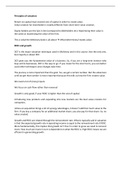
Principles of valuation
Return on capital must exceed cost of capital in order to create value.
Value creation for shareholder is totally different from short-term value creation.
Equity holders are the last in line (compared to debtholders etc). Maximizing their value is
the same as maximizing the value of the firm.
This is what the McKinsey book is all about → What determines/creates value.
ROIC and growth
DCF is the major valuation technique used in McKinsey and in this course. Not the only one,
but majority is about DCF.
DCF gives you the fundamental value of a business. So, if you are a long-term investor who
buys entire businesses, DCF is the way to go. If you invest for the short term, you can better
used other techniques since changes take time.
The journey is more important than the goal. Yes, we get a certain number. But the adventure
until we get that number is more important because this tells us how the firm creates value.
We need a lot of (noisy) inputs.
We focus on cash flow rather than revenue!
Growth is only good, if your ROIC is higher than the cost of capital.
Introducing new products and expanding into new markets are the best value creators for
companies.
Unless an acquisition brings a lot of synergy advantages, it doesn’t add that much value to the
firm. If you buy a company for an additional market share, you also pay for that share. So, no
value created.
Growth and ROIC are related through the reinvestment rate. What is typically said in valuation
is that the expected growth rate in operating income is equal to the reinvestment rate X ROIC.
More fundamentally, this implies that growth isn’t free! In order to grow we need to reinvest
more. How much we invest in turn is dependent on what the ROIC is. High ROIC means we are
efficient in generating growth.
, The firm as a growing perpetuity
We subtract the growth from the discount rate.
The reason we use EBIT and not EBITDA or net income, is because EBIT covers all payments to
both equity and debt holders. If we would use net income, and discount this, we would
discount the tax shield twice.
IR = g/ROIC
We need partial derivatives in order to know what happens when one rises and the others
stay equal.
Value creation by growth can go either way, dependent on if ROIC is bigger of less than WACC.
Cost of capital
To get to the cost of equity, we use the CAPM.
ROIC and competitive advantage
How do you assure a high ROIC? → This all has to do with competitive advantages.
VERY IMPORTANT: A FIRM CANNOT INCREASE ITS VALUE BY DOING WHAT INVESTORS CAN
DO BY THEMSELVES (INVESTING IN RISK-FREE RATE).
Types of growth
Organic vs. inorganic growth
High vs. low value creation
Patterns of growth
Early adopters are keen to pay a higher price. People that have not bought your product yet,
did this for a reason. It’s harder to attract them.
If we want to model growth into our valuation, we have three options:
1. Stable growth
Big mature companies that only grow with the economy
2. 2-stage growth (goes from high growth to stable growth immediately)
More rare to have, can be used for stuff like patents → high growth when patent is viable
and stable growth when the patent expires since competitors come in.
3. 3-stage growth (Goes from high growth to stable growth with an intermediate period of
declining growth)
Used for most company-valuations, companies like Facebook, Spotify & Uber who are
Return on capital must exceed cost of capital in order to create value.
Value creation for shareholder is totally different from short-term value creation.
Equity holders are the last in line (compared to debtholders etc). Maximizing their value is
the same as maximizing the value of the firm.
This is what the McKinsey book is all about → What determines/creates value.
ROIC and growth
DCF is the major valuation technique used in McKinsey and in this course. Not the only one,
but majority is about DCF.
DCF gives you the fundamental value of a business. So, if you are a long-term investor who
buys entire businesses, DCF is the way to go. If you invest for the short term, you can better
used other techniques since changes take time.
The journey is more important than the goal. Yes, we get a certain number. But the adventure
until we get that number is more important because this tells us how the firm creates value.
We need a lot of (noisy) inputs.
We focus on cash flow rather than revenue!
Growth is only good, if your ROIC is higher than the cost of capital.
Introducing new products and expanding into new markets are the best value creators for
companies.
Unless an acquisition brings a lot of synergy advantages, it doesn’t add that much value to the
firm. If you buy a company for an additional market share, you also pay for that share. So, no
value created.
Growth and ROIC are related through the reinvestment rate. What is typically said in valuation
is that the expected growth rate in operating income is equal to the reinvestment rate X ROIC.
More fundamentally, this implies that growth isn’t free! In order to grow we need to reinvest
more. How much we invest in turn is dependent on what the ROIC is. High ROIC means we are
efficient in generating growth.
, The firm as a growing perpetuity
We subtract the growth from the discount rate.
The reason we use EBIT and not EBITDA or net income, is because EBIT covers all payments to
both equity and debt holders. If we would use net income, and discount this, we would
discount the tax shield twice.
IR = g/ROIC
We need partial derivatives in order to know what happens when one rises and the others
stay equal.
Value creation by growth can go either way, dependent on if ROIC is bigger of less than WACC.
Cost of capital
To get to the cost of equity, we use the CAPM.
ROIC and competitive advantage
How do you assure a high ROIC? → This all has to do with competitive advantages.
VERY IMPORTANT: A FIRM CANNOT INCREASE ITS VALUE BY DOING WHAT INVESTORS CAN
DO BY THEMSELVES (INVESTING IN RISK-FREE RATE).
Types of growth
Organic vs. inorganic growth
High vs. low value creation
Patterns of growth
Early adopters are keen to pay a higher price. People that have not bought your product yet,
did this for a reason. It’s harder to attract them.
If we want to model growth into our valuation, we have three options:
1. Stable growth
Big mature companies that only grow with the economy
2. 2-stage growth (goes from high growth to stable growth immediately)
More rare to have, can be used for stuff like patents → high growth when patent is viable
and stable growth when the patent expires since competitors come in.
3. 3-stage growth (Goes from high growth to stable growth with an intermediate period of
declining growth)
Used for most company-valuations, companies like Facebook, Spotify & Uber who are