CARDIAC MUSCLE
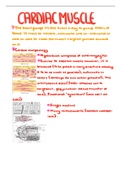
The heart pumps 115,000 times a day to pump 8000L of
blood It must be reliable automatic and co ordinated as
well as able to reach the lowest t highest possible demand
on it
Cardiac morphology
Myocardium composed of cardiomyocytes
Similar to skeletal muscle however it is
branched C to be pulled in many directions allowing
it to be as small as possible automatic in
nature develops its own action potential has
i intercalated discs folds attaches cell to
neighbour gap junction allows transfer of
ions Functional Syncitium Cone cell all
cells
Single nucleus
Many mitochondria aerobic
metabo ism
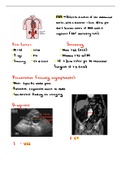
, Cardiac electrophysiology
Resting membrane potential
large negative ions on inside of
cell K T leaks out due to leaky
channels but Nat doesn't leak in
overall
charge
Natl Kt exchanger is electrogenic
Excitable cells activated by allowing
ions in
making the ceil
temporarily
De polarisation action potential
Cardiac action potentials
A Non pacemaker Atrial t ventrical t
myocytes
due to
ofopening
Icl purniky e fibres
long R M P of 92 mV
g
plateau
due to Ca 2T Force development
channels opening t
it cell phase Nat channels open
0
entering
Cprolongs AP
phase 1 Closure of Nat
Kt Channel
channels opening of
ITO and Ct Channel Ict
Phase 2 prolonged opening of Coit channels
Slow
Phase 3 2 Kt channels Ikr
inwardly rectifying
I KS
delayed rectifying
Phase 4 RMP
The heart pumps 115,000 times a day to pump 8000L of
blood It must be reliable automatic and co ordinated as
well as able to reach the lowest t highest possible demand
on it
Cardiac morphology
Myocardium composed of cardiomyocytes
Similar to skeletal muscle however it is
branched C to be pulled in many directions allowing
it to be as small as possible automatic in
nature develops its own action potential has
i intercalated discs folds attaches cell to
neighbour gap junction allows transfer of
ions Functional Syncitium Cone cell all
cells
Single nucleus
Many mitochondria aerobic
metabo ism
, Cardiac electrophysiology
Resting membrane potential
large negative ions on inside of
cell K T leaks out due to leaky
channels but Nat doesn't leak in
overall
charge
Natl Kt exchanger is electrogenic
Excitable cells activated by allowing
ions in
making the ceil
temporarily
De polarisation action potential
Cardiac action potentials
A Non pacemaker Atrial t ventrical t
myocytes
due to
ofopening
Icl purniky e fibres
long R M P of 92 mV
g
plateau
due to Ca 2T Force development
channels opening t
it cell phase Nat channels open
0
entering
Cprolongs AP
phase 1 Closure of Nat
Kt Channel
channels opening of
ITO and Ct Channel Ict
Phase 2 prolonged opening of Coit channels
Slow
Phase 3 2 Kt channels Ikr
inwardly rectifying
I KS
delayed rectifying
Phase 4 RMP