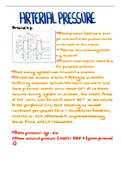
ARTERIAL PRESSURE
Arterial b p
Blood pressure defined as force
per unit area is the pressure exerted
on the walls of the arteries
There are main conducting arteries
e
g brachial
Pressure head imparts motive force
for peripheral perfusion
Peak during systole nadir Clowest in diastole
Wind Kessel function of aorta Acting as an elastic
behind the heart the aorta and
buffering chamber
some proximal vessels store about 50 of LV stroke
volume In diastole the elastic forces
during systole
of the aortic wall forward about so of the volume
to the peripheral ciro thus almost
creating an
constant peripheral flow Wind Kessel function
results in TLV after load t improved coronary
blood flow and CV relaxation
Pulse pressure Sys dia
Mean arterial pressure MAP DB P t pulse pressured
3
, Effects of posture Co 77mm Hg 1cm height t
age
Determinants of B P
Arterial b p is directly related to
Cardiac output
the arterioles C total
Total peripheral resistance
mainlyin
amount of Space blood has to exist in
B P CO X TPR
Control of b p via control of either Col TPR
Baroreceptors
Stretch receptors in the walls of
the carotid sinus aortic arch
Signals via
vagus C x t
gloss pharyngeal
afferents IX to the
medullary cardiac and vasomotor
areas
Make changes appropriate to keep BP
in normal ranges
O
CO and baro receptors
Afferents from baro receptors synapse
in the NTS of the medulla
Neurons inhibitory to sympathetic
Arterial b p
Blood pressure defined as force
per unit area is the pressure exerted
on the walls of the arteries
There are main conducting arteries
e
g brachial
Pressure head imparts motive force
for peripheral perfusion
Peak during systole nadir Clowest in diastole
Wind Kessel function of aorta Acting as an elastic
behind the heart the aorta and
buffering chamber
some proximal vessels store about 50 of LV stroke
volume In diastole the elastic forces
during systole
of the aortic wall forward about so of the volume
to the peripheral ciro thus almost
creating an
constant peripheral flow Wind Kessel function
results in TLV after load t improved coronary
blood flow and CV relaxation
Pulse pressure Sys dia
Mean arterial pressure MAP DB P t pulse pressured
3
, Effects of posture Co 77mm Hg 1cm height t
age
Determinants of B P
Arterial b p is directly related to
Cardiac output
the arterioles C total
Total peripheral resistance
mainlyin
amount of Space blood has to exist in
B P CO X TPR
Control of b p via control of either Col TPR
Baroreceptors
Stretch receptors in the walls of
the carotid sinus aortic arch
Signals via
vagus C x t
gloss pharyngeal
afferents IX to the
medullary cardiac and vasomotor
areas
Make changes appropriate to keep BP
in normal ranges
O
CO and baro receptors
Afferents from baro receptors synapse
in the NTS of the medulla
Neurons inhibitory to sympathetic