- LECTURE 4 -
BRAIN STRUCTURE & FUNCTION CONTINUED
Structure of upcoming test:
- There will be 2 or 3 questions
- A combination of application, higher-order questions and rope learning
- BIG HINT: THE TEST WILL LIKELY BE ON LECTURE 3 AND LECTURE 4
- IE: BRAIN STRUCTURE AND FUNCTION
- The short answer question will not be based on lecture 2
- You will still need to know lecture 2 for the MCQs though
PRIMARY PROCESSING AREAS
PRIMARY PROCESSING AREAS: The place where information from your sense
goes to first to be processed
- They specialise in dealing with specific information
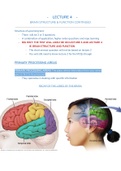
RECAP OF THE LOBES OF THE BRAIN:
,FRONTAL LOBE
- Is involved in higher-order executive functions
- Ability to plan, strategise, inhibit yourself, etc…
- Controls voluntary movement
PARIETAL LOBE
- Contains the SOMATOSENSORY CORTEX which processes info about
temperature, taste, touch and movement
OCCIPITAL LOBE
- Controls visual processing
- Information coming in from the eyes
TEMPORAL LOBE
- Is involved in auditory processing
- Hearing information from the ears
- Processes memories; integrating them with sensations of taste, sound, sight
and tough
, SECONDARY PROCESSING AREAS
From there, the info moves to SECONDARY PROCESSING AREAS
- This is where the area combines elements of what you are sensing
- IMAGINE: you see a dog → your primary visual area will deal with the colour,
lines and orientation of the dog → the secondary processing area puts all of
those elements together to create a ‘picture’ of sorts → info is sent to
ASSOCIATION AREAS1 where the integration of the information from
different senses come
Essentially, there are 3 areas:
1. Primary processing areas
2. Secondary processing areas
3. Association areas
1
The word ‘area’ can be swapped with ‘cortex’. EG: primary association area = primary association
cortex
BRAIN STRUCTURE & FUNCTION CONTINUED
Structure of upcoming test:
- There will be 2 or 3 questions
- A combination of application, higher-order questions and rope learning
- BIG HINT: THE TEST WILL LIKELY BE ON LECTURE 3 AND LECTURE 4
- IE: BRAIN STRUCTURE AND FUNCTION
- The short answer question will not be based on lecture 2
- You will still need to know lecture 2 for the MCQs though
PRIMARY PROCESSING AREAS
PRIMARY PROCESSING AREAS: The place where information from your sense
goes to first to be processed
- They specialise in dealing with specific information
RECAP OF THE LOBES OF THE BRAIN:
,FRONTAL LOBE
- Is involved in higher-order executive functions
- Ability to plan, strategise, inhibit yourself, etc…
- Controls voluntary movement
PARIETAL LOBE
- Contains the SOMATOSENSORY CORTEX which processes info about
temperature, taste, touch and movement
OCCIPITAL LOBE
- Controls visual processing
- Information coming in from the eyes
TEMPORAL LOBE
- Is involved in auditory processing
- Hearing information from the ears
- Processes memories; integrating them with sensations of taste, sound, sight
and tough
, SECONDARY PROCESSING AREAS
From there, the info moves to SECONDARY PROCESSING AREAS
- This is where the area combines elements of what you are sensing
- IMAGINE: you see a dog → your primary visual area will deal with the colour,
lines and orientation of the dog → the secondary processing area puts all of
those elements together to create a ‘picture’ of sorts → info is sent to
ASSOCIATION AREAS1 where the integration of the information from
different senses come
Essentially, there are 3 areas:
1. Primary processing areas
2. Secondary processing areas
3. Association areas
1
The word ‘area’ can be swapped with ‘cortex’. EG: primary association area = primary association
cortex