08/03
MN10500 Lecture 5: Introduction to Risk & Return
Lecture Summary
● Common measures of risk and return
○ Compare different asset classes
● Portfolio risk and return
○ Return as weighted-average return
○ Risk (in most cases) not weighted-average, but dependent on correlation.
● Diversification
○ Market (systematic) and unique (firm-specific) risks.
Return Measures of a Stock
● Holding Period Return (HPR)
● Example: Pt = £100, P0 = £100, Dt = £10, HPR = (110 - 100 + 10)/100 = 20%
● Expected Mean Return: E(r)
● Risk Premium: E(r) - rf
● For simplicity, we don't use E(*)
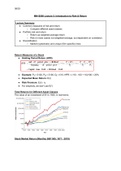
Total Returns for Different Asset Classes
The value of an investment of $1 in 1925, in real terms.
Stock Market Return (Monthly S&P 500, 1871 - 2019)
, 08/03
What Drives the Difference in Total Returns?
● Maturity Premium: Extra average return from investing in long-term VS short-term
Treasury securities.
● Risk Premium: Expected return in excess of risk-free return as compensation for
risk.
Measuring Risk
● Standard deviation is the square root of variance. Variance is the average value of
squared deviations from the mean. Variance can only be positive. This is how we
measure risk in finance.
● Variance: Average value of squared deviations from mean. A measure of volatility.
Variance = averaged squared deviations
● Standard Deviation: Square root of variance. Also a measure of volatility.
Standard Deviation (%) = Square root (Variance)
Market Risk (S&P 500, 1871 - 2019)
MN10500 Lecture 5: Introduction to Risk & Return
Lecture Summary
● Common measures of risk and return
○ Compare different asset classes
● Portfolio risk and return
○ Return as weighted-average return
○ Risk (in most cases) not weighted-average, but dependent on correlation.
● Diversification
○ Market (systematic) and unique (firm-specific) risks.
Return Measures of a Stock
● Holding Period Return (HPR)
● Example: Pt = £100, P0 = £100, Dt = £10, HPR = (110 - 100 + 10)/100 = 20%
● Expected Mean Return: E(r)
● Risk Premium: E(r) - rf
● For simplicity, we don't use E(*)
Total Returns for Different Asset Classes
The value of an investment of $1 in 1925, in real terms.
Stock Market Return (Monthly S&P 500, 1871 - 2019)
, 08/03
What Drives the Difference in Total Returns?
● Maturity Premium: Extra average return from investing in long-term VS short-term
Treasury securities.
● Risk Premium: Expected return in excess of risk-free return as compensation for
risk.
Measuring Risk
● Standard deviation is the square root of variance. Variance is the average value of
squared deviations from the mean. Variance can only be positive. This is how we
measure risk in finance.
● Variance: Average value of squared deviations from mean. A measure of volatility.
Variance = averaged squared deviations
● Standard Deviation: Square root of variance. Also a measure of volatility.
Standard Deviation (%) = Square root (Variance)
Market Risk (S&P 500, 1871 - 2019)