Maternity Exam 3 Study Guide
Module 8: Labor Process and Pain Management
What are the 5 Ps of *Passenger (fetus + placenta), *Passageway (birth canal), *Power (contractions),
labor? Position, Psychological response
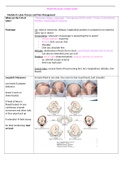
Passenger Lie: vertical, transverse, oblique, longitudinal position in comparison to maternal
spine (up or down)
Presentation: what part of passenger is presenting first in pelvis?
- Vertex/cephalic: head first
- Breech: butt, sacrum, feet
- Shoulder
- Chin out, shoulder first
Attitude: relationship of fetal chin to chest, want flexed attitude (chin to chest)
- Can also be extended (arms are out)
Position: left or right (maternal pelvis), occiput, anterior or posterior
- ex: LOA left occiput anterior
- direct op: back pain
Easiest labor: occiput (back of head coming first, lie is longitudinal, attitude: chin
flexed)
Leopold’s Maneuver lie back tilted to one side, face mom to feel: head (hard), butt (smooth)
use hands & palpate
abdomen
doesn’t work on
twins/triplets
if head of fetus is
flexed/tucked one
continuous smooth
movement and other side:
in then pops back up
if extended feels bump
for fetal monitoring: best
on back
,Breech
Frank breech: baby’s legs
are up
Footling (incomplete
breech)
Complete breech
Passageway: birth canal Four types of pelvis: gynecoid, android (heart), anthropoid (oval)- most common
with OP occiput posterior, platypodid (flat) but only 3%- often see it with transverse
lie)
Gynecoid pelvis (most common) gives best diameter/space for passenger to pass
through
- Once passenger has descended & engaged (if you did exam, head stays in
place)
Fetal station: where is cephalic in relation to ischial spine
- Negative station: higher up in pelvis
- Positive station: lower in station (closer to delivery)
- Ex: +1, +4 station
Report: how far dilated, how thinned out, fetal head in relation to ischial spine
Power: contractions What 2 things must the cervix do for labor to progress? – dilate (10 cm) & efface
(thin out), labor is cervical change***
- First time moms usually efface & dilate
Regular contractions more Frequency: start of one contraction to start of next (sec or min)
effective Duration: how long ONE contraction is
Intensity: mild, moderate (feels like chin), strong (whole belly feels like forehead)
- External monitor only tells us frequency and duration, doesn’t tell us
intensity
, Stages of labor Four stages
How many phases?
What signs precede labor? Lightening (fetal presentation dropping), can breathe better
Return of urinary frequency
Back aches
Stronger Braxton-Hicks contractions
Increase of bloody discharge, surge of energy
Module 9: Labor Process / Nursing Assessment During Labor
True Labor Contractions: regular (ex: every 10 min, then 5 min), become stronger
Lasting longer & closer together
More intense w/ walking
Lower back
Continue despite comfort measures
False Labor Contractions: irregular, stop with walking or position change
Felt in back or abdomen
Can be stopped with comfort measures
Initial Assessment: What brings you? EDC? GP? Drugs/meds/allergies?
Interview Ruptured membranes? (COAT) = color, odor, amount, time
Complications
Birth plan + labs (GBS +/-)
Physical Assessment General systems assessment, VS (temperature + pain)
Leopold maneuvers (position of baby) *know 4 maneuvers*
Assessment of FHR and pattern (2 monitors), assessment of uterine contractions
(UC) and pattern
Cervical exam (RN, midwife, ob/gyn, depends)
Labs and Diagnostics UA (sp grav, color, amt, ketones, leukocytes, pro)
Blood: CBC, HIV, Type and screen, Type, and cross match
GBS (+ give abx during labor)
Tests for rupture of Q-tip sample of fluid amniotic fluid
Module 8: Labor Process and Pain Management
What are the 5 Ps of *Passenger (fetus + placenta), *Passageway (birth canal), *Power (contractions),
labor? Position, Psychological response
Passenger Lie: vertical, transverse, oblique, longitudinal position in comparison to maternal
spine (up or down)
Presentation: what part of passenger is presenting first in pelvis?
- Vertex/cephalic: head first
- Breech: butt, sacrum, feet
- Shoulder
- Chin out, shoulder first
Attitude: relationship of fetal chin to chest, want flexed attitude (chin to chest)
- Can also be extended (arms are out)
Position: left or right (maternal pelvis), occiput, anterior or posterior
- ex: LOA left occiput anterior
- direct op: back pain
Easiest labor: occiput (back of head coming first, lie is longitudinal, attitude: chin
flexed)
Leopold’s Maneuver lie back tilted to one side, face mom to feel: head (hard), butt (smooth)
use hands & palpate
abdomen
doesn’t work on
twins/triplets
if head of fetus is
flexed/tucked one
continuous smooth
movement and other side:
in then pops back up
if extended feels bump
for fetal monitoring: best
on back
,Breech
Frank breech: baby’s legs
are up
Footling (incomplete
breech)
Complete breech
Passageway: birth canal Four types of pelvis: gynecoid, android (heart), anthropoid (oval)- most common
with OP occiput posterior, platypodid (flat) but only 3%- often see it with transverse
lie)
Gynecoid pelvis (most common) gives best diameter/space for passenger to pass
through
- Once passenger has descended & engaged (if you did exam, head stays in
place)
Fetal station: where is cephalic in relation to ischial spine
- Negative station: higher up in pelvis
- Positive station: lower in station (closer to delivery)
- Ex: +1, +4 station
Report: how far dilated, how thinned out, fetal head in relation to ischial spine
Power: contractions What 2 things must the cervix do for labor to progress? – dilate (10 cm) & efface
(thin out), labor is cervical change***
- First time moms usually efface & dilate
Regular contractions more Frequency: start of one contraction to start of next (sec or min)
effective Duration: how long ONE contraction is
Intensity: mild, moderate (feels like chin), strong (whole belly feels like forehead)
- External monitor only tells us frequency and duration, doesn’t tell us
intensity
, Stages of labor Four stages
How many phases?
What signs precede labor? Lightening (fetal presentation dropping), can breathe better
Return of urinary frequency
Back aches
Stronger Braxton-Hicks contractions
Increase of bloody discharge, surge of energy
Module 9: Labor Process / Nursing Assessment During Labor
True Labor Contractions: regular (ex: every 10 min, then 5 min), become stronger
Lasting longer & closer together
More intense w/ walking
Lower back
Continue despite comfort measures
False Labor Contractions: irregular, stop with walking or position change
Felt in back or abdomen
Can be stopped with comfort measures
Initial Assessment: What brings you? EDC? GP? Drugs/meds/allergies?
Interview Ruptured membranes? (COAT) = color, odor, amount, time
Complications
Birth plan + labs (GBS +/-)
Physical Assessment General systems assessment, VS (temperature + pain)
Leopold maneuvers (position of baby) *know 4 maneuvers*
Assessment of FHR and pattern (2 monitors), assessment of uterine contractions
(UC) and pattern
Cervical exam (RN, midwife, ob/gyn, depends)
Labs and Diagnostics UA (sp grav, color, amt, ketones, leukocytes, pro)
Blood: CBC, HIV, Type and screen, Type, and cross match
GBS (+ give abx during labor)
Tests for rupture of Q-tip sample of fluid amniotic fluid