Essay plans
Approaches
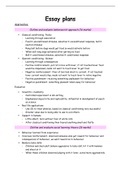
Outline and evaluate behaviourist approach (16 marks)
Classical conditioning- Pavlov
- Learning through association
- Food unconditioned stimulus, salvation unconditioned response, bell
neutral stimulus
- Rung bell before dogs would get food so would salivate before
- When bell rang dogs salivated after getting no food
- Bell conditioned stimulus, salvation conditioned response
Operant conditioning- Skinner
- Learning through consequences
- Positive reinforcement- put rat in box with lever, if rat touched lever food
would be dispensed, made rat want to touch lever to get food
- Negative reinforcement- floor of box had electric current, if rat touched
lever current would stop, made rat want to touch lever to relive negative
- Positive punishment- receiving something unpleasant for behaviour
- Negative punishment- something pleasant taken away for behaviour
Evaluation
Scientific credibility
- Controlled experiment in lab setting
- Emphasised objectivity and replicability, influential in development of psych
as science
Real life applications
- Use SD to treat phobias, based on classical conditioning very successful
- Greater value due to being able to use to aid others
Support in humans
- Little albert, born without fear of white rats
- After classical conditioning then feared anything small and fluffy
Outline and evaluate social learning theory (16 marks)
Behaviour learned from experience
Vicarious reinforcement- observed someone else get reward for behaviour and
consequences of behaviour, we want reward so to behaviour
Bandura bobo dolls-
- Children watched adult behave aggressive to bobo doll, hit it with hammer
and shout at it
- When these children observed playing with it later, acted more aggressively
Approaches
Outline and evaluate behaviourist approach (16 marks)
Classical conditioning- Pavlov
- Learning through association
- Food unconditioned stimulus, salvation unconditioned response, bell
neutral stimulus
- Rung bell before dogs would get food so would salivate before
- When bell rang dogs salivated after getting no food
- Bell conditioned stimulus, salvation conditioned response
Operant conditioning- Skinner
- Learning through consequences
- Positive reinforcement- put rat in box with lever, if rat touched lever food
would be dispensed, made rat want to touch lever to get food
- Negative reinforcement- floor of box had electric current, if rat touched
lever current would stop, made rat want to touch lever to relive negative
- Positive punishment- receiving something unpleasant for behaviour
- Negative punishment- something pleasant taken away for behaviour
Evaluation
Scientific credibility
- Controlled experiment in lab setting
- Emphasised objectivity and replicability, influential in development of psych
as science
Real life applications
- Use SD to treat phobias, based on classical conditioning very successful
- Greater value due to being able to use to aid others
Support in humans
- Little albert, born without fear of white rats
- After classical conditioning then feared anything small and fluffy
Outline and evaluate social learning theory (16 marks)
Behaviour learned from experience
Vicarious reinforcement- observed someone else get reward for behaviour and
consequences of behaviour, we want reward so to behaviour
Bandura bobo dolls-
- Children watched adult behave aggressive to bobo doll, hit it with hammer
and shout at it
- When these children observed playing with it later, acted more aggressively