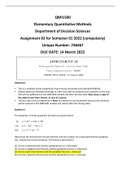
QMI1500
Elementary Quantitative Methods
Department of Decision Sciences
Assignment 02 for Semester 01 2022 (compulsory)
Unique Number: 746467
DUE DATE: 14 March 2022
Important:
• This is a multiple-choice assignment that must be answered and submitted ONLINE.
• Always keep your detailed workings in a file to be able to compare your solutions to the ones
that will be published on the QMI1500 module site after the due date. Also, keep a copy of
the options you have chosen, in case of a query.
• The due date of this assignment is fixed. No extension can be granted because the solutions
will be posted on the QMI1500 module site shortly after the closing date.
Question 1
The equations of three quadratic functions are given below:
(i) 𝑦 = 2𝑥 2 + 12𝑥 + 18
(ii) 𝑦 = −3𝑥 2 − 5𝑥 + 3
(iii) 𝑦 = 𝑥 2 + 2𝑥 − 5
Determine the discriminant of each function and the number of x-intercepts that the parabola
has. Choose the correct sentence. The function described in
[1] (i) has no discriminant and the parabola has no 𝑥-intercepts
[2] (ii) has a negative discriminant and the parabola has two 𝑥-intercepts
[3] (i) has a zero discriminant and the parabola has one 𝑥-intercept
[4] (iii) has a positive discriminant and the parabola has one 𝑥-intercept
, Answer:
(i) 𝒚 = 𝟐𝒙𝟐 + 𝟏𝟐𝒙 + 𝟏𝟖
The discriminant of a quadratic is the expression inside the radical of the quadratic
formula.
𝑏 2 − 4(𝑎𝑐)
Substitute in the values of 𝑎, 𝑏, and 𝑐.
122 − 4(2 × 18)
Evaluate the result to find the discriminant.
Simplify each term.
Raise 12 to the power of 2.
144 − 4(2 × 18)
Multiply 2 by 18.
144 − 4 × 36
Multiply −4 by 36.
144 − 144
Subtract 144 from 144.
∆= 0
(One 𝑥-intercept)
(ii) 𝒚 = −𝟑𝒙𝟐 − 𝟓𝒙 + 𝟑
The discriminant of a quadratic is the expression inside the radical of the quadratic
formula.
𝑏 2 − 4(𝑎𝑐)
Substitute in the values of 𝑎, 𝑏, and 𝑐.
(−5)2 − 4(−3 × 3)
Evaluate the result to find the discriminant.
Simplify each term.
Raise −5 to the power of 2.
Elementary Quantitative Methods
Department of Decision Sciences
Assignment 02 for Semester 01 2022 (compulsory)
Unique Number: 746467
DUE DATE: 14 March 2022
Important:
• This is a multiple-choice assignment that must be answered and submitted ONLINE.
• Always keep your detailed workings in a file to be able to compare your solutions to the ones
that will be published on the QMI1500 module site after the due date. Also, keep a copy of
the options you have chosen, in case of a query.
• The due date of this assignment is fixed. No extension can be granted because the solutions
will be posted on the QMI1500 module site shortly after the closing date.
Question 1
The equations of three quadratic functions are given below:
(i) 𝑦 = 2𝑥 2 + 12𝑥 + 18
(ii) 𝑦 = −3𝑥 2 − 5𝑥 + 3
(iii) 𝑦 = 𝑥 2 + 2𝑥 − 5
Determine the discriminant of each function and the number of x-intercepts that the parabola
has. Choose the correct sentence. The function described in
[1] (i) has no discriminant and the parabola has no 𝑥-intercepts
[2] (ii) has a negative discriminant and the parabola has two 𝑥-intercepts
[3] (i) has a zero discriminant and the parabola has one 𝑥-intercept
[4] (iii) has a positive discriminant and the parabola has one 𝑥-intercept
, Answer:
(i) 𝒚 = 𝟐𝒙𝟐 + 𝟏𝟐𝒙 + 𝟏𝟖
The discriminant of a quadratic is the expression inside the radical of the quadratic
formula.
𝑏 2 − 4(𝑎𝑐)
Substitute in the values of 𝑎, 𝑏, and 𝑐.
122 − 4(2 × 18)
Evaluate the result to find the discriminant.
Simplify each term.
Raise 12 to the power of 2.
144 − 4(2 × 18)
Multiply 2 by 18.
144 − 4 × 36
Multiply −4 by 36.
144 − 144
Subtract 144 from 144.
∆= 0
(One 𝑥-intercept)
(ii) 𝒚 = −𝟑𝒙𝟐 − 𝟓𝒙 + 𝟑
The discriminant of a quadratic is the expression inside the radical of the quadratic
formula.
𝑏 2 − 4(𝑎𝑐)
Substitute in the values of 𝑎, 𝑏, and 𝑐.
(−5)2 − 4(−3 × 3)
Evaluate the result to find the discriminant.
Simplify each term.
Raise −5 to the power of 2.