AP BIOLOGY 21 POGIL The Hardy Weinberg Equilibrium
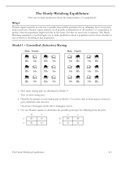
The Hardy-Weinberg Equilibrium How can we make predictions about the characteristics of a population? Why? Punnett squares provide an easy way to predict the possible genotypes for an offspring, but it is not practical to perform a Punnett square analysis on all possible combinations of all members of a population to predict what the population might look like in the future. For that we must turn to statistics. The Hardy- Weinberg equation is a tool biologists use to make predictions about a population and to show whether or not evolution is occurring in that population. Model 1 – Controlled (Selective) Mating Bb Bb Bb bb bb bb Bb Bb Bb bb bb bb Males Females Bb Bb Bb bb bb bb Males Females Bb Bb Bb bb bb bb 1. How many mating pairs are illustrated in Model 1? There are twelve mating pairs. 2. Describe the parents in each mating pair in Model 1. Use terms such as homozygous, heterozygous, dominant, and recessive. One parent is heterozygous and the other is homozygous recessive. 3. Use two Punnett squares to determine the possible genotypes for offspring from the pairs. B b b b b Bb bb B Bb Bb b Bb bb b bb bb 212 POGIL™ Activities for AP® Biology 4. If each mating pair has one offspring, predict how many of the first generation offspring will have the following genotypes. BB Bb bb 0 6 6 5. Imagine the 24 beetles in Model 1 as a population in an aquarium tank. a. How likely is the pairing scenario in Model 1 to take place during the natural course of things within that tank? This pairing scenario is too organized. It is not very likely. b. Why is Model 1 labeled “Selective Mating”? Each heterozygous beetle was mated with a homozygous beetle purposefully. 6. List two other pairings that might occur in the population in Model 1 if the beetles were allowed to mate naturally. Bb with Bb bb with bb 7. If the population of beetles in Model 1 mated naturally would your prediction for the offspring in Question 4 still be valid? Explain. No, the prediction from the Punnett squares would not include the offspring from the other two types of pairings. 8. Discuss in your group the limitations of Punnett square predictions when it comes to large populations. Summarize the key points of your discussion here. Answers will vary. Punnett squares only give the predicted offspring ratios for one type of pairing. In large populations it would be cumbersome to do a Punnett square for every possible pairing scenario. There is no way to know how many of each type of pairing will occur naturally in a large population. The Hardy-Weinberg Equilibrium 213 Model 2 – Population Genetics Bb bb Bb Bb Bb Bb Bb bb bb bb bb bb Bb bb Bb Bb Bb Bb Bb bb bb bb bb bb MalesFemales 9. Compare the organisms in the population in Model 1 with the organisms in the population in Model 2. The populations are exactly the same in number of males and females, heterozygous, and homozygous recessive. 10. Individually match up twelve mating pairs from the population in Model 2 that might occur in a natural, random mating situation. Answers will vary. 4 pairs of Bb × Bb 2 pairs of Bb × Bb 5 pairs of Bb × Bb 4 pairs of Bb × bb 8 pairs of Bb × bb 2 pairs of Bb × bb 4 pairs of bb × bb 2 pairs of bb × bb 5 pairs of bb × bb 11. Compare your set of mating pairs with other members of your group. Did your mating scheme match anyone else’s in the group? Students should see some variation in the crosses listed by students in their group. 214
Written for
- Institution
- Junior / 11th grade
- Course
- AP BIOLOGY
- School year
- 3
Document information
- Uploaded on
- February 28, 2022
- Number of pages
- 10
- Written in
- 2022/2023
- Type
- Exam (elaborations)
- Contains
- Questions & answers
Subjects
-
ap biology 21 pogil the hardy weinberg equilibrium 211 the hardy weinberg equilibrium how can we make predictions about the characteristics of a population why punnett squares provide an easy way to

Also available in package deal