Molecular Genetics
Lecture 1 – Clinical characteristics, Biology and Genetics of neuroblastoma
Neuroblastoma → childhood cancer
➔ Tumor of the peripheral sympathetic nervous system
- Incidence
o Children <15 years → 10% of all tumors
o About 30 cases/year in the Netherlands
o Peak incidence → 0-4 years, median age of 23 months
o Responsible for 15% of all tumor-related childhood deaths
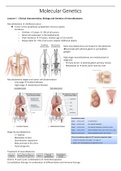
Most neuroblastomas are located in the abdomen
➔ Associate with adrenal gland or sympathetic
ganglia
High stage neuroblastomas are metastasized at
diagnosis
- Primary tumor → adrenal gland, primary nerves
- Metastases to → bone, bone marrow, liver
Neuroblastoma stages and tumor cell dissemination
- Low stage → localized disease
- High stage → metastasized disease
Stage 4S neuroblastoma
- S = special
- Metastasis to liver
- Spontaneous regression
- Wait-and-see in the clinic
- Good prognosis
Treatment of neuroblastoma
Chemo → each cycle: combinations of chemotherapeutics
Consolidation therapy → combination of differentiation and immune therapy
,Survival of neuroblastoma
What determines the survival of these patient?
➔ Neuroblastoma progression
o Primary tumor → initial response to therapy
o Relapses → resistant to therapy
▪ Completely not understood in
neuroblastoma
Clinical characteristics summary
- Childhood tumor
- Different stages of disease, but no progression between stages
- High stage tumors present with distant metastasis at diagnosis
- Treatment includes chemotherapy, surgery, differentiation-
and immune therapy
- Poor prognosis of high stage tumors
- High stage tumors initially respond to treatment, but relapses
are resistant
- Currently, no curative treatment options
Location of neuroblastoma relates to cell of origin
Development of the sympatho-adrenal lineage from the
neural crest
Neuroblastoma → expression of sympatho-adrenal genes
like PHOX2A and PHOX2B
PHOX2A + PHOX2B → DBH
DBH → important gene, essential for
the conversion of dopamine to
noradrenalin
- Neuroblast → precursors of adrenalin-producing cells
- Adrenalin synthesis route is preserved in tumors
- Neuroblastoma produces catecholamines
Summary Developmental origin of neuroblastoma
- The neural crest gives rise to sympatho-adrenal lineage
- Most neuroblastomas are located in the abdomen
- Associate with adrenal gland or sympathetic ganglia
- Neuroblasts are precursors of adrenalin-producing cells in the adrenals
- Neuroblastoma is tumor from the adrenergic lineage
- Neuroblastoma produces metabolites of adrenalin synthesis route
Metabolites → used for detection of neuroblastoma
,MIBG scintigraphy
- Differentiated neuroblasts produce adrenalin
o They express adrenalin re-uptake receptors
- meta-iodobenzylguanidine (MIBG) → adrenalin-analogue
o Labelled with 123I or 131I
- 90% neuroblastoma MIBG+
Which genes are driving neuroblastoma?
Amplification of MYCN oncogene in neuroblastoma
Oncogenic function of MYCN?
- Targeted MYCN expression induces neuroblastoma
Mutation in PHOX2B
- Mutation → expansion of alanine tract at C-term PHOX2B portein
➔ Act as repressors
o Represses DBH, while PHOX2B-wt activates DBH
PHOX2B → master gene in sympathetic nervous system development
ALK → recurrently mutated in neuroblastoma
- Intracellular domain of this kinase is mutated
- Occurs in about 10 % of neuroblastoma
Mutation in the ALK gene → induce mutations
Mutant ALK is oncogenic in mice
➔ ALK inhibition induces tumor regression in vivo
Summary Genetics and mutated genes
- Amplification MYCN oncogene
- Chromosomal gains and -losses
- Recurrent mutation of ALK
, Lecture 2 – Gene mutations cause cancer
What are the molecular defects driving cancer?
- Cancer is caused by mutations in genes → mutated genes produce mutated proteins → mutated
proteins can be targeted with new drugs → cancer is essentially solved
Chromosomes → consist of DNA and genes
Abnormal chromosomes → cause or result of cancer?
- Chromosomes are abnormal in form and number in cancer
- Chromosomal imbalances → developmental defects
➔ Right chromosome number is essential for life and development
o Chromosomal defects underly all cancers
Cancer can also be caused by viruses for example RSV virus in chicken
Two theories in cancer development
- Cancer is caused by a virus
- Cancer is caused by chromosomal defects/endogenous genes
Rous Sarcoma Virus
- SRC sequences found in DNA of all normal chicken cells
- Viral SRC gene was mutated copy of the chicken SRC genes
- Chicken SRC had been high-jacked by the virus
- Mutations in viral SRC → responsible for oncogenesis
Three assays to identify oncogenes
- From retroviruses
o Cancer inducing animal retroviruses analyzed → any
harbored vertebrate cDNA sequences that caused cancer
▪ The cellular homologues were identified as
oncogenes e.g. Ki-ras
- From chromosomal translocations in tumors
o Translocation t(9:22) → new gene is formed with oncogenic properties
- By functional assays
o Cellular transformation assay → when cells stop growing
when they have contact with each other, they are
normal cells
Mutated oncogenes can activate cells in vitro
Oncogenes in transgenic mouse strains induce cancer
Oncogenes (in)directly regulate cell division
➔ Mutated oncogenes cause cancer
➔ Cancer is caused by activated/mutated oncogenes
Tumor-suppressor genes
➔ Genes that normally control cell proliferation, and upon inactivation
cause cancer
➔ Normally two copies, both need to be inactivated/deleted to cause cancer
Chromosomal gains and losses are very frequent in human tumors
There are classical tumor-suppressor genes for different kinds of cancer
- RB tumor-suppressor gene on chromosome 13q14 → retinoblastoma
- APC tumor-suppressor gene on chromosome 5q → colon cancer
➔ Confirmation that chromosomal deletions mark tumor-suppressor genes regions
Lecture 1 – Clinical characteristics, Biology and Genetics of neuroblastoma
Neuroblastoma → childhood cancer
➔ Tumor of the peripheral sympathetic nervous system
- Incidence
o Children <15 years → 10% of all tumors
o About 30 cases/year in the Netherlands
o Peak incidence → 0-4 years, median age of 23 months
o Responsible for 15% of all tumor-related childhood deaths
Most neuroblastomas are located in the abdomen
➔ Associate with adrenal gland or sympathetic
ganglia
High stage neuroblastomas are metastasized at
diagnosis
- Primary tumor → adrenal gland, primary nerves
- Metastases to → bone, bone marrow, liver
Neuroblastoma stages and tumor cell dissemination
- Low stage → localized disease
- High stage → metastasized disease
Stage 4S neuroblastoma
- S = special
- Metastasis to liver
- Spontaneous regression
- Wait-and-see in the clinic
- Good prognosis
Treatment of neuroblastoma
Chemo → each cycle: combinations of chemotherapeutics
Consolidation therapy → combination of differentiation and immune therapy
,Survival of neuroblastoma
What determines the survival of these patient?
➔ Neuroblastoma progression
o Primary tumor → initial response to therapy
o Relapses → resistant to therapy
▪ Completely not understood in
neuroblastoma
Clinical characteristics summary
- Childhood tumor
- Different stages of disease, but no progression between stages
- High stage tumors present with distant metastasis at diagnosis
- Treatment includes chemotherapy, surgery, differentiation-
and immune therapy
- Poor prognosis of high stage tumors
- High stage tumors initially respond to treatment, but relapses
are resistant
- Currently, no curative treatment options
Location of neuroblastoma relates to cell of origin
Development of the sympatho-adrenal lineage from the
neural crest
Neuroblastoma → expression of sympatho-adrenal genes
like PHOX2A and PHOX2B
PHOX2A + PHOX2B → DBH
DBH → important gene, essential for
the conversion of dopamine to
noradrenalin
- Neuroblast → precursors of adrenalin-producing cells
- Adrenalin synthesis route is preserved in tumors
- Neuroblastoma produces catecholamines
Summary Developmental origin of neuroblastoma
- The neural crest gives rise to sympatho-adrenal lineage
- Most neuroblastomas are located in the abdomen
- Associate with adrenal gland or sympathetic ganglia
- Neuroblasts are precursors of adrenalin-producing cells in the adrenals
- Neuroblastoma is tumor from the adrenergic lineage
- Neuroblastoma produces metabolites of adrenalin synthesis route
Metabolites → used for detection of neuroblastoma
,MIBG scintigraphy
- Differentiated neuroblasts produce adrenalin
o They express adrenalin re-uptake receptors
- meta-iodobenzylguanidine (MIBG) → adrenalin-analogue
o Labelled with 123I or 131I
- 90% neuroblastoma MIBG+
Which genes are driving neuroblastoma?
Amplification of MYCN oncogene in neuroblastoma
Oncogenic function of MYCN?
- Targeted MYCN expression induces neuroblastoma
Mutation in PHOX2B
- Mutation → expansion of alanine tract at C-term PHOX2B portein
➔ Act as repressors
o Represses DBH, while PHOX2B-wt activates DBH
PHOX2B → master gene in sympathetic nervous system development
ALK → recurrently mutated in neuroblastoma
- Intracellular domain of this kinase is mutated
- Occurs in about 10 % of neuroblastoma
Mutation in the ALK gene → induce mutations
Mutant ALK is oncogenic in mice
➔ ALK inhibition induces tumor regression in vivo
Summary Genetics and mutated genes
- Amplification MYCN oncogene
- Chromosomal gains and -losses
- Recurrent mutation of ALK
, Lecture 2 – Gene mutations cause cancer
What are the molecular defects driving cancer?
- Cancer is caused by mutations in genes → mutated genes produce mutated proteins → mutated
proteins can be targeted with new drugs → cancer is essentially solved
Chromosomes → consist of DNA and genes
Abnormal chromosomes → cause or result of cancer?
- Chromosomes are abnormal in form and number in cancer
- Chromosomal imbalances → developmental defects
➔ Right chromosome number is essential for life and development
o Chromosomal defects underly all cancers
Cancer can also be caused by viruses for example RSV virus in chicken
Two theories in cancer development
- Cancer is caused by a virus
- Cancer is caused by chromosomal defects/endogenous genes
Rous Sarcoma Virus
- SRC sequences found in DNA of all normal chicken cells
- Viral SRC gene was mutated copy of the chicken SRC genes
- Chicken SRC had been high-jacked by the virus
- Mutations in viral SRC → responsible for oncogenesis
Three assays to identify oncogenes
- From retroviruses
o Cancer inducing animal retroviruses analyzed → any
harbored vertebrate cDNA sequences that caused cancer
▪ The cellular homologues were identified as
oncogenes e.g. Ki-ras
- From chromosomal translocations in tumors
o Translocation t(9:22) → new gene is formed with oncogenic properties
- By functional assays
o Cellular transformation assay → when cells stop growing
when they have contact with each other, they are
normal cells
Mutated oncogenes can activate cells in vitro
Oncogenes in transgenic mouse strains induce cancer
Oncogenes (in)directly regulate cell division
➔ Mutated oncogenes cause cancer
➔ Cancer is caused by activated/mutated oncogenes
Tumor-suppressor genes
➔ Genes that normally control cell proliferation, and upon inactivation
cause cancer
➔ Normally two copies, both need to be inactivated/deleted to cause cancer
Chromosomal gains and losses are very frequent in human tumors
There are classical tumor-suppressor genes for different kinds of cancer
- RB tumor-suppressor gene on chromosome 13q14 → retinoblastoma
- APC tumor-suppressor gene on chromosome 5q → colon cancer
➔ Confirmation that chromosomal deletions mark tumor-suppressor genes regions