

FLG 211 EXAM NOTES
UNIT 1.1
WHAT IS LIFE?
‐ Open systems
‐ Maintain homeostasis
‐ Composed of cells
‐ Have a life cycle
‐ Undergo metabolism
‐ Grow
‐ Adapt to their environment
‐ Respond to stimuli
‐ Reproduce
‐ Evolve
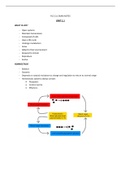
HOMEOSTASIS
‐ Balance
‐ Dynamic
‐ Depends on natural resistance to change and regulation to return to normal range
‐ Homeostasis systems always contain:
• Receptors
• Control centre
• Effectors
,UNIVERSAL PRINCIPLES OF LIFE AND CELL BIOLOGY
‐ There are a limited number of general principles that can explain the most complex
processes
‐ They are based on common molecular mechanisms
1. GENETIC INFORMATION
‐ Genetic information is stored as DNA sequence is duplicated and passed on to
daughter cells
,2. TRANSCRIPTION AND TRANSLATION
‐ Linear chemical sequences known as DNA – give rise to the
linear sequences and three-dimensional structures of RNAs
ad proteins
3. MACROMOLECULES
‐ Macromolecules are built by combining subunits
‐ Allows for diversity from identical building blocks
‐ Self-assemble
4. MEMBRANES
‐ Living organisms are surrounded by a membrane
‐ Made up of a lipid bilayer
‐ Following the fluid mosaic model
‐ Membranes are not made de novo
, 5. SUBCELLULAR TARGETING
‐ Spatial targeting a form of regulation
‐ Dependent on protein motifs/signals
‐ Soluble proteins start at ribosomes
‐ Membrane proteins carried by vesicles to target membrane
6. MOVEMENT
‐ Cellular constituents move by diffusion, pumps, and motors
7. SIGNALING
‐ Mechanism to receive, adapt and respond to intracellular and extracellular signals
‐ Signals can be nutrients, growth factors, hormones, neurotransmitters, and toxins
8. FEEDBACK
‐ Feedback control is the regulation of prior steps in a pathway by downstream
products of that pathway
UNIT 1.1
WHAT IS LIFE?
‐ Open systems
‐ Maintain homeostasis
‐ Composed of cells
‐ Have a life cycle
‐ Undergo metabolism
‐ Grow
‐ Adapt to their environment
‐ Respond to stimuli
‐ Reproduce
‐ Evolve
HOMEOSTASIS
‐ Balance
‐ Dynamic
‐ Depends on natural resistance to change and regulation to return to normal range
‐ Homeostasis systems always contain:
• Receptors
• Control centre
• Effectors
,UNIVERSAL PRINCIPLES OF LIFE AND CELL BIOLOGY
‐ There are a limited number of general principles that can explain the most complex
processes
‐ They are based on common molecular mechanisms
1. GENETIC INFORMATION
‐ Genetic information is stored as DNA sequence is duplicated and passed on to
daughter cells
,2. TRANSCRIPTION AND TRANSLATION
‐ Linear chemical sequences known as DNA – give rise to the
linear sequences and three-dimensional structures of RNAs
ad proteins
3. MACROMOLECULES
‐ Macromolecules are built by combining subunits
‐ Allows for diversity from identical building blocks
‐ Self-assemble
4. MEMBRANES
‐ Living organisms are surrounded by a membrane
‐ Made up of a lipid bilayer
‐ Following the fluid mosaic model
‐ Membranes are not made de novo
, 5. SUBCELLULAR TARGETING
‐ Spatial targeting a form of regulation
‐ Dependent on protein motifs/signals
‐ Soluble proteins start at ribosomes
‐ Membrane proteins carried by vesicles to target membrane
6. MOVEMENT
‐ Cellular constituents move by diffusion, pumps, and motors
7. SIGNALING
‐ Mechanism to receive, adapt and respond to intracellular and extracellular signals
‐ Signals can be nutrients, growth factors, hormones, neurotransmitters, and toxins
8. FEEDBACK
‐ Feedback control is the regulation of prior steps in a pathway by downstream
products of that pathway


