Joana Inês da Costa Santos
Student number: 2732721
Conflict and Crimes
Preparatory assignment Tutorial 2.1
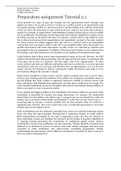
Wood presents two types of rape: the strategic and the opportunistic kinds. Strategic rape
implies an order to do so and is used as a weapon in a conflict; however, an opportunistic rape
can happen during a conflict for "personal reasons", having nothing to do with the motivations
of the war. Since the motivation to rape could not be clear, and it is one of the main criteria to
qualify it as strategic or opportunistic, understanding if raping is being used as a tool in conflict
can be problematic. Nevertheless, Wood argues that such concepts simplify this complex crime,
and these concepts are divided by fine lines. For instance, a direct order to rape might not exist,
but a cultural environment that congratulates toxic masculinity can lead to the same conduct.
For those reasons, the author suggests that rape can be a "practice" and is an intermediate
concept that does not require a direct order but is not punished either and is the product of a
specific environment and social interactions. In other words, it is tolerated by superiors and
encouraged by the war atmosphere. In addition, Wood says that the latter is more common than
the strategic, and if this behaviour is not tolerated, we are dealing with an opportunistic rape.
In the Eriksson Baaz & Stern article, some testimonials on rapes can be read. However, the DRC
soldiers interviewed used other terminology: the evil rapes and the lust rapes. I would argue that
"Evil rapes" can be seen as a "practice" and "lust rapes" seem to be "opportunistic". In other
words, soldiers said there are different motivations and ways to perform it; it can have personal
motivations in the case of a lust rape, and therefore they are opportunistic, or it can be more
violent and have the intention to destroy, carrying the weight, frustrations, and anger of a war
environment, fitting in the "practise" concept.
Many factors contribute to these crimes, and the authors pointed some ways to revert them.
Poverty, poor training, and bad conditions of the soldiers are mentioned as plausible causes of
the bad feelings that "lead" soldiers to aggressive behaviour. Possibly an utmost concern with
their well-being could diminish their aggressivity, but that alone would never be enough. The
work of Justice institutions can also be a problem, often they do not function during conflicts, so
there is no reports or ways to prosecute rapists.
In my opinion, the biggest problem is how masculinity and women's rights are perceived. Toxic
masculinity is intensified by wartime and group interactions. For instance, the testimonials
showed that even the soldiers who believe rape is wrong do not see it as harmful or unfair for
women, but as an insult to their family and husbands; it is like they are not worth it per se —
perceiving rape as not just a women's problem but one that concerns them too would be a
significant step. However, this is not a short-term work; it would take generations to revert this
mindset and can not explain it alone.
Roles of institutions are also addressed, especially their values. It is said that institutions attract
those who share the same principles. Meaning that if institutions change, so would soldiers.
Hold commandants accountable for any rape is suggested to make sure they are attentive to
their subordinate actions and eliminate the tolerance and the feeling of impunity embedded in
it. Ongoing training promoting the socialization of combatants against sexual violence,
including the reasons for its prohibition, can raise awareness. Policies should be customized and
adjusted to an institution's pattern of violence and could include campaigns that have been
successful in other institutions, like male-to-male counselling programmes. Finally,
understanding the phenomenon and its different motivations is essential not only to prevent it
but to act upon it and prosecute it.
Student number: 2732721
Conflict and Crimes
Preparatory assignment Tutorial 2.1
Wood presents two types of rape: the strategic and the opportunistic kinds. Strategic rape
implies an order to do so and is used as a weapon in a conflict; however, an opportunistic rape
can happen during a conflict for "personal reasons", having nothing to do with the motivations
of the war. Since the motivation to rape could not be clear, and it is one of the main criteria to
qualify it as strategic or opportunistic, understanding if raping is being used as a tool in conflict
can be problematic. Nevertheless, Wood argues that such concepts simplify this complex crime,
and these concepts are divided by fine lines. For instance, a direct order to rape might not exist,
but a cultural environment that congratulates toxic masculinity can lead to the same conduct.
For those reasons, the author suggests that rape can be a "practice" and is an intermediate
concept that does not require a direct order but is not punished either and is the product of a
specific environment and social interactions. In other words, it is tolerated by superiors and
encouraged by the war atmosphere. In addition, Wood says that the latter is more common than
the strategic, and if this behaviour is not tolerated, we are dealing with an opportunistic rape.
In the Eriksson Baaz & Stern article, some testimonials on rapes can be read. However, the DRC
soldiers interviewed used other terminology: the evil rapes and the lust rapes. I would argue that
"Evil rapes" can be seen as a "practice" and "lust rapes" seem to be "opportunistic". In other
words, soldiers said there are different motivations and ways to perform it; it can have personal
motivations in the case of a lust rape, and therefore they are opportunistic, or it can be more
violent and have the intention to destroy, carrying the weight, frustrations, and anger of a war
environment, fitting in the "practise" concept.
Many factors contribute to these crimes, and the authors pointed some ways to revert them.
Poverty, poor training, and bad conditions of the soldiers are mentioned as plausible causes of
the bad feelings that "lead" soldiers to aggressive behaviour. Possibly an utmost concern with
their well-being could diminish their aggressivity, but that alone would never be enough. The
work of Justice institutions can also be a problem, often they do not function during conflicts, so
there is no reports or ways to prosecute rapists.
In my opinion, the biggest problem is how masculinity and women's rights are perceived. Toxic
masculinity is intensified by wartime and group interactions. For instance, the testimonials
showed that even the soldiers who believe rape is wrong do not see it as harmful or unfair for
women, but as an insult to their family and husbands; it is like they are not worth it per se —
perceiving rape as not just a women's problem but one that concerns them too would be a
significant step. However, this is not a short-term work; it would take generations to revert this
mindset and can not explain it alone.
Roles of institutions are also addressed, especially their values. It is said that institutions attract
those who share the same principles. Meaning that if institutions change, so would soldiers.
Hold commandants accountable for any rape is suggested to make sure they are attentive to
their subordinate actions and eliminate the tolerance and the feeling of impunity embedded in
it. Ongoing training promoting the socialization of combatants against sexual violence,
including the reasons for its prohibition, can raise awareness. Policies should be customized and
adjusted to an institution's pattern of violence and could include campaigns that have been
successful in other institutions, like male-to-male counselling programmes. Finally,
understanding the phenomenon and its different motivations is essential not only to prevent it
but to act upon it and prosecute it.