Andreas Savva 6A
To what extent does immigration affect the supply of labour?
Net migration is the difference between difference between emigration and immigration. It is
controversial whether immigration can affect the supply of labour.
On the one hand, it can be argued that immigration can positively affect the supply of labour.
One initial piece of evidence that proves this is the effects of positive net migration. A positive
net migration occurs when more people enter the country than leave it. This means that since
there are more people entering, the workforce is bigger as more people live in that specific
country. Therefore, since there is a greater amount of workers that are part of the workforce,
the greater the supply of labour will be due to the larger workforce. This can also be seen
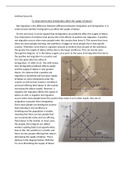
through the diagram. S1 is the labour supply curve prior to the wave of immigration that led to
the positive net migration in a country and
S2 is the point after the influx of
immigration. S1 shifts to S2. This shift shows
how immigration positively affects supply
and the supply of labour is now greater.
Hence, it is obvious that a positive net
migration is beneficial and increases supply
of labour as more immigrants enter the
country as well as that country’s workforce
and start offering their labour in the market,
increasing the labour supply. However, a
negative net migration affects the supply of
labour as well. A negative net migration
occurs when more people leave the country than enter it or in other words, the rate of
emigration is greater than immigration.
Since more people are leaving the country
than entering it, the workforce is
shrinking and the population is smaller,
meaning that there are less people that
are economically active and are offering
their labour in the market. In most cases,
the people that emigrate are skilled
workers seeking better job opportunities.
Due to this, the workforce is smaller and
there are less people offering their labour,
decreasing the supply of labour. This is
obvious in the diagram below. With the
S1 curve illustrating the supply of labour
To what extent does immigration affect the supply of labour?
Net migration is the difference between difference between emigration and immigration. It is
controversial whether immigration can affect the supply of labour.
On the one hand, it can be argued that immigration can positively affect the supply of labour.
One initial piece of evidence that proves this is the effects of positive net migration. A positive
net migration occurs when more people enter the country than leave it. This means that since
there are more people entering, the workforce is bigger as more people live in that specific
country. Therefore, since there is a greater amount of workers that are part of the workforce,
the greater the supply of labour will be due to the larger workforce. This can also be seen
through the diagram. S1 is the labour supply curve prior to the wave of immigration that led to
the positive net migration in a country and
S2 is the point after the influx of
immigration. S1 shifts to S2. This shift shows
how immigration positively affects supply
and the supply of labour is now greater.
Hence, it is obvious that a positive net
migration is beneficial and increases supply
of labour as more immigrants enter the
country as well as that country’s workforce
and start offering their labour in the market,
increasing the labour supply. However, a
negative net migration affects the supply of
labour as well. A negative net migration
occurs when more people leave the country than enter it or in other words, the rate of
emigration is greater than immigration.
Since more people are leaving the country
than entering it, the workforce is
shrinking and the population is smaller,
meaning that there are less people that
are economically active and are offering
their labour in the market. In most cases,
the people that emigrate are skilled
workers seeking better job opportunities.
Due to this, the workforce is smaller and
there are less people offering their labour,
decreasing the supply of labour. This is
obvious in the diagram below. With the
S1 curve illustrating the supply of labour