grade 12
-
I :
work
and the
>
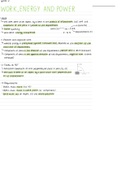
the work done on an object by a force is the
product of displacement ( Ox )
component of the force (F) parallel the displacement (N)
to
→ force
scalar work CJ ) l
W FOX
quantity
> =
'
displacement cm )
work done
energy transferred J N m
> =
.
.
.
1. l positive and negative work
>
whether
energy is transferred ( gained ) / removed ( lost ) depends ,
on the direction of the
force and its displacement
>
component of force in the direction of the displacement positive
,
work is done (transfer )
component of force direction of the displacement is done
negative
>
in the opposite ,
work
( removed )
°
1. 2 Forces at 90
> horizontal component of this perpendicular force is zero ( Fx -
-
O)
> zero work is done on an object by a force which acts perpendicular
to its displacement
1. 3
Requirements
Object (ox )
•
must move >O
object move in same plane ( x component )
•
must
-
force object for the entire distance
•
must act on
,2. Energy
2. 1 Gravitational potential
energy
>
energy an object posses due to its position relative to reference point
scalar
quantity Ckg )
>
> mass
gravitational Ep Mgh vertical height ( m )
= >
potential
energy (J )
(9,8ms 2)
-
>
acceleration
2. 2 kinetic
energy
object has result of object 's motion
>
energy an as a the
1ms )
"
>
scalar
quantity
>
speed
Ek Em v2
energy CJY
=
kinetic
2. 3 Mechanical
energy
> mass Ckg )
of its and kinetic
sum
gravitational potential energy energy
>
>
scalar Em Ep Ek
quantity
= +
The Law of conservation of
2. 4
Energy
> the total
energy in a
system cannot be created nor
destroyed ; only transferred
from one form to another
2.5 The principle of conservation of mechanical energy
> in the absence of air resistance or
any external forces ,
the mechanical
energy of
an object is constant
>
Epi
+
Eki =
Epf +
Ekf
> external forces :
friction applied forces and normal forces
,
-
I :
work
and the
>
the work done on an object by a force is the
product of displacement ( Ox )
component of the force (F) parallel the displacement (N)
to
→ force
scalar work CJ ) l
W FOX
quantity
> =
'
displacement cm )
work done
energy transferred J N m
> =
.
.
.
1. l positive and negative work
>
whether
energy is transferred ( gained ) / removed ( lost ) depends ,
on the direction of the
force and its displacement
>
component of force in the direction of the displacement positive
,
work is done (transfer )
component of force direction of the displacement is done
negative
>
in the opposite ,
work
( removed )
°
1. 2 Forces at 90
> horizontal component of this perpendicular force is zero ( Fx -
-
O)
> zero work is done on an object by a force which acts perpendicular
to its displacement
1. 3
Requirements
Object (ox )
•
must move >O
object move in same plane ( x component )
•
must
-
force object for the entire distance
•
must act on
,2. Energy
2. 1 Gravitational potential
energy
>
energy an object posses due to its position relative to reference point
scalar
quantity Ckg )
>
> mass
gravitational Ep Mgh vertical height ( m )
= >
potential
energy (J )
(9,8ms 2)
-
>
acceleration
2. 2 kinetic
energy
object has result of object 's motion
>
energy an as a the
1ms )
"
>
scalar
quantity
>
speed
Ek Em v2
energy CJY
=
kinetic
2. 3 Mechanical
energy
> mass Ckg )
of its and kinetic
sum
gravitational potential energy energy
>
>
scalar Em Ep Ek
quantity
= +
The Law of conservation of
2. 4
Energy
> the total
energy in a
system cannot be created nor
destroyed ; only transferred
from one form to another
2.5 The principle of conservation of mechanical energy
> in the absence of air resistance or
any external forces ,
the mechanical
energy of
an object is constant
>
Epi
+
Eki =
Epf +
Ekf
> external forces :
friction applied forces and normal forces
,