Student Number: 12770213
Student Name: Ani Davtyan
Course: International Relations Law
Assignment: Case Comment on the European Road Transport Agreement Case
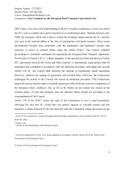
ERTA plays a key role in the understanding of the EU's external competences, as this case shows
the EU’s role as a global actor and its transition to a constitutional entity.1 Starting from the early
1960s the European Union had a plan to extend the European regime beyond the EU, and this
was seen in the external affairs in the form of negotiations with third countries. These recent
developments became more prominent with the quantitative and qualitative growth with
reference to power in external affairs under the Lisbon Treaty.2 The Council validated
proceedings to coordinate settlements for negotiating the European Road Transport Agreement.
On the basis of Article 218 (1) without prejudice to the specific provisions laid down in Article
207, agreements between the Union and third countries or international organisations shall be
negotiated and concluded in accordance with the following procedure, and taking into account
Article 218 (2) the Council shall authorise the opening of negotiations, adopt negotiating
directives, authorise the signing of agreements and conclude them.3 However, the Commission
challenged the actions of the Council and started an annulment procedure.4 The Commission
argues the process and the right to conclude agreements falls within the exclusive competence of
the European Union. Adding to this, as far as the treaties do not contain any clauses on the
external policy of road and transport, then the Member States should act according to the
commandments of the Council.
Article 210 of the TFEU5 claims the right of the Community to have a legal personality,
following the idea that EU would have the general capacity to conclude treaties and this
statement is being followed by the fact that each time the Community adopts provisions laying
1
(Case 22/70, Commission v Council (European Road Transport Agreement), Court of Justice of the EC, [1971]
ECR 263, 2021)
2
(Eckes, n.d.)
3
(Treaty on the Functioning of the European Union)
4
Action for annulment for an EU act is being regulated in accordance with the Article 263 of the Treaty on the
Functioning of the European Union.
5
(Treaty on the Functioning of the European Union)
1
Student Name: Ani Davtyan
Course: International Relations Law
Assignment: Case Comment on the European Road Transport Agreement Case
ERTA plays a key role in the understanding of the EU's external competences, as this case shows
the EU’s role as a global actor and its transition to a constitutional entity.1 Starting from the early
1960s the European Union had a plan to extend the European regime beyond the EU, and this
was seen in the external affairs in the form of negotiations with third countries. These recent
developments became more prominent with the quantitative and qualitative growth with
reference to power in external affairs under the Lisbon Treaty.2 The Council validated
proceedings to coordinate settlements for negotiating the European Road Transport Agreement.
On the basis of Article 218 (1) without prejudice to the specific provisions laid down in Article
207, agreements between the Union and third countries or international organisations shall be
negotiated and concluded in accordance with the following procedure, and taking into account
Article 218 (2) the Council shall authorise the opening of negotiations, adopt negotiating
directives, authorise the signing of agreements and conclude them.3 However, the Commission
challenged the actions of the Council and started an annulment procedure.4 The Commission
argues the process and the right to conclude agreements falls within the exclusive competence of
the European Union. Adding to this, as far as the treaties do not contain any clauses on the
external policy of road and transport, then the Member States should act according to the
commandments of the Council.
Article 210 of the TFEU5 claims the right of the Community to have a legal personality,
following the idea that EU would have the general capacity to conclude treaties and this
statement is being followed by the fact that each time the Community adopts provisions laying
1
(Case 22/70, Commission v Council (European Road Transport Agreement), Court of Justice of the EC, [1971]
ECR 263, 2021)
2
(Eckes, n.d.)
3
(Treaty on the Functioning of the European Union)
4
Action for annulment for an EU act is being regulated in accordance with the Article 263 of the Treaty on the
Functioning of the European Union.
5
(Treaty on the Functioning of the European Union)
1