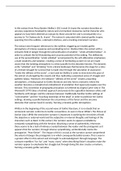
In this extract from Percy Bysshe Shelley’s 1811 novel St Irvyne the narrator describes an
uncanny experience focalised by nature and a tormented, lonesome central character who
appears to have been deemed an outcast by those around her and is consequently on a
journey to “le Chateau de St. Irvyne”. The extract is saturated with classical gothic tropes;
spanning from the sublime, a damsel in distress, and a mocking omniscient narrator.
The extract sees frequent references to the sublime, triggering an innately gothic
atmosphere of intense suspense and overloading terror. Shelley litters the extract with a
semantic field of danger through the personification of weather; “winds whistled hollow”, in
order to unleash the full threatening and uncanny potential of the setting. The deliberate
use of the personification “winds whistled” accompanied by the soft alliteration emphasises
a state weakness and isolation, creating a sense of foreboding as later on we are made
aware that the isolating atmosphere is a direct parallel to the desolate heroine. The dynamic
verbs “whistled” and “shrieking” form a brutal landscape that becomes the stage for a story
of a female struggle for survival that is made clear through the saturation of assonance;
“broke the stillness of the scene”, a tool used by Shelley in order to slow down the pace of
the extract via elongating the vowels and thus replicating a perpetual sense of struggle and
pathetic fallacy. Moreover, the sibilance “stillness of the scene” creates a daunting
atmosphere, a hissing typical to Gothic literature and also forms a dynamic where the
weather becomes a metaphorical embodiment of predation that vigorously topples over the
heroine. This convention of geographical locations is furthered by Angela Carter who in The
Werewolf (1979) takes a feminist approach and presents the opposition between safety and
familiarity with danger and the unknown between traditionally familiar Gothic settings of
“cold weather” and the “touching townships of the dead” in order to politicise her Gothic
settings, drawing a parallel between the uncanniness of the forest and the uncanny
obstacles that women faced in society, forming a innately gothic atmosphere.
Written in the beginning of the second wave of Gothic literature, it is no doubt that an
omniscient narrator conforms to Gothic conventions. As seen in Oscar Wilde’s The Picture of
Dorian Gray (1890) the omniscient narrator is important in outlining the chronicles of both
the objective or external world and the subjective or internal thoughts and feelings of the
characters such as Basil. In this extract, the narrator seems to appear unreliable by
constantly sympathising with the heroine; dissolving a sense of authenticity. Moreover,
there seems to be a lack of intimacy created between the reader and the protagonist as it
appears that the narrator, through intense sympathising, unintentionally mocks the
protagonist; “Poor Eloise!”. The impact of this is crucial as the narrator cannot comprehend
the extent of danger the protagonist is in which consequently builds tension. This is seen in
a greater effect in this extract and is brought to acknowledgment through language. The
constant repetition “far, far” and “many, many” when describing Eloise’s situation make the
narrator appear to emphasise her struggle but through doing this also creates a mockery,
forming a innately gothic narrative.
uncanny experience focalised by nature and a tormented, lonesome central character who
appears to have been deemed an outcast by those around her and is consequently on a
journey to “le Chateau de St. Irvyne”. The extract is saturated with classical gothic tropes;
spanning from the sublime, a damsel in distress, and a mocking omniscient narrator.
The extract sees frequent references to the sublime, triggering an innately gothic
atmosphere of intense suspense and overloading terror. Shelley litters the extract with a
semantic field of danger through the personification of weather; “winds whistled hollow”, in
order to unleash the full threatening and uncanny potential of the setting. The deliberate
use of the personification “winds whistled” accompanied by the soft alliteration emphasises
a state weakness and isolation, creating a sense of foreboding as later on we are made
aware that the isolating atmosphere is a direct parallel to the desolate heroine. The dynamic
verbs “whistled” and “shrieking” form a brutal landscape that becomes the stage for a story
of a female struggle for survival that is made clear through the saturation of assonance;
“broke the stillness of the scene”, a tool used by Shelley in order to slow down the pace of
the extract via elongating the vowels and thus replicating a perpetual sense of struggle and
pathetic fallacy. Moreover, the sibilance “stillness of the scene” creates a daunting
atmosphere, a hissing typical to Gothic literature and also forms a dynamic where the
weather becomes a metaphorical embodiment of predation that vigorously topples over the
heroine. This convention of geographical locations is furthered by Angela Carter who in The
Werewolf (1979) takes a feminist approach and presents the opposition between safety and
familiarity with danger and the unknown between traditionally familiar Gothic settings of
“cold weather” and the “touching townships of the dead” in order to politicise her Gothic
settings, drawing a parallel between the uncanniness of the forest and the uncanny
obstacles that women faced in society, forming a innately gothic atmosphere.
Written in the beginning of the second wave of Gothic literature, it is no doubt that an
omniscient narrator conforms to Gothic conventions. As seen in Oscar Wilde’s The Picture of
Dorian Gray (1890) the omniscient narrator is important in outlining the chronicles of both
the objective or external world and the subjective or internal thoughts and feelings of the
characters such as Basil. In this extract, the narrator seems to appear unreliable by
constantly sympathising with the heroine; dissolving a sense of authenticity. Moreover,
there seems to be a lack of intimacy created between the reader and the protagonist as it
appears that the narrator, through intense sympathising, unintentionally mocks the
protagonist; “Poor Eloise!”. The impact of this is crucial as the narrator cannot comprehend
the extent of danger the protagonist is in which consequently builds tension. This is seen in
a greater effect in this extract and is brought to acknowledgment through language. The
constant repetition “far, far” and “many, many” when describing Eloise’s situation make the
narrator appear to emphasise her struggle but through doing this also creates a mockery,
forming a innately gothic narrative.