

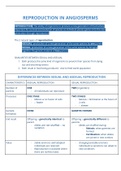
REPRODUCTION IN ANGIOSPERMS
REPRODUCTION: The ability of organisms to produce a new generation of themselves.
Important for survival and evolution of species as individual passes genes onto the next
generation through reproduction
The 2 natural types of reproduction:
1. ASEXUAL: production of a new generation of the same species by one parent
2. SEXUAL: production of a new generation of the same species by bringing
together the genetic material of two parents
SIMILARITIES BETWEEN SEXUAL AND ASEXUAL
1. Both produce the same kind of organisms to prevent their species from dying
out and becoming extinct
2. Both result in food being produced - vital to feed world population
DIFFERENCES BETWEEN SEXUAL AND ASEXUAL REPRODUCTION
CHARACTERISTICS ASEXUAL REPRODUCTION SEXUAL REPRODUCTION
Number of ONE TWO [2 genders]
parents - All individuals can reproduce
Processes ONE STAGE TWO STAGES
- Mitosis w no fusion of cells - Meiosis + fertilization w the fusion of
- ∴ faster 2 cells
- ∴ slower
Gamete NONE GAMETES FORMED
formation
End result Offspring = genetically identical to Offspring = genetically different to
parent parents
- Alleles are not shuffled ∴ no - Alleles are shuffled during:
variation - Meiosis: when gametes are
formed
- Fertilization: when alleles
are joined in new combos
Value - stable environs: well adapted - changing/unstable environs:
individuals are reserved individuals w variations can adapt to
- Reproduction in possible where new conditions
there are no/few mates
, Rate of FASTER: all individuals can reproduce SLOWER: half population are males who
reproduction don't produce offspring
Energy input MORE EFFICIENT: no energy input is LESS EFFICIENT: energy input is needed to
needed produce gametes + find mate
Outside agents NONE Pollinators may be needed for pollination/
animals to carry seeds
Ability to adapt to NO YES
environment
Possibility of LOW: usually no genotype variation GOOD: genotype variation
evolution
ADVANTAGES AND DISADVANTAGES OF SEXUAL AND ASEXUAL
REPRODUCTION
REPRODUCTION ADVANTAGES DISADVANTAGES
PROCESS
SEXUAL Results in variation which: High expenditure of energy
- May reduce chance of inheriting - Production of reproductive organs
disease from parent
- Is basis of evolution Slower reproductive process than asexual
- Gamete production + meeting of
gametes takes time
- Gives organisms better survival Unfavourable mutations and recessive
chance in unstable environ as genes can be expressed in offspring
offspring may adapt to new
conditions
- May prevent disease spread as Outside agents may be needed to carry
offspring may adapt to new pollen/seeds
conditions
ASEXUAL All individuals can produce offspring No variation in offspring unless there's a
- ∴ no energy expenditure mutation
needed to produce - Pop. could die out if environ changes
gametes/find mate and they can't adapt
Simple + fast process Overcrowding can occur
- Only involves mitosis - Resources (food+light) can become
REPRODUCTION: The ability of organisms to produce a new generation of themselves.
Important for survival and evolution of species as individual passes genes onto the next
generation through reproduction
The 2 natural types of reproduction:
1. ASEXUAL: production of a new generation of the same species by one parent
2. SEXUAL: production of a new generation of the same species by bringing
together the genetic material of two parents
SIMILARITIES BETWEEN SEXUAL AND ASEXUAL
1. Both produce the same kind of organisms to prevent their species from dying
out and becoming extinct
2. Both result in food being produced - vital to feed world population
DIFFERENCES BETWEEN SEXUAL AND ASEXUAL REPRODUCTION
CHARACTERISTICS ASEXUAL REPRODUCTION SEXUAL REPRODUCTION
Number of ONE TWO [2 genders]
parents - All individuals can reproduce
Processes ONE STAGE TWO STAGES
- Mitosis w no fusion of cells - Meiosis + fertilization w the fusion of
- ∴ faster 2 cells
- ∴ slower
Gamete NONE GAMETES FORMED
formation
End result Offspring = genetically identical to Offspring = genetically different to
parent parents
- Alleles are not shuffled ∴ no - Alleles are shuffled during:
variation - Meiosis: when gametes are
formed
- Fertilization: when alleles
are joined in new combos
Value - stable environs: well adapted - changing/unstable environs:
individuals are reserved individuals w variations can adapt to
- Reproduction in possible where new conditions
there are no/few mates
, Rate of FASTER: all individuals can reproduce SLOWER: half population are males who
reproduction don't produce offspring
Energy input MORE EFFICIENT: no energy input is LESS EFFICIENT: energy input is needed to
needed produce gametes + find mate
Outside agents NONE Pollinators may be needed for pollination/
animals to carry seeds
Ability to adapt to NO YES
environment
Possibility of LOW: usually no genotype variation GOOD: genotype variation
evolution
ADVANTAGES AND DISADVANTAGES OF SEXUAL AND ASEXUAL
REPRODUCTION
REPRODUCTION ADVANTAGES DISADVANTAGES
PROCESS
SEXUAL Results in variation which: High expenditure of energy
- May reduce chance of inheriting - Production of reproductive organs
disease from parent
- Is basis of evolution Slower reproductive process than asexual
- Gamete production + meeting of
gametes takes time
- Gives organisms better survival Unfavourable mutations and recessive
chance in unstable environ as genes can be expressed in offspring
offspring may adapt to new
conditions
- May prevent disease spread as Outside agents may be needed to carry
offspring may adapt to new pollen/seeds
conditions
ASEXUAL All individuals can produce offspring No variation in offspring unless there's a
- ∴ no energy expenditure mutation
needed to produce - Pop. could die out if environ changes
gametes/find mate and they can't adapt
Simple + fast process Overcrowding can occur
- Only involves mitosis - Resources (food+light) can become



