Question
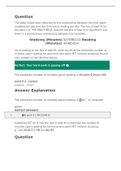
The table shows data collected on the relationship between the time spent
studying per day and the time spent reading per day. The line of best fit for
the data is yˆ=0.16x+36.2. Assume the line of best fit is significant and
there is a strong linear relationship between the variables.
Studying (Minutes) 507090110 Reading
(Minutes) 44485054
(a) According to the line of best fit, what would be the predicted number of
minutes spent reading for someone who spent 67 minutes studying? Round
your answer to two decimal places.
Perfect. Your hard work is paying off �
The predicted number of minutes spent reading is 46 point 9 2$$46.9246
point 9 2 - correct.
response - correct
Answer Explanation
The predicted number of minutes spent reading is 1$$1 - no response
given.
Correct answers:
146 point 9 2 $46.92$46.92
Substitute 67 for x into the line of best fit to estimate the number of
minutes spent reading for someone who spent 67 minutes studying:
yˆ=0.16(67)+36.2=46.92.
Question
,The table shows data collected on the relationship between the time spent
studying per day and the time spent reading per day. The line of best fit for
the data is yˆ=0.16x+36.2.
Studying (Minutes) 507090110 Reading
(Minutes) 44485054
(a) According to the line of best fit, the predicted number of minutes spent
reading for someone who spent 67 minutes studying is 46.92.
(b) Is it reasonable to use this line of best fit to make the above prediction?
Great work! That's correct.
The estimate, a predicted time of 46.92 minutes, is both reliable and
reasonable.
The estimate, a predicted time of 46.92 minutes, is both unreliable and
unreasonable.
The estimate, a predicted time of 46.92 minutes, is reliable but
unreasonable.
The estimate, a predicted time of 46.92 minutes, is unreliable but
reasonable.
Answer Explanation
Correct answer:
The estimate, a predicted time of 46.92 minutes, is both reliable and
reasonable.
The data in the table only includes studying times between 50 and 110
minutes, so the line of best fit gives reliable and reasonable predictions for
values of x between 50 and 110. Since 67 is between these values, the
estimate is both reliable and reasonable.
, Question
Michelle is studying the relationship between the hours worked (per week)
and time spent reading (per day) and has collected the data shown in the
table. The line of best fit for the data is yˆ=−0.79x+98.8. Assume the
line of best fit is significant and there is a strong linear relationship between
the variables.
Hours Worked (per week) 30405060 Minutes Reading
(per day) 75685852
(a) According to the line of best fit, what would be the predicted number of
minutes spent reading for a person who works 27 hours (per week)? Round
your answer to two decimal places, as needed.
Yes that's right. Keep it up!
The predicted number of minutes spent reading is 77 point 4 7$$77.4777
point 4 7 - correct.
response - correct
Answer Explanation
The predicted number of minutes spent reading is 1$$1 - no response
given.
Correct answers:
177 point 4 7 $77.47$77.47
Substitute 27 for x into the line of best fit to estimate the number of
minutes spent reading for a person who works 27 hours (per week):
yˆ=−0.79(27)+98.8=77.47.
The table shows data collected on the relationship between the time spent
studying per day and the time spent reading per day. The line of best fit for
the data is yˆ=0.16x+36.2. Assume the line of best fit is significant and
there is a strong linear relationship between the variables.
Studying (Minutes) 507090110 Reading
(Minutes) 44485054
(a) According to the line of best fit, what would be the predicted number of
minutes spent reading for someone who spent 67 minutes studying? Round
your answer to two decimal places.
Perfect. Your hard work is paying off �
The predicted number of minutes spent reading is 46 point 9 2$$46.9246
point 9 2 - correct.
response - correct
Answer Explanation
The predicted number of minutes spent reading is 1$$1 - no response
given.
Correct answers:
146 point 9 2 $46.92$46.92
Substitute 67 for x into the line of best fit to estimate the number of
minutes spent reading for someone who spent 67 minutes studying:
yˆ=0.16(67)+36.2=46.92.
Question
,The table shows data collected on the relationship between the time spent
studying per day and the time spent reading per day. The line of best fit for
the data is yˆ=0.16x+36.2.
Studying (Minutes) 507090110 Reading
(Minutes) 44485054
(a) According to the line of best fit, the predicted number of minutes spent
reading for someone who spent 67 minutes studying is 46.92.
(b) Is it reasonable to use this line of best fit to make the above prediction?
Great work! That's correct.
The estimate, a predicted time of 46.92 minutes, is both reliable and
reasonable.
The estimate, a predicted time of 46.92 minutes, is both unreliable and
unreasonable.
The estimate, a predicted time of 46.92 minutes, is reliable but
unreasonable.
The estimate, a predicted time of 46.92 minutes, is unreliable but
reasonable.
Answer Explanation
Correct answer:
The estimate, a predicted time of 46.92 minutes, is both reliable and
reasonable.
The data in the table only includes studying times between 50 and 110
minutes, so the line of best fit gives reliable and reasonable predictions for
values of x between 50 and 110. Since 67 is between these values, the
estimate is both reliable and reasonable.
, Question
Michelle is studying the relationship between the hours worked (per week)
and time spent reading (per day) and has collected the data shown in the
table. The line of best fit for the data is yˆ=−0.79x+98.8. Assume the
line of best fit is significant and there is a strong linear relationship between
the variables.
Hours Worked (per week) 30405060 Minutes Reading
(per day) 75685852
(a) According to the line of best fit, what would be the predicted number of
minutes spent reading for a person who works 27 hours (per week)? Round
your answer to two decimal places, as needed.
Yes that's right. Keep it up!
The predicted number of minutes spent reading is 77 point 4 7$$77.4777
point 4 7 - correct.
response - correct
Answer Explanation
The predicted number of minutes spent reading is 1$$1 - no response
given.
Correct answers:
177 point 4 7 $77.47$77.47
Substitute 27 for x into the line of best fit to estimate the number of
minutes spent reading for a person who works 27 hours (per week):
yˆ=−0.79(27)+98.8=77.47.