2. Verbranding in ottomotoren
2.1. Mengselvorming
a) één cilinder, ideale menging, volledige verdamping:
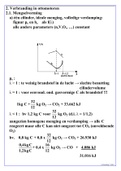
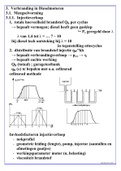
figuur pe en be als f(λ)
alle andere parameters (n,V.O., …) constant
pe :
λ > 1 : te weinig brandstof in de lucht → slechte benutting
cilindervolume
λ = 1 : voor eenvoud. ond. gasvormige C als brandstof !!!
32
1kg C + kg O2 → CO2 + 33.662 kJ
12
32
λ < 1 : bv 1,2 kg C voor kg O2 (d.i. λ = 1/1,2)
12
aangezien homogene menging en verdamping → alle C
reageert maar alle C kan niet omgezet tot CO2 (onvoldoende
O2)
32
bv. 0,8 kg C + 0,8 x kg O2 → CO2 + 26.930 kJ
12
0,4 kg C 16
+ 0,4 x kg O2 → CO + 4.086 kJ
1,2 kg C 12
31.016 kJ
verbranding 2 slide 1.
,be :
λ > 1 : eerst : → minder brandstof in cilinder; dus pi <<
wel ± zelfde mechanische wrijvingsverliezen → ηm <
daarna : armer mengsel → tragere verbranding (T<)
(minder isochoor) → ηi <
1 1
be ≈ ≈ → be ↑
ηe η i ηm
tenslotte : bij λ >> verbranding niet afgelopen als
uitlaat opent
uiteindelijk : bij λ ≈ 1,2 misfire limit
λ < 1 : door dissociatie, slechter brandstofverbruik
(cfr. pe; λ < 1) → be ↑
b) Eéncilinder motor : geen ideale menging en geen volledige
verdamping (werkelijke motor)
pe : max naar links : alle toegevoerde brandstof niet
verbrand
be : min naar rechts
bij λ = 1 onvolmaakte menging en
verdamping (condensatie) → deel
brandstof kan niet verbranden
bij λ > 1 aandeel kleiner
verbranding 2 slide 2.
,2.2. Voorreacties
- temperatuur einde aanzuiging ± 100 °C
(functie buitenluchttemperatuur, verdampingswarmte,
opwarming door wanden, belasting, …)
- einde compressie T ≥ 550 °C afhankelijk van TIS , ε, λ, …
- einde compressie → alle brandstof verdampt
- door hoge temperatuur reeds voorreacties:
• peroxiden ROOR’ H2O2
• aldehyden (cfr. formaldehyde CH2O)
2.3. Vonkenergie
minimale warmteontwikkeling om voldoende
ladingshoeveelheid op vereiste temperatuur
- minimale energie :
d 2λ
E=C ΔT
c
E ~ warmteafvoer
1
E~
vlamsnelheid
c = vlamsnelheid
λ = warmtegeleidendheid
- d voldoende groot om minimaal ontstekingsvolume
- vollast en λ ≤ 1; sterkte van vonk weinig belang
- deellast en (of) λ > 1; sterkte, duur en aantal wel belangrijk:
luchtbeweging met veranderende λ rond bougie benutten
- belang “baby flame”
verbranding 2 slide 3.
, 2.4. Normale verbranding
- bougievonk → baby flame → vlamfront in alle richtingen
- verbranding van schil veroorzaakt temperatuurstijging
en uitzetting (Δp stijging)
- pcil : overal dezelfde : voortplantingssnelheid drukgolf >>>
(akoest. a = χRT ) (900 m/sec)
- Tcil : warmte voortplanting vooral door conductie
≈ 10 m/sec
→ ΔT gradiënt honderden graden over de cilinder
(in de verbrande gassen !) met Tmax rond bougie
→ in onverbrand deel is ΔT bepaald door Δp !
- vlamsnelheid (absolute) (ct,r) :
belangrijk i.v.m. het al of niet afgelopen zijn van
verbanding bij U0
⎛ dx ⎞
- verbrandingssnelheid ⎜ ⎟ :
⎝ dt ⎠
belangrijke parameter bij thermodynamische analyse van
de cyclus
verbranding 2 slide 4.
2.1. Mengselvorming
a) één cilinder, ideale menging, volledige verdamping:
figuur pe en be als f(λ)
alle andere parameters (n,V.O., …) constant
pe :
λ > 1 : te weinig brandstof in de lucht → slechte benutting
cilindervolume
λ = 1 : voor eenvoud. ond. gasvormige C als brandstof !!!
32
1kg C + kg O2 → CO2 + 33.662 kJ
12
32
λ < 1 : bv 1,2 kg C voor kg O2 (d.i. λ = 1/1,2)
12
aangezien homogene menging en verdamping → alle C
reageert maar alle C kan niet omgezet tot CO2 (onvoldoende
O2)
32
bv. 0,8 kg C + 0,8 x kg O2 → CO2 + 26.930 kJ
12
0,4 kg C 16
+ 0,4 x kg O2 → CO + 4.086 kJ
1,2 kg C 12
31.016 kJ
verbranding 2 slide 1.
,be :
λ > 1 : eerst : → minder brandstof in cilinder; dus pi <<
wel ± zelfde mechanische wrijvingsverliezen → ηm <
daarna : armer mengsel → tragere verbranding (T<)
(minder isochoor) → ηi <
1 1
be ≈ ≈ → be ↑
ηe η i ηm
tenslotte : bij λ >> verbranding niet afgelopen als
uitlaat opent
uiteindelijk : bij λ ≈ 1,2 misfire limit
λ < 1 : door dissociatie, slechter brandstofverbruik
(cfr. pe; λ < 1) → be ↑
b) Eéncilinder motor : geen ideale menging en geen volledige
verdamping (werkelijke motor)
pe : max naar links : alle toegevoerde brandstof niet
verbrand
be : min naar rechts
bij λ = 1 onvolmaakte menging en
verdamping (condensatie) → deel
brandstof kan niet verbranden
bij λ > 1 aandeel kleiner
verbranding 2 slide 2.
,2.2. Voorreacties
- temperatuur einde aanzuiging ± 100 °C
(functie buitenluchttemperatuur, verdampingswarmte,
opwarming door wanden, belasting, …)
- einde compressie T ≥ 550 °C afhankelijk van TIS , ε, λ, …
- einde compressie → alle brandstof verdampt
- door hoge temperatuur reeds voorreacties:
• peroxiden ROOR’ H2O2
• aldehyden (cfr. formaldehyde CH2O)
2.3. Vonkenergie
minimale warmteontwikkeling om voldoende
ladingshoeveelheid op vereiste temperatuur
- minimale energie :
d 2λ
E=C ΔT
c
E ~ warmteafvoer
1
E~
vlamsnelheid
c = vlamsnelheid
λ = warmtegeleidendheid
- d voldoende groot om minimaal ontstekingsvolume
- vollast en λ ≤ 1; sterkte van vonk weinig belang
- deellast en (of) λ > 1; sterkte, duur en aantal wel belangrijk:
luchtbeweging met veranderende λ rond bougie benutten
- belang “baby flame”
verbranding 2 slide 3.
, 2.4. Normale verbranding
- bougievonk → baby flame → vlamfront in alle richtingen
- verbranding van schil veroorzaakt temperatuurstijging
en uitzetting (Δp stijging)
- pcil : overal dezelfde : voortplantingssnelheid drukgolf >>>
(akoest. a = χRT ) (900 m/sec)
- Tcil : warmte voortplanting vooral door conductie
≈ 10 m/sec
→ ΔT gradiënt honderden graden over de cilinder
(in de verbrande gassen !) met Tmax rond bougie
→ in onverbrand deel is ΔT bepaald door Δp !
- vlamsnelheid (absolute) (ct,r) :
belangrijk i.v.m. het al of niet afgelopen zijn van
verbanding bij U0
⎛ dx ⎞
- verbrandingssnelheid ⎜ ⎟ :
⎝ dt ⎠
belangrijke parameter bij thermodynamische analyse van
de cyclus
verbranding 2 slide 4.