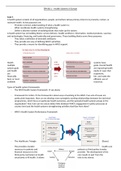
EPH3011 – Health Systems in Europe
Case 1
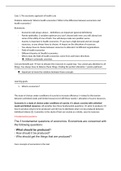
A health system consists of all organizations, people, and actions whose primary intent is to promote, restore, or
maintain health. Its key purposes are:
- Promote common understanding of what a health system is;
- What constitutes health systems strengthening;
- Define a discrete number of building blocks that make up the system.
A health system has six building blocks: service delivery, health workforce, information, medical products, vaccines
and technologies, financing, and leadership and governance. These building blocks serve three purposes:
- They allow a definition of desirable attributes;
- They provide one way of defining WHO’s priorities;
- They provide a means for identifying gaps in WHO support.
Health systems have
multiple goals. Overall health
system goals are improving health
and health equity in ways that
are responsive,
financially fair, and make the
best, or most efficient, use of
available resources.
Types of health system frameworks:
- The WHO Health System Framework see above
- Framework for Action the framework is about ways of working in the WHO. Two sets of issues are
particularly important. How can we develop more synergistic working relationships between the technical
programmes, which focus on particular health outcomes, and the specialist health system groups in the
organization? And, how can we ensure better links between WHO’s engagement in policy processes at
country level and the health systems strengthening activities that flow from them?
- WHO’s Health System Performance Framework
- The Healthcare Triangle (Busse)
The providers transfer health care
resources to patients and patients or third parties transfer
financial resources to the provider. The development of the
third-party mechanism in health care results in part from the
uncertainty of ill health. It allows risks to be shared.
, - Rothgang et al. house (2010)
Healthcare system typologies
- In the domain of health systems research it is not uncommon to divide health systems into two broad
categories:
o National Health Services (NHS) Beveridge
Funded by means of general taxation
Strong influence of the state
Hierarchical and strict geographic subdivision
Gate-keeping system
Hospitals are state owned and individual GPs have contracts with the NHS
Weakness: risk for under-funding
o Social Security (based) health care systems (SSH) Bismarck
Funded by means of earmarked premiums, mainly from salaried employees
More loosely organised, with less state influence and more pluralistic
Strong influence of health care providers and (social) insurers
Parallel access and no strict geographic subdivision
Care is provided by non-profit hospitals and individual practitioners
Weakness: lack of a power centre, cost control is difficult
- The Private Health System type: core features are coordination by market actors, private financing sources,
and for-profit providers.
Summary:
Health care reforms refer to major health policy creation or changes. There have been three waves of heath care
reforms in the past:
1. Universal coverage and equal access (since md-19 th century);
2. Controls, rationing, and expenditure caps (from mid 1970s onwards);
3. Incentives and competition (starting in the early 1990s).
Case 2
Case 1
A health system consists of all organizations, people, and actions whose primary intent is to promote, restore, or
maintain health. Its key purposes are:
- Promote common understanding of what a health system is;
- What constitutes health systems strengthening;
- Define a discrete number of building blocks that make up the system.
A health system has six building blocks: service delivery, health workforce, information, medical products, vaccines
and technologies, financing, and leadership and governance. These building blocks serve three purposes:
- They allow a definition of desirable attributes;
- They provide one way of defining WHO’s priorities;
- They provide a means for identifying gaps in WHO support.
Health systems have
multiple goals. Overall health
system goals are improving health
and health equity in ways that
are responsive,
financially fair, and make the
best, or most efficient, use of
available resources.
Types of health system frameworks:
- The WHO Health System Framework see above
- Framework for Action the framework is about ways of working in the WHO. Two sets of issues are
particularly important. How can we develop more synergistic working relationships between the technical
programmes, which focus on particular health outcomes, and the specialist health system groups in the
organization? And, how can we ensure better links between WHO’s engagement in policy processes at
country level and the health systems strengthening activities that flow from them?
- WHO’s Health System Performance Framework
- The Healthcare Triangle (Busse)
The providers transfer health care
resources to patients and patients or third parties transfer
financial resources to the provider. The development of the
third-party mechanism in health care results in part from the
uncertainty of ill health. It allows risks to be shared.
, - Rothgang et al. house (2010)
Healthcare system typologies
- In the domain of health systems research it is not uncommon to divide health systems into two broad
categories:
o National Health Services (NHS) Beveridge
Funded by means of general taxation
Strong influence of the state
Hierarchical and strict geographic subdivision
Gate-keeping system
Hospitals are state owned and individual GPs have contracts with the NHS
Weakness: risk for under-funding
o Social Security (based) health care systems (SSH) Bismarck
Funded by means of earmarked premiums, mainly from salaried employees
More loosely organised, with less state influence and more pluralistic
Strong influence of health care providers and (social) insurers
Parallel access and no strict geographic subdivision
Care is provided by non-profit hospitals and individual practitioners
Weakness: lack of a power centre, cost control is difficult
- The Private Health System type: core features are coordination by market actors, private financing sources,
and for-profit providers.
Summary:
Health care reforms refer to major health policy creation or changes. There have been three waves of heath care
reforms in the past:
1. Universal coverage and equal access (since md-19 th century);
2. Controls, rationing, and expenditure caps (from mid 1970s onwards);
3. Incentives and competition (starting in the early 1990s).
Case 2