
From Molecule to Mind - Neurophysiology
Action Potential Propagation
Passive properties:
- Input resistance: when a current is injected into the cell by patch clamping, the
response (change in potential) of the cell does exactly follow the current injection.
This is because the cell responses according to Ohm’s law: ∆𝑉 = 𝐼 ∗ 𝑅𝑚
The membrane has a certain resistance (Rm) that is determined by the ion
channels that are open. So, if you want to know the change in potential (∆V), you
need to multiply the injected current (I) with the membrane resistance (Rm). Cells
have to deal with limitations that electrical circuits have.
- Capacitor: the cell membrane has a positive (outside) and negative (inside) side.
This is a limiting factor for the action potential propagation.
- Resistor: the ion channels in the membrane.
𝑄
𝐶=
𝑉
Capacitance = ions / voltage
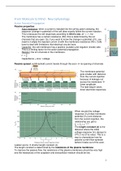
Passive spread: subthreshold current travels through the axon no opening of channels
The membrane potential
gets smaller with distance
from the current injection
because of leakage out
across the membrane
lower amplitude.
The lipid bilayer slows
down electrical responses.
When we plot the voltage
response (VX)/initial membrane
potential (V0) over distance
from the current injection, the
relationship you get is:
𝑉𝑥 = 𝑉0 ∗ 𝑒 −𝑥/𝜆
The length constant (λ) is the
distance where the initial
voltage response (V0) decays to
37% (1/e) of its value. This is a
way to characterize how far
passive current flow spreads
before it leaks out of the axon.
Leakier axons shorter length constant (λ).
The length constant is determined by the resistance of the plasma membrane.
To improve the passive flow, the resistance of the plasma membrane should be very high
and the resistances of the axoplasm and extracellular medium should be low.
1
, If the cell membrane would not
be a capacitor, then the change
in membrane potential at any
time (Vt) can be described as:
𝑡
𝑉𝑡 = 𝑉∞ (1 − 𝑒 −𝜏 )
𝑉∞ is the maximum voltage
obtained.
The time constant (𝝉) is the
amount of time it takes for a cell
to reach 63% (1-(1/e)) of the
end voltage.
The decline of the membrane
potential change can be
described as:
𝑉𝑡 = 𝑉∞ ∗ 𝑒 −𝑡/𝜏
It characterizes how rapidly
current flow changes the
membrane potential.
The time constant is determined by the resistance and capacitance of the plasma
membrane. So, by the lipid bilayer and the open ion channels.
Active spread: when a suprathreshold current is injected, action potentials are generated
along the axon opening of ion channels.
This is an effective way to circumvent the leakiness of the axon.
- The length constant (λ) is very high.
- The time constant (𝜏) is very short.
Action potential spread:
1. The Na-channels locally open at the site of depolarization and generates an action
potential there.
2. The current passively flows towards the right.
3. Upstream Na-channels inactivate and the K-channels open, so the membrane
potential there is repolarized and is refractory.
4. Downstream, neighboring Na-channels open and an action potential is generated.
5. This process is repeated downstream along the axon.
2
Action Potential Propagation
Passive properties:
- Input resistance: when a current is injected into the cell by patch clamping, the
response (change in potential) of the cell does exactly follow the current injection.
This is because the cell responses according to Ohm’s law: ∆𝑉 = 𝐼 ∗ 𝑅𝑚
The membrane has a certain resistance (Rm) that is determined by the ion
channels that are open. So, if you want to know the change in potential (∆V), you
need to multiply the injected current (I) with the membrane resistance (Rm). Cells
have to deal with limitations that electrical circuits have.
- Capacitor: the cell membrane has a positive (outside) and negative (inside) side.
This is a limiting factor for the action potential propagation.
- Resistor: the ion channels in the membrane.
𝑄
𝐶=
𝑉
Capacitance = ions / voltage
Passive spread: subthreshold current travels through the axon no opening of channels
The membrane potential
gets smaller with distance
from the current injection
because of leakage out
across the membrane
lower amplitude.
The lipid bilayer slows
down electrical responses.
When we plot the voltage
response (VX)/initial membrane
potential (V0) over distance
from the current injection, the
relationship you get is:
𝑉𝑥 = 𝑉0 ∗ 𝑒 −𝑥/𝜆
The length constant (λ) is the
distance where the initial
voltage response (V0) decays to
37% (1/e) of its value. This is a
way to characterize how far
passive current flow spreads
before it leaks out of the axon.
Leakier axons shorter length constant (λ).
The length constant is determined by the resistance of the plasma membrane.
To improve the passive flow, the resistance of the plasma membrane should be very high
and the resistances of the axoplasm and extracellular medium should be low.
1
, If the cell membrane would not
be a capacitor, then the change
in membrane potential at any
time (Vt) can be described as:
𝑡
𝑉𝑡 = 𝑉∞ (1 − 𝑒 −𝜏 )
𝑉∞ is the maximum voltage
obtained.
The time constant (𝝉) is the
amount of time it takes for a cell
to reach 63% (1-(1/e)) of the
end voltage.
The decline of the membrane
potential change can be
described as:
𝑉𝑡 = 𝑉∞ ∗ 𝑒 −𝑡/𝜏
It characterizes how rapidly
current flow changes the
membrane potential.
The time constant is determined by the resistance and capacitance of the plasma
membrane. So, by the lipid bilayer and the open ion channels.
Active spread: when a suprathreshold current is injected, action potentials are generated
along the axon opening of ion channels.
This is an effective way to circumvent the leakiness of the axon.
- The length constant (λ) is very high.
- The time constant (𝜏) is very short.
Action potential spread:
1. The Na-channels locally open at the site of depolarization and generates an action
potential there.
2. The current passively flows towards the right.
3. Upstream Na-channels inactivate and the K-channels open, so the membrane
potential there is repolarized and is refractory.
4. Downstream, neighboring Na-channels open and an action potential is generated.
5. This process is repeated downstream along the axon.
2



