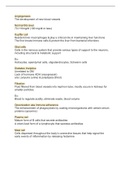
Angiogenesis
The development of new blood vessels
Normal BG level
70-110mg/dl (100 mg/dl or less)
Kupffer cell
Resident liver macrophages & play a critical role in maintaining liver functions
The first innate immune cells & protect the liver from bacterial infections
Glial cells
Cells in the nervous system that provide various types of support to the neurons, including structural & metabolic support
Ex:
Astrocytes, ependymal cells, oligodendrocytes, Schwann cells
Diabetes Insipidus
Unrelated to DM
Lack of hormone ADH (vasopressin)
s/sx: polyuria (urine) & polydipsia (thirst)
Filtration
Fluid filtered from blood vessels into nephron tube; mostly occurs in kidneys for smaller particles.
Ex:
Blood to regulate acidity, eliminate waste, blood volume
Opsonization aka immune adherence
The enhancement of phagocytosis by coating microorganisms with certain serum
proteins (opsonins)
Plasma cell
Mature form of B cells that secrete antibodies
A short-lived form of a lymphocyte that secretes antibodies
Mast cell
Cells dispersed throughout the body’s connective tissues that help signal the early events of inflammation by releasing histamine Fertilization
Process by which two gametes (one from each parent) fuse together to produce a new cell
Known as conception in humans
Normal hematocrit
The fraction of the blood volume that is occupied by RBC’s (45%)
Men = 42-52%
Women = 37-47%
Tendon
Connects muscle to bone
Ligament
Connects bone to bone
Role of diaphragm as respiratory muscle
When you breathe in or inhale, your diaphragm contracts (tightens), causing it to flatten & move downward.
This increases the space in your chest cavity, into which your lungs expand.
Primary inspiratory muscle for respiration.
Tidal volume
“Normal breathing”
Amount of air inhaled or exhaled with each normal breath
Residual volume
Amount of air in lungs after forced expiration
Functional Residual Capacity (FRC)
Amount of air remaining in lungs after normal expiration
Primary inspiratory muscles
Diaphragm 75% & external intercostals 25%
The muscle partition that separates the abdominal & thoracic cavities
Type1 & 2 alveolar cells & their functions
Type 1
Extremely thin covered with a single-layer of epithelial cells making up the wall of
alveoli
The development of new blood vessels
Normal BG level
70-110mg/dl (100 mg/dl or less)
Kupffer cell
Resident liver macrophages & play a critical role in maintaining liver functions
The first innate immune cells & protect the liver from bacterial infections
Glial cells
Cells in the nervous system that provide various types of support to the neurons, including structural & metabolic support
Ex:
Astrocytes, ependymal cells, oligodendrocytes, Schwann cells
Diabetes Insipidus
Unrelated to DM
Lack of hormone ADH (vasopressin)
s/sx: polyuria (urine) & polydipsia (thirst)
Filtration
Fluid filtered from blood vessels into nephron tube; mostly occurs in kidneys for smaller particles.
Ex:
Blood to regulate acidity, eliminate waste, blood volume
Opsonization aka immune adherence
The enhancement of phagocytosis by coating microorganisms with certain serum
proteins (opsonins)
Plasma cell
Mature form of B cells that secrete antibodies
A short-lived form of a lymphocyte that secretes antibodies
Mast cell
Cells dispersed throughout the body’s connective tissues that help signal the early events of inflammation by releasing histamine Fertilization
Process by which two gametes (one from each parent) fuse together to produce a new cell
Known as conception in humans
Normal hematocrit
The fraction of the blood volume that is occupied by RBC’s (45%)
Men = 42-52%
Women = 37-47%
Tendon
Connects muscle to bone
Ligament
Connects bone to bone
Role of diaphragm as respiratory muscle
When you breathe in or inhale, your diaphragm contracts (tightens), causing it to flatten & move downward.
This increases the space in your chest cavity, into which your lungs expand.
Primary inspiratory muscle for respiration.
Tidal volume
“Normal breathing”
Amount of air inhaled or exhaled with each normal breath
Residual volume
Amount of air in lungs after forced expiration
Functional Residual Capacity (FRC)
Amount of air remaining in lungs after normal expiration
Primary inspiratory muscles
Diaphragm 75% & external intercostals 25%
The muscle partition that separates the abdominal & thoracic cavities
Type1 & 2 alveolar cells & their functions
Type 1
Extremely thin covered with a single-layer of epithelial cells making up the wall of
alveoli