Study Guide
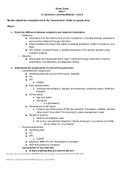
Quiz 1
37 questions covering Modules 1 and 2
Module objectives completed and in the “Assessment” folder on google drive
Week 1
● Know the difference between subjective and objective information
○ Subjective
■ Information from the client's point of view (“symptoms”), including feelings, perceptions,
and concerns obtained through interviews
■ Chief complaint: the reason the patient is seeking assistance, written in quotes on your
ROS
■ HPI: History of present illness, a detailed description of the primary problem using
symptom analysis
○ Objective
■ Observable and measurable data (“signs”) obtained through observation, physical
examination, and laboratory and diagnostic testing
● Understand the components of a full and focused exam
○ Comprehensive Assessment
■ Identifying data and source of the history; reliability
■ CC
■ HPI
● PQRST
■ Past medical history
● Including immunizations, allergies and responses, screening exams, childhood
illnesses
■ Family history
● Age and health
● Genogram
○ 2-3 generations
■ Personal and social history
● Tobacco use (Pack years), ETOH (be specific!!), Occupation, nutrition, exercise
(How much? How often? For how long?), stress management, sleep
■ Review of systems
● Head to toe subjective data
● Be sure to use pertinent negatives (“denies chest pain”) or positives (c/o SOB)
○ Never written as “no problems”
○ Focused Assessment
■ Identifying data
■ CC
■ HPI
● PQRST
■ Data from PMH, FH, SH, that pertain to complaint
■ ROS that pertains to complaint
○ Last question of any interview
■ Is there anything else you want to tell me?
This study source was downloaded by 100000806176105 from CourseHero.com on 02-01-2022 04:02:08 GMT -06:00
https://www.coursehero.com/file/38834963/study-guide-1-completedpdf/
, ● Review the approaches to discussing sensitive topics
○ Be aware of self and how personal judgments affect way of thinking
○ Confidentiality is of high importance
○ Patient’s autonomy can not be ignored
○ Be direct and firm
○ Do not apologize for questions
○ Do not preach
○ Do not push too hard
○ Must be ready to explain why you need to ask
○ Explore patient's feelings
○ Offer patient opportunity to ask questions
○ Questions should be gender neutral
■ Are your partners men, women, or both?
○ Legalities
■ Notification in cases of sexual abuse etc
● Cultural competence
○ Any culture has 4 basic characteristics
■ Learned from birth through language and socialization
■ Shared by all members of the same group
■ Can be adapted to situations
■ Dynamic and ever changing
○ Assess
■ What are the pts personal beliefs about health?
■ What religious influences may affect care?
■ What language is primary?
■ What are the roles in the family?
■ Are there special dietary practices that may influence compliance or recovery?
○ Important to
■ Recognize diversity
■ Demonstrate respect to the unfamiliar
■ Identify own cultural beliefs
■ Don’t stereotype
■ Learn the facts
■ Develop plan with culture in mind
● Review the different specific assessment tools
○ 2 question depression screening:
■ In The last month have you been bothered by :
● Little interest or pleasure in doing things?
○ Yes No
● Feeling down, depressed, or hopeless?
○ Yes No
■ If the patient’s response to both questions is no, it is negative
■ If the patient responded yes to either question it requires further assessment.
○ MMSE
■ Mini Mental State Exam
● Standardized screening tool of mental status
This study source was downloaded by 100000806176105 from CourseHero.com on 02-01-2022 04:02:08 GMT -06:00
https://www.coursehero.com/file/38834963/study-guide-1-completedpdf/
Quiz 1
37 questions covering Modules 1 and 2
Module objectives completed and in the “Assessment” folder on google drive
Week 1
● Know the difference between subjective and objective information
○ Subjective
■ Information from the client's point of view (“symptoms”), including feelings, perceptions,
and concerns obtained through interviews
■ Chief complaint: the reason the patient is seeking assistance, written in quotes on your
ROS
■ HPI: History of present illness, a detailed description of the primary problem using
symptom analysis
○ Objective
■ Observable and measurable data (“signs”) obtained through observation, physical
examination, and laboratory and diagnostic testing
● Understand the components of a full and focused exam
○ Comprehensive Assessment
■ Identifying data and source of the history; reliability
■ CC
■ HPI
● PQRST
■ Past medical history
● Including immunizations, allergies and responses, screening exams, childhood
illnesses
■ Family history
● Age and health
● Genogram
○ 2-3 generations
■ Personal and social history
● Tobacco use (Pack years), ETOH (be specific!!), Occupation, nutrition, exercise
(How much? How often? For how long?), stress management, sleep
■ Review of systems
● Head to toe subjective data
● Be sure to use pertinent negatives (“denies chest pain”) or positives (c/o SOB)
○ Never written as “no problems”
○ Focused Assessment
■ Identifying data
■ CC
■ HPI
● PQRST
■ Data from PMH, FH, SH, that pertain to complaint
■ ROS that pertains to complaint
○ Last question of any interview
■ Is there anything else you want to tell me?
This study source was downloaded by 100000806176105 from CourseHero.com on 02-01-2022 04:02:08 GMT -06:00
https://www.coursehero.com/file/38834963/study-guide-1-completedpdf/
, ● Review the approaches to discussing sensitive topics
○ Be aware of self and how personal judgments affect way of thinking
○ Confidentiality is of high importance
○ Patient’s autonomy can not be ignored
○ Be direct and firm
○ Do not apologize for questions
○ Do not preach
○ Do not push too hard
○ Must be ready to explain why you need to ask
○ Explore patient's feelings
○ Offer patient opportunity to ask questions
○ Questions should be gender neutral
■ Are your partners men, women, or both?
○ Legalities
■ Notification in cases of sexual abuse etc
● Cultural competence
○ Any culture has 4 basic characteristics
■ Learned from birth through language and socialization
■ Shared by all members of the same group
■ Can be adapted to situations
■ Dynamic and ever changing
○ Assess
■ What are the pts personal beliefs about health?
■ What religious influences may affect care?
■ What language is primary?
■ What are the roles in the family?
■ Are there special dietary practices that may influence compliance or recovery?
○ Important to
■ Recognize diversity
■ Demonstrate respect to the unfamiliar
■ Identify own cultural beliefs
■ Don’t stereotype
■ Learn the facts
■ Develop plan with culture in mind
● Review the different specific assessment tools
○ 2 question depression screening:
■ In The last month have you been bothered by :
● Little interest or pleasure in doing things?
○ Yes No
● Feeling down, depressed, or hopeless?
○ Yes No
■ If the patient’s response to both questions is no, it is negative
■ If the patient responded yes to either question it requires further assessment.
○ MMSE
■ Mini Mental State Exam
● Standardized screening tool of mental status
This study source was downloaded by 100000806176105 from CourseHero.com on 02-01-2022 04:02:08 GMT -06:00
https://www.coursehero.com/file/38834963/study-guide-1-completedpdf/