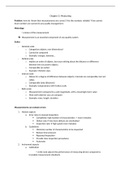
Chapter 3: Measuring
Problem: how do I know that measurements are correct? Are the numbers reliable? If we cannot
trust numbers we cannot do any quality management.
Metrology
= science of the measurement
Measurement is an essential component of any quality system
Scales
- Nominal scale
o Categorizes objects, non-dimensional
o Cannot be compared
o Example: oranges, bananas…
- Ordinal scale
o Implies an order of objects, but says nothing about the distance or difference
between two successive objects.
o Comparable (an order)
o Example: Michelin stars
- Interval scale
o Allows for a degree of difference between objects, intervals are comparable, but not
ratios.
o Comparable (only distances)
o Example: temperatures with Celsius scale
- Ratio scale
o Measurement compared to a unit magnitude, with a meaningful zero value
o Most well ordered: you can compare
o Example: mass, length, duration
Measurements can contain errors:
1. Human aspects
a. Error rates in manual inspection:
Complexity: high number of characteristics -> more mistakes
Defect rate: if low more defects are overlooked
Inspection rate: if high speed more mistakes
b. Guidelines:
Minimize number of characteristics to be inspected
Reduce time pressure
Repeated inspection
Provide clear inspection procedures
Automate
2. Instrument aspects
a. Calibration
= verify (and adjust) the performance of measuring device compared to
traceable measurement standards
Problem: how do I know that measurements are correct? Are the numbers reliable? If we cannot
trust numbers we cannot do any quality management.
Metrology
= science of the measurement
Measurement is an essential component of any quality system
Scales
- Nominal scale
o Categorizes objects, non-dimensional
o Cannot be compared
o Example: oranges, bananas…
- Ordinal scale
o Implies an order of objects, but says nothing about the distance or difference
between two successive objects.
o Comparable (an order)
o Example: Michelin stars
- Interval scale
o Allows for a degree of difference between objects, intervals are comparable, but not
ratios.
o Comparable (only distances)
o Example: temperatures with Celsius scale
- Ratio scale
o Measurement compared to a unit magnitude, with a meaningful zero value
o Most well ordered: you can compare
o Example: mass, length, duration
Measurements can contain errors:
1. Human aspects
a. Error rates in manual inspection:
Complexity: high number of characteristics -> more mistakes
Defect rate: if low more defects are overlooked
Inspection rate: if high speed more mistakes
b. Guidelines:
Minimize number of characteristics to be inspected
Reduce time pressure
Repeated inspection
Provide clear inspection procedures
Automate
2. Instrument aspects
a. Calibration
= verify (and adjust) the performance of measuring device compared to
traceable measurement standards