DNA
Eukaryotic cells’ DNA is packages in linear, protein bound strands called chromosomes. There are
2m of DNA in each cells tightly coiled around proteins called histones. DNA + Histones = Chromatins,
which make up chromosomes. Humans have 46 chromosomes in body cells, 23 in gametes, and 0 in
red blood cells.
Prokaryotic cells have no histones or chromosomes. Instead their DNA loose in the cytoplasm, in
the nucleoid region, as well as single-gene loop called plasmids.
DNA is a Genetic code. It has a sequence of base pairs, which make up thousands of sections called
genes. Each gene codes for a specific polypeptide, where are triplet/codon of base pairs code for a
single amino acid, and can be turned on or off.
It is universal, meaning the same sequences of bases will code for the same amino acids in all
organisms. The triplet code is degenerate and there are more possible triplets (64) than amino acids
(21).
The structure of chromosomes (from small to large):
- DNA double helix
- Nucleosome fibre (nucleosomes are 8 histones each which DNA is wrapped around)
- Solenoid fibre (nucleosomes closely folded into 30nm diameter fibre)
- Folded/coiled solenoid fibre (300nm length loops, fibre squashed together)
- Supercoiling (folded solenoid fibre coils up)
- Chromosomes
Nucleotides are the monomers of polynucleotides such as
DNA and RNA. They have a phosphate (phosphoric acid)
group which gives the acidic property. A Pentose sugar
group is ribose in RNA, and deoxyribose in DNA. There is also
a nitrogen containing base.
, DNA
There are 5 different types of bases. Adenine (A), Thymine (T), Cytosine (C), Guanine (G), Uracil (U).
A and G are purine bases, which are bigger as they have 2 cyclic structures. T, C, and U are
pyrimidine bases. DNA has bases AT and GC. RNA has bases AU and GC.
C and G form 3 hydrogen bonds (can be broken at 60°C, and the base denatured) when they are
complementary base pairs. AT and AU form 2 bonds.
Sometimes mutations occur, meaning that one of the bases in a pair is different, so the base pair is
not complementary. This means no bonds are formed between the two, and don’t code for (or code
for the wrong) amino acid.
There are four major differences between DNA and RNA. The pentose sugar in RNA is Ribose, and in
DNA is Deoxyribose. The bases in DNA are AT and CG, and AU and CG in RNA. DNA is double
stranded whereas RNA is single stranded, although it is sometimes folded and twisted. All DNA has a
whole genome of information, but RNA only has one Gene. There are also differences between two
types of RNA: messenger and transfer.
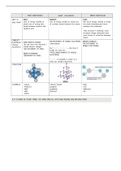
DNA Double stranded Deoxyribose Thiamine Whole genome
mRNA Single strand Ribose Uracil 1 gene
mRNA no Codon no linear
tRNA Hydrogen bonds Anticodon Amino acid bind Clover leaf
ATP
The structure of ATP has 3 parts: a tri-phosphate group, a
ribose sugar, and a nitrogenous base (adenine).
ADP + Pi -> ATP. ATP is Adenosine tri-phosphate, ADP is
Adenosine di-phosphate, and Pi is an inorganic phosphate ion
(there is no carbon in it).
Eukaryotic cells’ DNA is packages in linear, protein bound strands called chromosomes. There are
2m of DNA in each cells tightly coiled around proteins called histones. DNA + Histones = Chromatins,
which make up chromosomes. Humans have 46 chromosomes in body cells, 23 in gametes, and 0 in
red blood cells.
Prokaryotic cells have no histones or chromosomes. Instead their DNA loose in the cytoplasm, in
the nucleoid region, as well as single-gene loop called plasmids.
DNA is a Genetic code. It has a sequence of base pairs, which make up thousands of sections called
genes. Each gene codes for a specific polypeptide, where are triplet/codon of base pairs code for a
single amino acid, and can be turned on or off.
It is universal, meaning the same sequences of bases will code for the same amino acids in all
organisms. The triplet code is degenerate and there are more possible triplets (64) than amino acids
(21).
The structure of chromosomes (from small to large):
- DNA double helix
- Nucleosome fibre (nucleosomes are 8 histones each which DNA is wrapped around)
- Solenoid fibre (nucleosomes closely folded into 30nm diameter fibre)
- Folded/coiled solenoid fibre (300nm length loops, fibre squashed together)
- Supercoiling (folded solenoid fibre coils up)
- Chromosomes
Nucleotides are the monomers of polynucleotides such as
DNA and RNA. They have a phosphate (phosphoric acid)
group which gives the acidic property. A Pentose sugar
group is ribose in RNA, and deoxyribose in DNA. There is also
a nitrogen containing base.
, DNA
There are 5 different types of bases. Adenine (A), Thymine (T), Cytosine (C), Guanine (G), Uracil (U).
A and G are purine bases, which are bigger as they have 2 cyclic structures. T, C, and U are
pyrimidine bases. DNA has bases AT and GC. RNA has bases AU and GC.
C and G form 3 hydrogen bonds (can be broken at 60°C, and the base denatured) when they are
complementary base pairs. AT and AU form 2 bonds.
Sometimes mutations occur, meaning that one of the bases in a pair is different, so the base pair is
not complementary. This means no bonds are formed between the two, and don’t code for (or code
for the wrong) amino acid.
There are four major differences between DNA and RNA. The pentose sugar in RNA is Ribose, and in
DNA is Deoxyribose. The bases in DNA are AT and CG, and AU and CG in RNA. DNA is double
stranded whereas RNA is single stranded, although it is sometimes folded and twisted. All DNA has a
whole genome of information, but RNA only has one Gene. There are also differences between two
types of RNA: messenger and transfer.
DNA Double stranded Deoxyribose Thiamine Whole genome
mRNA Single strand Ribose Uracil 1 gene
mRNA no Codon no linear
tRNA Hydrogen bonds Anticodon Amino acid bind Clover leaf
ATP
The structure of ATP has 3 parts: a tri-phosphate group, a
ribose sugar, and a nitrogenous base (adenine).
ADP + Pi -> ATP. ATP is Adenosine tri-phosphate, ADP is
Adenosine di-phosphate, and Pi is an inorganic phosphate ion
(there is no carbon in it).