Week 2
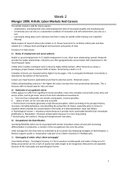
Menger 1999: Ar s c Labor Markets And Careers
The ar s c market is odd for many reasons:
- employment, unemployment and underemployment have all increased steadily and simultaneously
- Uncertainty acts not only as a substan ve condi on of innova on and self-achievement, but also as a
lure
- Learning by doing plays such a decisive role that in many art worlds ini al training is an imperfect
ltering
Meta analysis of research about job markets in CI. Shows how hard it is to de ne ar s c jobs and data
related to it. Cri ques both sociological and economic-only points of view.
Focuses on 4 main issues:
1) Status of employment and career pa erns
Stable vs casual employment->in CI stable employment is rare. Short term rela onships prevail. Networks
provide the stable rela onships. Industries are o en geographically-concentrated. Self employment is the
most frequent status
Unlike other markets con ngent work is done by highly skilled workers. Why? Artwork as unique a
prototype; project based; constant shi s of tastes. Uncertainty is built in in CI.
Unstable contracts are characterised by higher hourly wages-> this is unequally distributed. Uncertainty is
allocated to the bo om of the hierarchy.
Careers are impermanent, explora onal and ed to external events. Temporal careers.
Fallacy of backloading contracts-> the higher the salary increase the more produc vity decreases. This is
because with increased salaries risks are lower.
2) Ra onales of occupa onal choice
Ar sts appear to su er from signi cant income penal es, have more variable income both across me and
across ar sts, and to get lower returns from their educa onal investments.
a. Earn less than comparable non ar s c counterparts: income penal es
b. Labour of love: art for arts sake and not pro t
c. Environment uncertainty generates a high threat percep on, which according to the prospect theory,
increases risk taking behaviour, miscalcula ng the propor on of chance, especially when it comes to
situa on where rewards are concentrated in the hands of a few prac oners- base rate fallacy
d. Psychological income- > monetary reward because it provide more sustainable bene ts than immediate
gra ca on e. Reputa on > nancial compensa on because it is more long-las ng
f. Second job g. No rou ne h. Young and inexperienced: low salary
3) Occupa onal risk diversi ca on
Increasing exibility which can be associated with ar s c innova on means at least with increasing
di eren a on in produc on, a transfer of the occupa onal risks onto the ar sts
Ar st manage the risks they have to undertake to be successful by employing strategies of diversi ca on: 1.
Receive support: grants 2. Coopera ve: take part of an ar s c movement 3. Mul ple jobs.
4) Oversupply of ar sts- why is there oversupply?
Uncertainty a racts. Sociological income, it is fun to produce crea ve goods and make a living out of it.
Being unsuccessful can be a mark of quality but takes longer to be recognised. Newcomers are exploited
because of the oversupply and psychological income.
1
fi fftititifiti titititi tifl tt titi ttff tititi titi
fiti fiti
ti tifititititttift ti fiti tift tititititititi ti ti ti tititi tifititi titi ti tifi fiti ti
Menger 1999: Ar s c Labor Markets And Careers
The ar s c market is odd for many reasons:
- employment, unemployment and underemployment have all increased steadily and simultaneously
- Uncertainty acts not only as a substan ve condi on of innova on and self-achievement, but also as a
lure
- Learning by doing plays such a decisive role that in many art worlds ini al training is an imperfect
ltering
Meta analysis of research about job markets in CI. Shows how hard it is to de ne ar s c jobs and data
related to it. Cri ques both sociological and economic-only points of view.
Focuses on 4 main issues:
1) Status of employment and career pa erns
Stable vs casual employment->in CI stable employment is rare. Short term rela onships prevail. Networks
provide the stable rela onships. Industries are o en geographically-concentrated. Self employment is the
most frequent status
Unlike other markets con ngent work is done by highly skilled workers. Why? Artwork as unique a
prototype; project based; constant shi s of tastes. Uncertainty is built in in CI.
Unstable contracts are characterised by higher hourly wages-> this is unequally distributed. Uncertainty is
allocated to the bo om of the hierarchy.
Careers are impermanent, explora onal and ed to external events. Temporal careers.
Fallacy of backloading contracts-> the higher the salary increase the more produc vity decreases. This is
because with increased salaries risks are lower.
2) Ra onales of occupa onal choice
Ar sts appear to su er from signi cant income penal es, have more variable income both across me and
across ar sts, and to get lower returns from their educa onal investments.
a. Earn less than comparable non ar s c counterparts: income penal es
b. Labour of love: art for arts sake and not pro t
c. Environment uncertainty generates a high threat percep on, which according to the prospect theory,
increases risk taking behaviour, miscalcula ng the propor on of chance, especially when it comes to
situa on where rewards are concentrated in the hands of a few prac oners- base rate fallacy
d. Psychological income- > monetary reward because it provide more sustainable bene ts than immediate
gra ca on e. Reputa on > nancial compensa on because it is more long-las ng
f. Second job g. No rou ne h. Young and inexperienced: low salary
3) Occupa onal risk diversi ca on
Increasing exibility which can be associated with ar s c innova on means at least with increasing
di eren a on in produc on, a transfer of the occupa onal risks onto the ar sts
Ar st manage the risks they have to undertake to be successful by employing strategies of diversi ca on: 1.
Receive support: grants 2. Coopera ve: take part of an ar s c movement 3. Mul ple jobs.
4) Oversupply of ar sts- why is there oversupply?
Uncertainty a racts. Sociological income, it is fun to produce crea ve goods and make a living out of it.
Being unsuccessful can be a mark of quality but takes longer to be recognised. Newcomers are exploited
because of the oversupply and psychological income.
1
fi fftititifiti titititi tifl tt titi ttff tititi titi
fiti fiti
ti tifititititttift ti fiti tift tititititititi ti ti ti tititi tifititi titi ti tifi fiti ti