Corporate Governance Learning Unit 2
Info about the board as a whole.
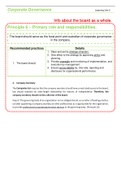
Principle 6 – Primary role and responsibilities.
The board should serve as the focal point and custodian of corporate governance
in the company.
Recommended practices Details
1. Steer and set its strategic direction.
2. Give effect to the strategy by approving policy and
planning.
3. Provide oversight and monitoring of implementation, and
1. The board should:
execution by management.
4. Ensure accountability by, inter alia, reporting and
disclosure for organisational performance.
,Principle 7 – Board composition.
The board should comprise the appropriate balance of knowledge, skills,
experience, diversity and independence for it to discharge its governance role
and responsibilities objectively and effectively.
Composition
Recommended practices Details
1. Academic qualifications
2. Technical expertise
3. Industry knowledge 1. To conduct
business of the
1. The composition of the board 4. Experience board and make it
to have suitable diversity i.t.o efficient.
5. Nationality 2. Promote better
decision making.
6. Race & Gender
7. Age
Executive director:
• Director who is involved in the management
of the company and/or is a full-time salaried
employee of the company and/or its subsidiary.
At least 2 on board.
Non-executive director:
• Director who is not involved in the management of a
2. Majority non-executive
company. Role is to provide independent
directors, the majority of whom
judgement and advice/opinion on issues
should be independent.
facing the company. Required to attend board
and committee meetings to which appointed on.
Independent non-executive director
• To be classified as independent, a non-
executive director would have to be regarded
as such by a reasonable and informed 3rd party.
Nomination, election and appointment
Recommended practices Details
A candidate’s
1. Board should evaluate… a. background independently investigated.
b. qualifications independently verified.
2. Where an independent, non-executive director has served 9 years, he has to undergo an
independence assessment every year for the following years of service.
,Chairperson of the board:
Recommended practices Details
1. Independent, non-executive director.
× Lead in the absence of the chair.
× Serve as sounding board for the chair.
× Act as intermediary between chair and other
directors.
2. Lead independent director – × Deal with shareholders’ concerns where normal
independent, non-executive channels failed to solve concerns.
director has to fulfil these
duties: × Strengthen independence on the board if chair is not
independent, non-executive.
× Chair discussions and decision making by the board
where chair has conflict of interest.
× Lead performance appraisal of chair.
3. CEO – cannot be classified as 1. CEO should not be chairperson.
non-executive officer. 2. Former CEO – 3 years cool-off period.
, 1. A director may not be classified as independent
▪ A significant provider of financial capital or ongoing funding to
the company, or is an officer, employee or representative of
1. Non-executive
such a provider.
directors may be
▪ Participates in a share-based incentive scheme of the
classified as
company.
independent if it
▪ Owns shares in the company, the value of which is material to
concludes that there
his personal wealth.
is no interest,
▪ Has been employed by the company as an executive
position, association
manager during the preceding 3 financial years or is related to
or relationship, when
such a manager.
classified from the
▪ Has been a designated external auditor for the company or
perspective of an
has been a key member of the external audit team during the
informed and
preceding 3 years.
reasonable 3rd party,
▪ Is a significant or ongoing professional advisor to the company
is likely to influence
(other than a director).
or cause bias in
▪ Is a member of the board or the executive management of a
decision making in
significant customer of, or supplier to the company.
the best interest of
▪ Is a member of the board or executive manager of another
the company.
company which is a related party to the company.
▪ Is entitled to remuneration depending on the performance of
the company.
Info about the board as a whole.
Principle 6 – Primary role and responsibilities.
The board should serve as the focal point and custodian of corporate governance
in the company.
Recommended practices Details
1. Steer and set its strategic direction.
2. Give effect to the strategy by approving policy and
planning.
3. Provide oversight and monitoring of implementation, and
1. The board should:
execution by management.
4. Ensure accountability by, inter alia, reporting and
disclosure for organisational performance.
,Principle 7 – Board composition.
The board should comprise the appropriate balance of knowledge, skills,
experience, diversity and independence for it to discharge its governance role
and responsibilities objectively and effectively.
Composition
Recommended practices Details
1. Academic qualifications
2. Technical expertise
3. Industry knowledge 1. To conduct
business of the
1. The composition of the board 4. Experience board and make it
to have suitable diversity i.t.o efficient.
5. Nationality 2. Promote better
decision making.
6. Race & Gender
7. Age
Executive director:
• Director who is involved in the management
of the company and/or is a full-time salaried
employee of the company and/or its subsidiary.
At least 2 on board.
Non-executive director:
• Director who is not involved in the management of a
2. Majority non-executive
company. Role is to provide independent
directors, the majority of whom
judgement and advice/opinion on issues
should be independent.
facing the company. Required to attend board
and committee meetings to which appointed on.
Independent non-executive director
• To be classified as independent, a non-
executive director would have to be regarded
as such by a reasonable and informed 3rd party.
Nomination, election and appointment
Recommended practices Details
A candidate’s
1. Board should evaluate… a. background independently investigated.
b. qualifications independently verified.
2. Where an independent, non-executive director has served 9 years, he has to undergo an
independence assessment every year for the following years of service.
,Chairperson of the board:
Recommended practices Details
1. Independent, non-executive director.
× Lead in the absence of the chair.
× Serve as sounding board for the chair.
× Act as intermediary between chair and other
directors.
2. Lead independent director – × Deal with shareholders’ concerns where normal
independent, non-executive channels failed to solve concerns.
director has to fulfil these
duties: × Strengthen independence on the board if chair is not
independent, non-executive.
× Chair discussions and decision making by the board
where chair has conflict of interest.
× Lead performance appraisal of chair.
3. CEO – cannot be classified as 1. CEO should not be chairperson.
non-executive officer. 2. Former CEO – 3 years cool-off period.
, 1. A director may not be classified as independent
▪ A significant provider of financial capital or ongoing funding to
the company, or is an officer, employee or representative of
1. Non-executive
such a provider.
directors may be
▪ Participates in a share-based incentive scheme of the
classified as
company.
independent if it
▪ Owns shares in the company, the value of which is material to
concludes that there
his personal wealth.
is no interest,
▪ Has been employed by the company as an executive
position, association
manager during the preceding 3 financial years or is related to
or relationship, when
such a manager.
classified from the
▪ Has been a designated external auditor for the company or
perspective of an
has been a key member of the external audit team during the
informed and
preceding 3 years.
reasonable 3rd party,
▪ Is a significant or ongoing professional advisor to the company
is likely to influence
(other than a director).
or cause bias in
▪ Is a member of the board or the executive management of a
decision making in
significant customer of, or supplier to the company.
the best interest of
▪ Is a member of the board or executive manager of another
the company.
company which is a related party to the company.
▪ Is entitled to remuneration depending on the performance of
the company.