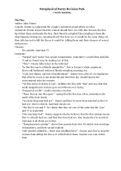
How does Priestley present the character of Sheila in ‘An Inspector Calls’?
In the morality and political play ‘An Inspector Calls’, Priestley uses the character of Sheila
as a device to create a specific meaning to his WW2 audience that the era they live in is
corrupted by the patriarchal society, known as capitalism, and changes need to be taken by
the younger generation, the socialist viewpoints that Priestley wants to get across to the
audience in order to live a happy life. Sheila’s character has a drastic change in the play,
from being the daughter of a capitalist man, to an independent woman with socialist
viewpoints, representing potential for the society through equality and social reform.
Priestley presents Sheila in the beginning of the play as a possession of Gerald that then
transforms into an independent woman from unintentional lessons she learns from Gerald.
Firstly when Sheila says ‘(Excited)-Oh-Gerald-you've got it-is it the one you wanted me to
have?’ shows how Sheila and her mindset is controlled by Gerald implying that she is a
victim of the patriarchal society where capitalism makes her worth nothing. Capitalism is
taught to Sheila as ‘when you’re married you'll realise that men with important work spend…
in their business’, showing how Gerald doesn’t care about her as much as he cares for his
wealth. The fact that she poses a question ‘you wanted me to have?’ connotes to the reader
that she is a woman who bows to a man’s preferences or to capitalism. The verb ‘wanted’
creates a sense of ownership and entitlement as if it is okay for her to be treated as a
possession. This has been intentionally crafted by Priestley to show how women were
treated in Edwardian times. This emphasizes how Sheila is manipulated by society's
expectations and even when she is willing to go against these expectations shows signs of
her reaching an equilibrium in her identity as she is sort of trying to break through this barrier
‘[half playful, half serious]’. This is mirrored at the middle of the play where she hands over
the ring to Gerald ‘I think you better take that with you (hands him the ring). Priestley wants
to show how she grew into a woman who is independent from men by going against the
symbolism of the ring, bringing change to her own identity and showing first signs of socialist
viewpoints. The lesson she learnt from Gerald is that men are to be kept accountable for
their behaviour and empowerment of women by refusing to be a material use. Priestley
showed us through Sheila the reality of 1912, where in the year that the play was played to
the audience in 1945 gives out a message that 2 genders have to be at equity for a better
life.
Priestley presents Sheila as a girl who acts jealous and judgmental because of her high
status she has in society that later makes her regret her choices and feel in guilt. This
jealousy is shown when she said ‘I went to the manager…if they didn’t get rid of that girl…
with them’ because Eva was more beautiful than her and that made Sheila feel embarrassed
in front of the other people. The use of the complex sentence shows in detail how pathetic
Sheila is through the hateful language she uses. The use of the verb ‘rid’ and preposition
‘that’ shows the disgust she has for Eva and how hateful she is towards the working class.
This shows a parallelism between her and her parents' behaviour. However the difference is
that she accepts her mistakes. This is mirrored when Sheila feels regretful ‘I know I am to
blame and I’m desperately sorry’. The use of the aposiopesis shows an overwhelming
emotion of her, implying genuine guilt and sympathy for Eva making the audience believe
she has changed. Priestley by the phrase ‘I know I am to blame’ shows that Sheila has taken
responsibility for her actions. The repetition of the pronoun ‘I’ symbolises how capitalism
forces people into behaving evilish. In 1912 when Priestley wrote the play the higher class
In the morality and political play ‘An Inspector Calls’, Priestley uses the character of Sheila
as a device to create a specific meaning to his WW2 audience that the era they live in is
corrupted by the patriarchal society, known as capitalism, and changes need to be taken by
the younger generation, the socialist viewpoints that Priestley wants to get across to the
audience in order to live a happy life. Sheila’s character has a drastic change in the play,
from being the daughter of a capitalist man, to an independent woman with socialist
viewpoints, representing potential for the society through equality and social reform.
Priestley presents Sheila in the beginning of the play as a possession of Gerald that then
transforms into an independent woman from unintentional lessons she learns from Gerald.
Firstly when Sheila says ‘(Excited)-Oh-Gerald-you've got it-is it the one you wanted me to
have?’ shows how Sheila and her mindset is controlled by Gerald implying that she is a
victim of the patriarchal society where capitalism makes her worth nothing. Capitalism is
taught to Sheila as ‘when you’re married you'll realise that men with important work spend…
in their business’, showing how Gerald doesn’t care about her as much as he cares for his
wealth. The fact that she poses a question ‘you wanted me to have?’ connotes to the reader
that she is a woman who bows to a man’s preferences or to capitalism. The verb ‘wanted’
creates a sense of ownership and entitlement as if it is okay for her to be treated as a
possession. This has been intentionally crafted by Priestley to show how women were
treated in Edwardian times. This emphasizes how Sheila is manipulated by society's
expectations and even when she is willing to go against these expectations shows signs of
her reaching an equilibrium in her identity as she is sort of trying to break through this barrier
‘[half playful, half serious]’. This is mirrored at the middle of the play where she hands over
the ring to Gerald ‘I think you better take that with you (hands him the ring). Priestley wants
to show how she grew into a woman who is independent from men by going against the
symbolism of the ring, bringing change to her own identity and showing first signs of socialist
viewpoints. The lesson she learnt from Gerald is that men are to be kept accountable for
their behaviour and empowerment of women by refusing to be a material use. Priestley
showed us through Sheila the reality of 1912, where in the year that the play was played to
the audience in 1945 gives out a message that 2 genders have to be at equity for a better
life.
Priestley presents Sheila as a girl who acts jealous and judgmental because of her high
status she has in society that later makes her regret her choices and feel in guilt. This
jealousy is shown when she said ‘I went to the manager…if they didn’t get rid of that girl…
with them’ because Eva was more beautiful than her and that made Sheila feel embarrassed
in front of the other people. The use of the complex sentence shows in detail how pathetic
Sheila is through the hateful language she uses. The use of the verb ‘rid’ and preposition
‘that’ shows the disgust she has for Eva and how hateful she is towards the working class.
This shows a parallelism between her and her parents' behaviour. However the difference is
that she accepts her mistakes. This is mirrored when Sheila feels regretful ‘I know I am to
blame and I’m desperately sorry’. The use of the aposiopesis shows an overwhelming
emotion of her, implying genuine guilt and sympathy for Eva making the audience believe
she has changed. Priestley by the phrase ‘I know I am to blame’ shows that Sheila has taken
responsibility for her actions. The repetition of the pronoun ‘I’ symbolises how capitalism
forces people into behaving evilish. In 1912 when Priestley wrote the play the higher class