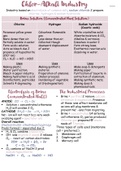
Chlor-Alkali Industry
Industry based on electrolysis of common salt, sodium chloride 2 prepare
chlorine, hydrogen & sodium hydroxide.
Brine Solution (Concentrated Nacl Solution)
Chlorine Hydrogen Sodium hydroxide
(Caustic soda)
Poisonous yellow green Colourless flammable White crystalline solid.
gas. gas. Absorbs moisture & CO2
More dense than air. Less dense than air. Alkaline & corrosive.
Partially soluble in water Collected though Dissolves in water 2
Form acidic solution. downward displacement form strong base.
Acts as bleach due 2 of water. Exothermic reaction w/e
presence of hypochlorite dissolving in water.
(ClO—ion)
Cl2 + H2O → HCl + HOCl
Uses Uses Uses
Making plastic. Making synthetic Make soap & detergents
Water purification. material. Making paper.
Bleach in paper industry. Preparation of ammonia Purification of bauxite in
Making hydrochloric acid (Haber process) extraction of aluminium.
Disinfectants, pesticides Hardening of vegetable Making synthetic mats.
Solvents 4 degreasing. oil (Hydrogenation) Making dyes &
pharmaceuticals.
Electrolysis of Brine The Industrial Processes
(concentrated NaCl) ▪ Brine = purified 2 remove calcium,
strontium & magnesium. Presence
ANODE: 2Cl- → Cl2 + 2e-
of these ions affect membrane cell
▪ Solution = concentrated otherwise
as ions will plug membrane &
H2O will oxidise 2 O2
prevent Na+ -ions from migrating.
CATHODE: 2H2O + 2e- → H2 + 2OH-
▪ Brine = concentrated b4 entering
Na+- ion will not react bcz very weak
cell otherwise O2 gas be produced.
oxidizing agent – spectator ion.
▪ Chlorine gas prepared @ anode
Overall reaction:
2NaCl(s)+2H2O(l)→2NaOH(aq)+Cl2(g)+H2(g) made of Titanium.
Prods formed = separated due 2: Three types of cells used (membrane
▪ H2 & Cl2 combine explosively. cell = preferred.)
▪ OH- ions migrate 2 anode 2 release 1. Membrane cell
O2 - react w/ carbon electrodes 2. Diaphragm cell
2OH- → H2O + ½O2 + 2e- 3. Mercury cell
& C + O2 → CO2
▪ Cl2 combine w/ NaOH 2 prod
sodium hypochlorite
NaOH + Cl2 → NaOCl + HCl
Industry based on electrolysis of common salt, sodium chloride 2 prepare
chlorine, hydrogen & sodium hydroxide.
Brine Solution (Concentrated Nacl Solution)
Chlorine Hydrogen Sodium hydroxide
(Caustic soda)
Poisonous yellow green Colourless flammable White crystalline solid.
gas. gas. Absorbs moisture & CO2
More dense than air. Less dense than air. Alkaline & corrosive.
Partially soluble in water Collected though Dissolves in water 2
Form acidic solution. downward displacement form strong base.
Acts as bleach due 2 of water. Exothermic reaction w/e
presence of hypochlorite dissolving in water.
(ClO—ion)
Cl2 + H2O → HCl + HOCl
Uses Uses Uses
Making plastic. Making synthetic Make soap & detergents
Water purification. material. Making paper.
Bleach in paper industry. Preparation of ammonia Purification of bauxite in
Making hydrochloric acid (Haber process) extraction of aluminium.
Disinfectants, pesticides Hardening of vegetable Making synthetic mats.
Solvents 4 degreasing. oil (Hydrogenation) Making dyes &
pharmaceuticals.
Electrolysis of Brine The Industrial Processes
(concentrated NaCl) ▪ Brine = purified 2 remove calcium,
strontium & magnesium. Presence
ANODE: 2Cl- → Cl2 + 2e-
of these ions affect membrane cell
▪ Solution = concentrated otherwise
as ions will plug membrane &
H2O will oxidise 2 O2
prevent Na+ -ions from migrating.
CATHODE: 2H2O + 2e- → H2 + 2OH-
▪ Brine = concentrated b4 entering
Na+- ion will not react bcz very weak
cell otherwise O2 gas be produced.
oxidizing agent – spectator ion.
▪ Chlorine gas prepared @ anode
Overall reaction:
2NaCl(s)+2H2O(l)→2NaOH(aq)+Cl2(g)+H2(g) made of Titanium.
Prods formed = separated due 2: Three types of cells used (membrane
▪ H2 & Cl2 combine explosively. cell = preferred.)
▪ OH- ions migrate 2 anode 2 release 1. Membrane cell
O2 - react w/ carbon electrodes 2. Diaphragm cell
2OH- → H2O + ½O2 + 2e- 3. Mercury cell
& C + O2 → CO2
▪ Cl2 combine w/ NaOH 2 prod
sodium hypochlorite
NaOH + Cl2 → NaOCl + HCl