

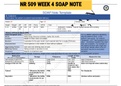
Exam (elaborations) NR 509 WEEK 4 SOAP NOTE
Exam (elaborations) NR 509 WEEK 4 SOAP NOTE nitials: BF Age: 58 Gender: Male Height Weight BP HR RR Temp SPO2 Pain Allergies 5’ 11 197lbs 146/ 90 104 19 36.7C 98% Medication: Codeine : reports causes nausea and vomiting Food: none Environment: none History of Present Illness (HPI) Chief Complaint (CC) Chest pain CC is a BRIEF statement identifying why the patient is here - in the patient’s own words - for instance "headache", NOT "bad headache for 3 days”. Sometimes a patient has more than one complaint. For example: If the patient presents with cough and sore throat, identify which is the CC and which may be an associated symptom Onset While doing strenuous acitivties, earlier this month. Location Middle of chest. Does not radiate. Duration 3 episodes for the past month. Each episode lasts for a couple of minutes. Characteristics Chest tightness in the middle of chest without radiation. Aggravating Factors Yard work and climbing stairs at work. Relieving Factors Taking a break or sat down to rest. Treatment Reports no treatment uses Current Medications: Include dosage, frequency, length of time used and reason for use; also include OTC or homeopathic products. Medication (Rx, OTC, or Homeopathic) Dosage Frequency Length of Time Used Reason for Use Atorvastatin (Lipitor) PO 10mg Daily at HS One year High Cholesterol Metoprolol (Lopressor) PO 100mg Daily One year High blood pressure Omega-3 Fish Oil PO 1200mg Daily Unable to respond ( last dose taken this AM) Does not respond when asked why. Tylenol “Whatever the bottle recommends for an adult” PRN PRN For Headache Ibuprofen “Whatever the bottle recommends for an adult” PRN PRN Varioius aches and pains S: Subjective Information the patient or patient representative told you This study source was downloaded by from CourseH on :49:35 GMT -05:00 This study resource was shared via CourseH NR 509 WEEK 4 SOAP NOTE Past Medical History (PMHx) – Includes but not limited to immunization status (note date of last tetanus for all adults), past major illnesses, hospitalizations, and surgeries. Depending on the CC, more info may be needed. 3 episodes of 5/10 chest pain with physical activity, that resolved with rest after 2 min. Reports no shortness of breath. History of hypertension and hyperlipidemia. Reports Stress test 4 mo ago: normal. EKG: NSR with no ST changes. Last annual exam by PCP: 3 months ago. Reports never hospitalized. Reports no surgical history. Threw out back few years ago and took codeine, but reports allergy to codeine. Unable to recall last Pneumovax vaccine. Tdap: last on 10/2014. Influenza : received this flu season. Regular caffeine intake 1-2 cups daily. Social History (Soc Hx) - Includes but not limited to occupation and major hobbies, family status, tobacco and alcohol use, and any other pertinent data. Include health promotion such as use seat belts all the time or working smoke detectors in the house. Patient is married, lives with wife and daughter. Son lives in town. Patient is a Civil Engineer (denies working out in the field) Goes over work proposals. Denies chemical exposure. Hobbies include: fishing, sports, going to see son’s body building competitions. Family dynamic is great. Low stress. Denies cigarette smoking.Denies tobacco use. Denies current illicit drug use. Reports history of cocaine use 30 yrs ago. Reports drinking 1-2 cups coffee daily. Reports 2-3 alcohol drinks per weekend (typically drinks 2- 3beers in one sitting). Denies hx or current suicidal ideation. Denies Depression. Denies regular exercise. Family History (Fam Hx) - Includes but not limited to illnesses with possible genetic predisposition, contagious or chronic illnesses. Reason for death of any deceased first degree relatives should be included. Include parents, grandparents, siblings, and children. Include grandchildren if pertinent. Mother 80 y.o.(living)- Type 2 Diabetes and hypertension Father-Deceased at 75y.o. from colon cancer. Hx obesity, hypertention, and hyperlipidemia Spouse (Maria) 51 y.o. : Denies illnesses Son (Sam) 26y.o. : reports is healthy, is a competitive body builder Daughter(Allie) 19y.o. : Asthma Sister: 52 g- Type 2 Diabetes and hypertention Brother: deceased at 24y.o. from a car accident. Paternal grandpa- died at 85y.o. unknown Paternal grandma- died at 78 y.o from pneumonia. Maternal grandpa- died at 54 from a heart attack. Maternal grandma- died at 65 from breast cancer. Review of Systems (ROS): Address all body systems that may help rule in or out a differential diagnosis Check the box next to each positive symptom and provide additional details. Constitutional Skin HEENT This study source was downloaded by from CourseH on :49:35 GMT -05:00 This study resource was shared via CourseH Fatigue Denies Weakness Denies Fever/Chills Denies Weight Gain reports 15- 20 lbs last 2 years. Weight Loss Denies Trouble Sleeping Denies Night Sweats Denies Other: Click or tap here to enter text. Itching Denies Rashes Denies Nail Changes Denies Skin Color Changes Denies Other: Click or tap here to enter text. Diplopia Denies Eye Pain Denies Eye redness Denies Vision changes Denies Photophobia Denies Eye discharge Denies Earache Denies Tinnitus Denies Epistaxis Denies Vertigo Denies Hearing Changes Denies Hoarseness Denies Oral Ulcers Denies Sore Throat Denies Congestion Denies Rhinorrhea Denies Other: Click or tap here to enter text. Respiratory Neuro Cardiovascular Cough Denies Hemoptysis Denies Dyspnea Denies Wheezing Denies Pain on Inspiration Denies Sputum Production Other: Fine crackles in bilateral posterior, lower lobes Syncope or Lightheadedness Denies Headache Denies Numbness Denies Tingling Denies Sensation Changes Speech Deficits Denies Other: Click or tap here to enter text. Chest pain 3 episodes the last month, each episode last 1-2 minutes and resides with rest. SOB Denies Exercise Intolerance Reports unable to exercise because afraid of chest pain occurring again Orthopnea Denies Edema Denies Murmurs Denies Palpitations Denies Faintness Denies OC Changes Denies Claudications Denies PND Denies Other: Click or tap here to enter text. MSK GI GU PSYCH Pain chest pain Stiffness Denies Crepitus not assessed Swelling Denies Limited ROM Redness Denies Misalignment not assessed Other: Click or tap here to enter Nausea/Vomiting Denies Dysphasia Denies Diarrhea Denies Appetite Change Denies Heartburn Denies Blood in Stool Denies Abdominal Pain Denies Excessive Flatus Denies Food Intolerance Denies Urgency Denies Dysuria Denies Burning Denies Hematuria Denies Polyuria Denies Nocturia Denies Incontinence Denies Other: Click or tap here to enter text. Stress low stress Anxiety Little anxious about the chest pain Depression Denies Suicidal/Homicidal Ideation Denies Memory Deficits Denies Mood Changes Denies Trouble Concentrating This study source was downloaded by from CourseH on :49:35 GMT -05:00 This study resource was shared via CourseH text. ☐Rectal Bleeding Denies Other: Click or tap here to enter text. Denies Other: Click or tap here to enter text. GYN Rash N/A Discharge N/A Itching N/A Irregular Menses N/A Dysmenorrhea N/A Foul Odor N/A Amenorrhea N/A LMP: N/A Contraception N/A Other:Click or tap here to enter text. O: Objective Information gathered during the physical examination by inspection, palpation, auscultation, and palpation. If unable to assess a body system, write “Unable to assess”. Document pertinent positive and negative assessment findings. This study source was downloaded by from CourseH on :49:35 GMT -05:00 This study resource was shared via CourseH Body System Positive Findings Negative Findings General N/A Pleasant 51 year old male sitting on exam table with normal stature. Alert and oriented x 4. Clear speech. No signs of current distress. No signs of pain or shortness of breath at this time. Able to follow commands and answer questions appropriately. Skin Inspected skin looks pale Inspected skin no scars, intact, no rash. Warm and dry. No tenting. Fingernails and toe nails inspected no abnormal color. HEENT N/A Inspected face: No visible abnormal findings. Respiratory Adventitious breath sound: Fine crackles heard in the posterior left and right lower lobes. Chest rise symmetrical. No visible abnormal findings. Neuro Click or tap here to enter text. Alert and oriented x 4, moves all extremities. Cardiovascular Auscultated extra heart sounds: Gallop, Auscultated carotid arteries: Right bruit present. Palpated Right carotid pulse: 3+ ,thrill. Palpated Right and Left popliteal, Tibial, dorsalis pedis pulses: no thrill at 1+ diminished pulses. Palpated PMI: displaced laterally 3 cm brisk and tapping. Auscultation:Left side absent for Bruit. S1, S2,S3 audible. Auscultated abdominal aorta and lower extremity arteries: no bruit.Capillary refill 3 seconds in all 4 extremities. Palpated Brachial, radial, femoral: no thrill and expected 2+. Kidneys are not palpable. EKG: Regular sinus rhythm, no ST changes. Musculoskeletal Click or tap here to enter text. Click or tap here to enter text. Gastrointestinal Liver Palpable at 1cm below right costal margin. Palpated: PMI displaced laterally. Inspected Abdome: symmetric, rounded, no abnormal visual findings. Bowel sounds: normoactive in all quadrants. Percussed Liver span at 7cm in the mid-clavicular line. Palpated Abdomen: no tenderness noted, No palpable mass. Spleen:not palpable Percussed abdomen and spleen: tympanic. Genitourinary Click or tap here to enter text. Click or tap here to enter text. Psychiatric Click or tap here to enter text. Click or tap here to enter text. This study source was downloaded by from CourseH on :49:35 GMT -05:00 This study resource was shared via CourseH Problem List 1 Chest pain 6 Hypertension 11 N/A 2 Abnormal heart gallop 7 Hypercholesterolemia 12 N/A 3 Adventitious breath sounds (fine crackles) 8 weight gain 13 N/A 4 carotid bruit 9 Diminished pulses in the bilateral lower extremities 14 N/A 5 tachycardia 10 physical activity intolerance 15 N/A Diagnosis ICD-10 Code Pertinent Findings Stable Angina I20.9 Chest pain with physical activity, 5/10 pain at worst, c/o chest tightness in the middle of chest. Last 1-2min and resolves on it’s own with rest. Congestive heart failure I50.2 Fine crackles present in posterior left and right lower lobes, weight gain, hypercholesterolemia, gallop heart sounds, physical activity intolerance. Coronary artery stenosis I65.29 Right carotid artery bruit present, has hypercholesterolemia, weight gain, decreased pulses in lower extremities. Diagnostics: List tests you will order this visit Test Rationale/Citation A: Assessment Medical Diagnoses. Provide 3 differential diagnoses which may provide an etiology for the CC. The first diagnosis (presumptive diagnosis) is the diagnosis with the highest priority. Provide the ICD-10 code and pertinent findings to support each diagnosis. P: Plan Address all 5 parts of the comprehensive treatment plan. If you do not wish to order an intervention for any part of the treatment plan, write “None at this time” but do not leave any heading blank. No intervention is self-evident. Provide a rationale and evidence-based in-text citation for each intervention. This study source was downloaded by from CourseH on :49:35 GMT -05:00 This study resource was shared via CourseH EKG Resting ECG testing is recommended with all symptoms of chest pain (typical or atypical in nature) (Jameson et al., 2019). Exercise treadmill is the preferred initial test to be employed if the baseline is normal, the patient can exercise, and the pretest likelihood of coronary disease is intermediate (Jameson et al., 2019). Blood work CMP,Cardiac enzymes CMP to check for magnesium and potassium levels, triglycerides, cholesterol, liver enzymes, cardiac enzymes blood tests to assess risk (e.g., lipid determinations, C-reactive protein) or cardiac function (BNP) (Jameson et al., 2019). CTchest Non invasive testing for fine crackles in chest (Jameson et al. 2019). Click or tap here to enter text. Click or tap here to enter text. Medications: List medications/treatments including OTC drugs you will order and “continue previous meds” if pertinent. Drug Dosage Length of Treatment Rationale/Citation Sublingual nitroglycerin 0.3 mg PRN for acute chest pain not relieved by rest Relieves pain within 3 min. Can be repeated 3 times but instruct to seek medical attention right away if pain not resolved after the 3rd dose (Brunton, Hilal-Dandan, Knollmann, 2019).. Aspirin 81mg Daily for prevention Appropriate medicine prescription: ASA 75–162 mg daily, moderate statin dosage, BP control and diabetic control, β-blocker therapy, and sublingual NTG (David &Esherick 2019). Lisinopril 5mg daily CCB should be added (Brunton, Hilal-Dandan, Knollmann, 2019). Continue previous meds Click or tap here to enter text. Click or tap here to enter text. Click or tap here to enter text. Continue previous meds Click or tap here to enter text. Click or tap here to enter text. Click or tap here to enter text. Referral/Consults: Cardiologist Rationale/Citation To provide further workup and testing Brunton, Hilal-Dandan, Knollmann, 2019). Education: Identify and teach hypertension treatment, advocate a diet low in saturated and trans fats, low sodium, and signs and symptoms of heart failure, and treatment plan. Rationale/Citation Identifying risk factors and treating them to correct excacerbating factors contributing to angina (Jameson et al., 2019). Follow Up: Indicate when patient should return to clinic and provide detailed instructions indicating if the patient should return sooner than scheduled or seek attention elsewhere. This study source was downloaded by from CourseH on :49:35 GMT -05:00 This study resource was shared via CourseH -Return to clinic in 5-7 days for evaluation and follow up. - Seek immediate medical attention if chest pain returns, gets worse, and is associated with radiation, diaphoresis, shortness of breath, nausea/vomiting, or dizziness/faintness. Rationale/Citation Brunton, Hilal-Dandan, Knollmann, 2019). References Include at least one evidence-based peer-reviewed journal article which relates to this case. Use the correct APA 6th edition formatting. David & Esherick. (2019). Current practice guidelines in primary care 2019: Cardiovascular disorders. New York, NY: McGraw-Hill. Retrieved from: Brunton LL, Hilal-Dandan R, Knollmann BC. (2019). Goodman & Gilman's: The pharmacological basis of therapeutics: Treatment of ischemic heart disease. New York, NY: McGraw-Hill. Retrieved from: Jameson J, Fauci AS, Kasper DL, Hauser SL, Longo DL, Loscalzo J. Harrison's manual of medicine: Chronic stable angina. New York, NY: McGraw-Hill. Retrieved from: bookid=2738§ionid=. This study source was downloaded by from CourseH on :49:35 GMT -05:00 This study resource was shared via
Document information
- Uploaded on
- January 20, 2022
- Number of pages
- 8
- Written in
- 2021/2022
- Type
- Exam (elaborations)
- Contains
- Questions & answers


