Summary Book: Yantis, S., & Abrams, R. A. (2017). Sensation and Perception (2nd
Edition). New York: Worth Publishers. ISBN: 9781319154097
Lecture 1 - Chapter 1 + Appendix (Foundations,
Psychophysics)
“I’m having a stroke!”
Hemorrhage is causing perceptual impairments, which means you’ll experience jumbled and
incoherent perceptions of the world (perception can change when the brain is damaged).
In order to survive and reproduce, organisms must respond to the physical conditions of their
environment. We are willing to say that organisms are sensing the environmental conditions,
and we’re reluctant to say that they are perceiving those conditions. However, we’ll say
perceiving when talking about organisms with nervous systems.
- Sensation: converting physical features of the environment into electrochemical signals
within specialized nerve cells, and sending those signals to the brain for processing.
Over the course of evolution, animals have acquired a variety of physiological functions
called senses, each of which has its own array of specialized cells, tissues and organs
for converting particular environmental features into electrochemical signals that are then
sent to the brain (sense of sight converts light into signals).
- Perception: the initial sensory signals are used to form a mental representation. It also
includes conscious awareness of the objects and events in a scene.
World, Brain, and Mind
To some extent, organisms’ knowledge about the world is innate (an infant ‘knows’ how to nurse
at her mother’s breast), but other ways of knowing (awareness of current conditions/learning
from experience) depend on information made available by the senses.
Complex tasks require knowledge obtained via multiple senses at the same time.
The Perceptual Process
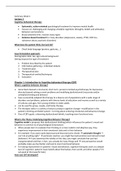
The starting point for perception is the world itself (distal stimulus), which gives rise to physical
phenomena that can be sensed (proximal stimulus).
The cells of the nervous system that produce and transmit information-carrying electrochemical
signals are called neurons, the electrochemical signals that they carry are the neural signals.
The specialized neurons that convert proximal stimuli into neural signals are called sensory
receptors (photoreceptors for example, convert light into neural signals). The neural signals are
sent to the brain (For more information, see figure 1.1)
,Often, the speed and accuracy of perception are enhanced by the perceiver's knowledge about
the current scene and by the expectations about what kind of things are likely to be present or to
occur. This knowledge, expectations and your goals (which determine what is important
attending to and what’s not) is called top-down information. Bottom-up information is
contained in the neural signals from receptors.
Three Main Types of Questions
(in exploring perception):
1. How does the proximal stimulus carry information about the thing that is perceived?
2. How is the proximal stimulus transformed into neural signals (a process called
transduction)? How do these neural signals form a neural code and how is information
in this code processed in the brain?
3. What is the relationship between perceptual experience and the distal stimulus? (This
question is interesting in psychophysics, which is concerned with relating psychological
experience to physical stimuli.
How Many Senses Are There?
The original idea is that there are 5 senses: vision, audition, touch, smell and taste. However,
there are more, see Table 1.1:
, As you can see, the senses can
be broken down into physical-
and perceptual dimensions.
Differences among the senses
show the differences in the ways
that each sense evolved as our
ancestors adapted to the physical
stimuli in their environments.
Evolution and
Perception
The biological function and
structure of every organism is the
result of natural selection
(advantageous traits are passed
on, disadvantageous traits are
not).
The modern theory of evolution
contains these core ideas:
- Phenotypes: observable
characteristics/traits.
- Genotype: a genetic code that uses the machinery of the cell to produce the phenotype.
- The genetic code is passed on via DNA via reproduction. DNA can undergo random
mutations, resulting in new genetic sequences -> new phenotypes. A mutation usually
yields a new trait that is advantageous (adaptive) in the environment of the organism.
- Organisms with adaptive new traits compete more effectively for resources -> more likely
to survive and reproduce (natural selection). Advantageous traits increase the
individual’s fitness (“survival of the fittest”).
Just like traits, senses have evolved by natural selection as well.
Exploring Perception by Studying Behavior: Psychophysics
19th century: researchers began to develop objective behavioral methods for assessing
subjective perceptual experiences, methods based on simple, well-defined responses (saying
“yes”/”no” when you see a dim spot of light against a black background). Methods like these
came to define the field of psychophysics. The responses of the participants can help form
theories of how perceptual systems encode physical attributes (intensity, wavelength, duration,
etc.) of the perceptual stimuli.
Psychophysics investigates the relationship between stimuli and experience in two ways:
1. Investigating the thresholds of perceptual experience (the points at which there are
perceptual transitions).
- How intense must a physical stimulus be for the stimulus to be detectable?
, - How different must two stimuli be for the difference to be detectable?
2. Investigating the scaling of perceptual experience (how perceptual experience changes
with changes in the physical characteristics of a perceptible stimulus).
Absolute Threshold
The absolute threshold is the minimum intensity of a physical stimulus that can be detected. It
marks the transition from not detecting - detecting. You can test the absolute threshold by
presenting stimuli that vary in physical intensity and having participants respond to each
stimulus if they detected it or not.
3 methods developed by Fechner for testing the absolute threshold:
1. Method of adjustment
2. Method of constant stimuli
3. Staircase method
Method of adjustment
Method of adjustment: the participant observes a stimulus and manipulates a control that
directly adjusts the intensity of the stimulus. It is repeated a few times, so the average of the
threshold estimates can be taken as the final estimate of the absolute threshold.
Method of constant stimuli
Method of constant stimuli: participant is repeatedly presented with a fixed set of stimuli in
random order, covering a range of intensities, and the participant must indicate whether or not
each stimulus was detected. Stimuli with each intensity are presented many times, and the
frequency of “yes” responses is plotted for each intensity.
The result is an S-shaped curve. As the
intensity of the tone increases, so does
the frequency of “yes” responses. This
type of curve is called a psychometric
function. This is a curve that relates a
measure of perceptual experience to the
intensity of a physical stimulus. The
absolute threshold is often defined as the
intensity at which people respond “yes”
50% of the time.
Staircase method
Staircase method: participant is
presented with a stimulus and indicates
whether it was detected, and based on
that response, the next stimulus is either
one step up or one step down in intensity.
It is often used to detect hearing loss in
older adults. For each of several tones at different frequencies (low pitch - high pitch), an
Edition). New York: Worth Publishers. ISBN: 9781319154097
Lecture 1 - Chapter 1 + Appendix (Foundations,
Psychophysics)
“I’m having a stroke!”
Hemorrhage is causing perceptual impairments, which means you’ll experience jumbled and
incoherent perceptions of the world (perception can change when the brain is damaged).
In order to survive and reproduce, organisms must respond to the physical conditions of their
environment. We are willing to say that organisms are sensing the environmental conditions,
and we’re reluctant to say that they are perceiving those conditions. However, we’ll say
perceiving when talking about organisms with nervous systems.
- Sensation: converting physical features of the environment into electrochemical signals
within specialized nerve cells, and sending those signals to the brain for processing.
Over the course of evolution, animals have acquired a variety of physiological functions
called senses, each of which has its own array of specialized cells, tissues and organs
for converting particular environmental features into electrochemical signals that are then
sent to the brain (sense of sight converts light into signals).
- Perception: the initial sensory signals are used to form a mental representation. It also
includes conscious awareness of the objects and events in a scene.
World, Brain, and Mind
To some extent, organisms’ knowledge about the world is innate (an infant ‘knows’ how to nurse
at her mother’s breast), but other ways of knowing (awareness of current conditions/learning
from experience) depend on information made available by the senses.
Complex tasks require knowledge obtained via multiple senses at the same time.
The Perceptual Process
The starting point for perception is the world itself (distal stimulus), which gives rise to physical
phenomena that can be sensed (proximal stimulus).
The cells of the nervous system that produce and transmit information-carrying electrochemical
signals are called neurons, the electrochemical signals that they carry are the neural signals.
The specialized neurons that convert proximal stimuli into neural signals are called sensory
receptors (photoreceptors for example, convert light into neural signals). The neural signals are
sent to the brain (For more information, see figure 1.1)
,Often, the speed and accuracy of perception are enhanced by the perceiver's knowledge about
the current scene and by the expectations about what kind of things are likely to be present or to
occur. This knowledge, expectations and your goals (which determine what is important
attending to and what’s not) is called top-down information. Bottom-up information is
contained in the neural signals from receptors.
Three Main Types of Questions
(in exploring perception):
1. How does the proximal stimulus carry information about the thing that is perceived?
2. How is the proximal stimulus transformed into neural signals (a process called
transduction)? How do these neural signals form a neural code and how is information
in this code processed in the brain?
3. What is the relationship between perceptual experience and the distal stimulus? (This
question is interesting in psychophysics, which is concerned with relating psychological
experience to physical stimuli.
How Many Senses Are There?
The original idea is that there are 5 senses: vision, audition, touch, smell and taste. However,
there are more, see Table 1.1:
, As you can see, the senses can
be broken down into physical-
and perceptual dimensions.
Differences among the senses
show the differences in the ways
that each sense evolved as our
ancestors adapted to the physical
stimuli in their environments.
Evolution and
Perception
The biological function and
structure of every organism is the
result of natural selection
(advantageous traits are passed
on, disadvantageous traits are
not).
The modern theory of evolution
contains these core ideas:
- Phenotypes: observable
characteristics/traits.
- Genotype: a genetic code that uses the machinery of the cell to produce the phenotype.
- The genetic code is passed on via DNA via reproduction. DNA can undergo random
mutations, resulting in new genetic sequences -> new phenotypes. A mutation usually
yields a new trait that is advantageous (adaptive) in the environment of the organism.
- Organisms with adaptive new traits compete more effectively for resources -> more likely
to survive and reproduce (natural selection). Advantageous traits increase the
individual’s fitness (“survival of the fittest”).
Just like traits, senses have evolved by natural selection as well.
Exploring Perception by Studying Behavior: Psychophysics
19th century: researchers began to develop objective behavioral methods for assessing
subjective perceptual experiences, methods based on simple, well-defined responses (saying
“yes”/”no” when you see a dim spot of light against a black background). Methods like these
came to define the field of psychophysics. The responses of the participants can help form
theories of how perceptual systems encode physical attributes (intensity, wavelength, duration,
etc.) of the perceptual stimuli.
Psychophysics investigates the relationship between stimuli and experience in two ways:
1. Investigating the thresholds of perceptual experience (the points at which there are
perceptual transitions).
- How intense must a physical stimulus be for the stimulus to be detectable?
, - How different must two stimuli be for the difference to be detectable?
2. Investigating the scaling of perceptual experience (how perceptual experience changes
with changes in the physical characteristics of a perceptible stimulus).
Absolute Threshold
The absolute threshold is the minimum intensity of a physical stimulus that can be detected. It
marks the transition from not detecting - detecting. You can test the absolute threshold by
presenting stimuli that vary in physical intensity and having participants respond to each
stimulus if they detected it or not.
3 methods developed by Fechner for testing the absolute threshold:
1. Method of adjustment
2. Method of constant stimuli
3. Staircase method
Method of adjustment
Method of adjustment: the participant observes a stimulus and manipulates a control that
directly adjusts the intensity of the stimulus. It is repeated a few times, so the average of the
threshold estimates can be taken as the final estimate of the absolute threshold.
Method of constant stimuli
Method of constant stimuli: participant is repeatedly presented with a fixed set of stimuli in
random order, covering a range of intensities, and the participant must indicate whether or not
each stimulus was detected. Stimuli with each intensity are presented many times, and the
frequency of “yes” responses is plotted for each intensity.
The result is an S-shaped curve. As the
intensity of the tone increases, so does
the frequency of “yes” responses. This
type of curve is called a psychometric
function. This is a curve that relates a
measure of perceptual experience to the
intensity of a physical stimulus. The
absolute threshold is often defined as the
intensity at which people respond “yes”
50% of the time.
Staircase method
Staircase method: participant is
presented with a stimulus and indicates
whether it was detected, and based on
that response, the next stimulus is either
one step up or one step down in intensity.
It is often used to detect hearing loss in
older adults. For each of several tones at different frequencies (low pitch - high pitch), an