Literature in English: Older
Period
Middle Ages (5th C – ca. 1485):
Begins: collapse of Roman Empire and Anglo-Saxon Conquest
Ends: Early Modern Period (introduction of moveable type)
The Middle Ages literature consist in three parts:
1. Old English or Anglo-Saxon literature
2. Anglo- Norman literature
3. Middle English literature
“Medieval” – “Middle Ages”:
In between Classical period and Renaissance
Previously seen as “Dark Ages”
BUT the accuracy of this label is now seriously contested
1. Old English Literature (5th - 11th C)
1.1 Socio-Historical context: Anglo-Saxon Period
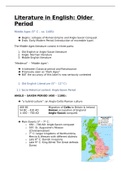
ANGLO – SAXON PERIOD (450 – 1100):
“a hybrid culture”: an Anglo-Celtic-Roman culture
400 BC Migration of Celts to Britain & Ireland
54 BC – 410 AD Roman occupation of England
± 450 – 700 AD Anglo-Saxon conquest
Main Events 5th – 7th C:
o 450 – 700 AD: Anglo-Saxon conquest
o 597: St. Augustine’s Mission
(Christianisation)
o 7th C: larger kingdoms of Northumbria,
Mercia & Wessex with different dialects
o Late 8th C: Danish invasions
o Late 9th C: King Alfred The Great defeats
Danes
,ANGLO – SAXON SOCIETY:
Warrior culture
o Battle & war
o Honour & heroism, duty to one’s lord, vengeance
o Fate
Warrior culture increasingly in conflict with Christian influences
o Great literature: “conflicting and contradictory impulses in a
culture”
1.2 Overview of Anglo-Saxon or Old English Literature
OLD ENGLISH LITERATURE: OVERVIEW:
Mainly oral
Influenced by oral Germanic tradition and written by Christian
tradition
Prose: in Latin and Old English
Poetry: heroic, elegiac, religious & battle poems
PROSE AND POETRY DEFINITIONS:
PROSE POETRY
- Without sustained rhythmic
regularity
- Rhythm
- Not merely a listing of ideas
- Compactness
- Characterized by style
- Concreteness
- Achieve variety oof
expression through varied
diction
PROSE IN ANGLO-SAXON PERIOD:
Latin: Bede (+/- 673-735)
English: King Alfred the Great of Wessex orders
o Translations
o Compilation of The Anglo-Saxon Chronicle
à Encouraged development of a national culture in the
English
à Established English as a literary language
OLD ENGLISH POETRY:
Orally transmitted
30.000 lines survived
Thematic interest: warrior culture
, Tone: sombre, sense of doom
Formal features: alliterative verse and kenning
Period
Middle Ages (5th C – ca. 1485):
Begins: collapse of Roman Empire and Anglo-Saxon Conquest
Ends: Early Modern Period (introduction of moveable type)
The Middle Ages literature consist in three parts:
1. Old English or Anglo-Saxon literature
2. Anglo- Norman literature
3. Middle English literature
“Medieval” – “Middle Ages”:
In between Classical period and Renaissance
Previously seen as “Dark Ages”
BUT the accuracy of this label is now seriously contested
1. Old English Literature (5th - 11th C)
1.1 Socio-Historical context: Anglo-Saxon Period
ANGLO – SAXON PERIOD (450 – 1100):
“a hybrid culture”: an Anglo-Celtic-Roman culture
400 BC Migration of Celts to Britain & Ireland
54 BC – 410 AD Roman occupation of England
± 450 – 700 AD Anglo-Saxon conquest
Main Events 5th – 7th C:
o 450 – 700 AD: Anglo-Saxon conquest
o 597: St. Augustine’s Mission
(Christianisation)
o 7th C: larger kingdoms of Northumbria,
Mercia & Wessex with different dialects
o Late 8th C: Danish invasions
o Late 9th C: King Alfred The Great defeats
Danes
,ANGLO – SAXON SOCIETY:
Warrior culture
o Battle & war
o Honour & heroism, duty to one’s lord, vengeance
o Fate
Warrior culture increasingly in conflict with Christian influences
o Great literature: “conflicting and contradictory impulses in a
culture”
1.2 Overview of Anglo-Saxon or Old English Literature
OLD ENGLISH LITERATURE: OVERVIEW:
Mainly oral
Influenced by oral Germanic tradition and written by Christian
tradition
Prose: in Latin and Old English
Poetry: heroic, elegiac, religious & battle poems
PROSE AND POETRY DEFINITIONS:
PROSE POETRY
- Without sustained rhythmic
regularity
- Rhythm
- Not merely a listing of ideas
- Compactness
- Characterized by style
- Concreteness
- Achieve variety oof
expression through varied
diction
PROSE IN ANGLO-SAXON PERIOD:
Latin: Bede (+/- 673-735)
English: King Alfred the Great of Wessex orders
o Translations
o Compilation of The Anglo-Saxon Chronicle
à Encouraged development of a national culture in the
English
à Established English as a literary language
OLD ENGLISH POETRY:
Orally transmitted
30.000 lines survived
Thematic interest: warrior culture
, Tone: sombre, sense of doom
Formal features: alliterative verse and kenning