ACCOUNTING 333 CHAPTER 3 PRACTICE QUIZ (ACCOUNTING333CHAPTER3PRACTICEQUIZ)
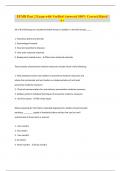
ACCOUNTING 333 CHAPTER 3 PRACTICE QUIZ. 1. Financial ratios that measure a firm's ability to pay its bills over the short run without undue stress are often referred to as: o asset management ratios. o liquidity measures. o leverage ratios. o profitability ratios. o utilization ratios. 2. Which one of these measures a firm's long-run ability to meet its obligations? o Cash ratio o Total asset turnover o Quick ratio o Return on equity o Equity multiplier 3. Which ratio measures the number of times a firm lends money to customers, collects that money, and relends it within a year? o Total asset turnover o Days' sales in receivables o Total debt ratio o Receivables turnover o Quick ratio 4. Which ratio calculates the amount of sales generated by each $1 invested in assets? o Total asset turnover o Return on equity o Return on assets o Equity multiplier o DuPont identity 5. The return on equity can be calculated as: o Profit margin × 1/Capital intensity ratio × Equity multiplier. o Return on assets × b. o Profit margin × Total asset turnover × Debt-equity ratio o Profit margin × 1/Equity multiplier × (1 + Debt-equity ratio). o Return on assets × Debt-equity ratio 6. If a firm decreases its operating costs, all else constant, then: o the profit margin increases while the cash coverage ratio decreases. o the return on assets increases while the return on equity decreases. Chapter 3 Practice Quiz MBA 6130 2 o both the return on assets and the return on equity increase. o both the profit margin and the equity multiplier increase. o the total asset turnover rate decreases while the profit margin increases. 7. Assume a firm is operating at full capacity. Which one of these accounts is least apt to vary directly with sales? o Inventory o Cash o Long-term debt o Accounts payable o Fixed assets 8. Financial planning, when properly executed: o helps ensure that adequate financing is in place to support the desired level of growth. o ensures that the primary goals of senior management are fully achieved. o reduces the necessity of daily management oversight of the business operations. o ignores the normal restraints encountered by a firm. o eliminates the need to plan more than one year in advance. 9. Juno's has sales of $389,000, a tax rate of 34 percent, a dividend payout ratio of 45 percent, and a profit margin of 6 percent. What is the addition to retained earnings? o $10,503.00 o $12,837.00 o $141,207.00 o $8,472.42 o $15,913.64 Addition to retained earnings = $389,000 × .06 × (1 - .45) = $12,837.00 10. A firm has total assets of $162,000, long-term debt of $46,000, stockholders' equity of $95,000, and current liabilities of $21,000. The dividend payout ratio is 60 percent and the profit margin is 8 percent. Assume all assets and current liabilities change spontaneously with sales and the firm is currently operating at full capacity. What is the external financing need if the current sales of $150,000 are projected to increase by 10 percent? o $4,220 o $54,820 o $16,200 o $38,700 o $8,820 Projected total assets = 1.1($162,000) = $178,200 Projected current liabilities = 1.1($21,000) = $23,100 Projected long-term debt = $46,000 (no change) Projected shareholders equity = $95,000 + (1.1 × $150,000 × .08 × (1 - .60) = $100,280 EFN = $178,200 - 23,100 - 46,000 - $100,280 = $8,820
Written for
Document information
- Uploaded on
- January 17, 2022
- Number of pages
- 6
- Written in
- 2021/2022
- Type
- Exam (elaborations)
- Contains
- Questions & answers
Subjects
-
chapter 3 practice quiz mba 6130 1 accounting 333 chapter 3 practice quiz 1 financial ratios that measure a firms ability to pay its bills over the short run without undue stress are often ref