

Haemostasis and Thrombosis - Fibrinolysis
Recap:
- Haemostatic mechanism is three distinct phases
- Primary haemostasis: interactions between blood vessels, platelets and von Willebrand factor
- Secondary haemostasis: pathways of coagulation to generate fibrin strands
- Fibrinolysis: biochemical system that degrades the fibrin clot
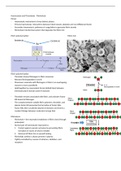
Fibrin polymerisation: Fibrin clot:
Fibrin polymerisation:
- Thrombin cleaves fibrinogen to fibrin monomer
- Releases fibrinopeptides A and B
- Monomers associate with fibrinogen or fibrin in an overlapping
manner to form protofibrils
- Held together by noncovalent forces (dotted lines) between
intermolecular D-domain and D-E domains
- Thrombin remains associated with fibrin, and activates Factor
XIII bound to fibrinogen
- The complex between soluble fibrin polymers, thrombin, and
plasma factor XIII promotes the formation of factor XIIIa.
- Factor XIIIa then covalently attaches D domains and inserts a
covalent linkage between molecules (orange line)
Fibrinolysis
- Fibrinolysis = the enzymatic breakdown of fibrin clots (through
proteolysis)
- Normal part of haemostasis important to:
1. Protect against vascular occlusion by preventing fibrin
formation in excess of what is needed
2. Removal of fibrin clot on wound healing
- Fibrinolytic activity is always present in plasma
- Tightly controlled by a series of cofactors, inhibitors, and
receptors
, - Plasmin is responsible for fibrinolysis
- It must degrade fibrin at multiple sites to release fibrin
degradation products
- The initial fragments are high molecular-weight
complexes
- Followed by further degradation to produce the
terminal D-dimer–E complex, which contains the dimer
antigen
Plasmin
- Activated from plasminogen by either of two primary
serine proteases, tissue plasminogen activator (tPA)
and urokinase (uPA)
- Plasminogen is synthesized by the liver
- tPA is released by endothelial cells
- uPA is produced by monocytes, macrophages, and urinary epithelium
Inhibitors of fibrinolysis
- Circulating plasmin and plasminogen activators are neutralised by serine
protease inhibitors (serpins)
- Serpins form covalent complexes with their unique target enzymes that are
subsequently cleared from the circulation
- The three serpins most important in fibrinolysis are:
1. plasminogen activator inhibitor-1 (PAI-1)
2. plasminogen activator inhibitor-2 (PAI-2)
3. α2-antiplasmin (A2AP)
Recap:
- Haemostatic mechanism is three distinct phases
- Primary haemostasis: interactions between blood vessels, platelets and von Willebrand factor
- Secondary haemostasis: pathways of coagulation to generate fibrin strands
- Fibrinolysis: biochemical system that degrades the fibrin clot
Fibrin polymerisation: Fibrin clot:
Fibrin polymerisation:
- Thrombin cleaves fibrinogen to fibrin monomer
- Releases fibrinopeptides A and B
- Monomers associate with fibrinogen or fibrin in an overlapping
manner to form protofibrils
- Held together by noncovalent forces (dotted lines) between
intermolecular D-domain and D-E domains
- Thrombin remains associated with fibrin, and activates Factor
XIII bound to fibrinogen
- The complex between soluble fibrin polymers, thrombin, and
plasma factor XIII promotes the formation of factor XIIIa.
- Factor XIIIa then covalently attaches D domains and inserts a
covalent linkage between molecules (orange line)
Fibrinolysis
- Fibrinolysis = the enzymatic breakdown of fibrin clots (through
proteolysis)
- Normal part of haemostasis important to:
1. Protect against vascular occlusion by preventing fibrin
formation in excess of what is needed
2. Removal of fibrin clot on wound healing
- Fibrinolytic activity is always present in plasma
- Tightly controlled by a series of cofactors, inhibitors, and
receptors
, - Plasmin is responsible for fibrinolysis
- It must degrade fibrin at multiple sites to release fibrin
degradation products
- The initial fragments are high molecular-weight
complexes
- Followed by further degradation to produce the
terminal D-dimer–E complex, which contains the dimer
antigen
Plasmin
- Activated from plasminogen by either of two primary
serine proteases, tissue plasminogen activator (tPA)
and urokinase (uPA)
- Plasminogen is synthesized by the liver
- tPA is released by endothelial cells
- uPA is produced by monocytes, macrophages, and urinary epithelium
Inhibitors of fibrinolysis
- Circulating plasmin and plasminogen activators are neutralised by serine
protease inhibitors (serpins)
- Serpins form covalent complexes with their unique target enzymes that are
subsequently cleared from the circulation
- The three serpins most important in fibrinolysis are:
1. plasminogen activator inhibitor-1 (PAI-1)
2. plasminogen activator inhibitor-2 (PAI-2)
3. α2-antiplasmin (A2AP)


