DECLARATION:
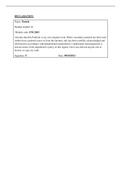
Name: Pamela
Student number: 6
Module code: ENG2603
I declare that this Portfolio is my own original work. Where secondary material has been used
(either from a printed source or from the internet), this has been carefully acknowledged and
referenced in accordance with departmental requirements. I understand what plagiarism is
and am aware of the department‟s policy in this regard. I have not allowed anyone else to
borrow or copy my work
Signature: P. Date: 09/10/2021
, SECTION A- Reflection
I vaguely remember telling my parents that I wanted to major in English and their response
was anything but supportive. The numerous amounts of interrogations from friends, family
and past teachers just became a part of my life as a literary student. This form of criticism
helped me in creating the type of quick wit and verbal manipulation skills that are needed in
order to function and survive in the outside world.
I had high expectations at the beginning of this module, as I truly enjoyed and had learnt so
much in the predecessor modules of this course. However, upon commencement of this year,
I came to realize just how much work and patience this module entailed.
Throughout the foundation of the, Colonial and Post-colonial African literature (ENG2603)
module, I experienced many new and alternative ways of constructing essays as well as
interpreting the different writing styles of many individuals. Each written peace took time,
effort and an assortment of ideas to analysis the work of these masterful writers, authors and
poets.
I was pleasingly surprised to find that one of the prescribed poems covered in this module
was “The zulu girl” by Roy Campbell and one of the prescribed novels was “Nervous
Conditions” by Tsitsi Dangarembga, as I had previously covered them in my final years at
high school. I found that the questions in tutorial letter 501 and in the assignments was
relatively easy as I had prior knowledge to these written works.
However, I did face a couple of challenges in this module, starting from learning how to write
an essay without narrating the story. The idea of composing a written piece by using language
and mechanics appropriate for specific genres was a struggle for me. I needed to ensure that
the appropriate language met the requirements for each paper written while still getting the
message across in the correct manner. My e-tutors regularly updated on our discussion
forums and provided us with guidelines on how to tackle these challenges, which I found
helpful as it helped me score marks in my assignments. I was taught to develop a mind map
of everything I want to write and then pick out the points that made the most sense. This
method of reducing my trait of reciting the novels, dramas and poetry became minimal.
My expectations in this module were definitely met, but I firmly believe that with even more
assistance from my e-tutors and lecturers I could have learnt a lot more. However, I truly
appreciated that the lecturers, e-tutors, and staff made attempts of interacting with us, as not a
lot of other students had that privilege, and if I could go back to the time when my parents
advised me not to take on English, I‟d still do it, because I get the pleasure of not only
enjoying this module again, but I get the chance to tell them that they were wrong.
Name: Pamela
Student number: 6
Module code: ENG2603
I declare that this Portfolio is my own original work. Where secondary material has been used
(either from a printed source or from the internet), this has been carefully acknowledged and
referenced in accordance with departmental requirements. I understand what plagiarism is
and am aware of the department‟s policy in this regard. I have not allowed anyone else to
borrow or copy my work
Signature: P. Date: 09/10/2021
, SECTION A- Reflection
I vaguely remember telling my parents that I wanted to major in English and their response
was anything but supportive. The numerous amounts of interrogations from friends, family
and past teachers just became a part of my life as a literary student. This form of criticism
helped me in creating the type of quick wit and verbal manipulation skills that are needed in
order to function and survive in the outside world.
I had high expectations at the beginning of this module, as I truly enjoyed and had learnt so
much in the predecessor modules of this course. However, upon commencement of this year,
I came to realize just how much work and patience this module entailed.
Throughout the foundation of the, Colonial and Post-colonial African literature (ENG2603)
module, I experienced many new and alternative ways of constructing essays as well as
interpreting the different writing styles of many individuals. Each written peace took time,
effort and an assortment of ideas to analysis the work of these masterful writers, authors and
poets.
I was pleasingly surprised to find that one of the prescribed poems covered in this module
was “The zulu girl” by Roy Campbell and one of the prescribed novels was “Nervous
Conditions” by Tsitsi Dangarembga, as I had previously covered them in my final years at
high school. I found that the questions in tutorial letter 501 and in the assignments was
relatively easy as I had prior knowledge to these written works.
However, I did face a couple of challenges in this module, starting from learning how to write
an essay without narrating the story. The idea of composing a written piece by using language
and mechanics appropriate for specific genres was a struggle for me. I needed to ensure that
the appropriate language met the requirements for each paper written while still getting the
message across in the correct manner. My e-tutors regularly updated on our discussion
forums and provided us with guidelines on how to tackle these challenges, which I found
helpful as it helped me score marks in my assignments. I was taught to develop a mind map
of everything I want to write and then pick out the points that made the most sense. This
method of reducing my trait of reciting the novels, dramas and poetry became minimal.
My expectations in this module were definitely met, but I firmly believe that with even more
assistance from my e-tutors and lecturers I could have learnt a lot more. However, I truly
appreciated that the lecturers, e-tutors, and staff made attempts of interacting with us, as not a
lot of other students had that privilege, and if I could go back to the time when my parents
advised me not to take on English, I‟d still do it, because I get the pleasure of not only
enjoying this module again, but I get the chance to tell them that they were wrong.