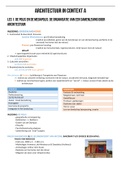
ARCHITECTUUR IN CONTEXT A
LES 1: DE POLIS EN DE MEGAPOLIS: DE ORGANISATIE VAN EEN SAMENLEVING DOOR
ARCHITECTUUR
INLEIDING: GRIEKENLAND-ROME
1. Continuïteit & diversiteit: discussie
Joachim Winckelmann: pro-Griekse benadering
(nadruk op esthetiek, genie van de kunstenaar en van de beschaving, perfectie in de
eenvoud, harmonie met de natuur)
Piranesi: pro-Romeinse houding
(nadruk op monumentale, ingenieurskunst, strijd tussen mens & natuur)
Hittorff
-> spanningsveld tussen pure esthetiek & ingenieurskunst
2. Maatschappelijke Organisatie:
polis <-> imperium
3. Culturele verschillen:
perfectie <-> assimilatie
4. Bouwtechnische evoluties:
zuil, architraaf <-> muur, gewelf
Winckelmann & Piranesi (schilderijen): Tempelsite van Phaestum
W: nadruk op culturele verfijning, harmonie met de natuur, arcadische eenvoud, diagonale benadering!
P: nadruk op constructieve logica, wetten van zwaartekracht en "verval" -> natuur verovert haar plaats op de
architectuur
GRIEKEN ROMEINEN
Realisme Fantasie & verbeelding
Perfectionering Megalomaan, techniek
Zuil & Architraaf Gewelfbouw
Axiaal - Hoek benadering Frontaal - gedwongen
Homogeen Dualisme van stijlen
Harmonie & proportie Horror vacui
Integratie in het landschap Los van landschap (aanpassing, creatie
INLEIDING: DE POLIS
- geografische versnippering
- Hellenisten <-> Barbaroi
- Goden van de Olympus
- Filosofie
- Pan-Hellenistische plaatsen
- Samenleving van "vrije" burgers
PALEIS VAN KNOSSOS & DE LEEUWENPOORT VAN MYCENE: BAKERMAT V/D GRIEKSE BESCHAVING:
PALEIS VAN KNOSSOS
- Kreta (ca. 2000 v.C. - 1100 v.C.)
- Mythologie: Homeros, de Minotaurus & Daedalus (Architect)
- Archeologie: Arthur John Evans
- Realisme en harmonie met de natuur
- Megaron als basis voor tempel (Cella)
, -> vorm van eerste tempels geïnspireerd
op woningbouw
-> onderscheidende KENMERKEN:
- megaronplan
- zuilen in antis en fronton
LEEUWENPOORT VAN MYCENE:
- Mycene (ca. 1250 v.C.)
- "archeoloog", avonturier & schattenjager Heinrich Schliemann
- Cyclopenmuur (Homeros)
- Militarische beschaving
- Basis v/d Griekse bouwprincipes: zuil, architraaf & tympaan
PERFECTIONEREN VAN DE ORDE ALS OPDRACHT VOOR DE GODEN:
-> ORDE: PROPORTIE, HARMONIE, MAATVOERING:
- modulus (diameter gemeten aan de voet v/d zuil als maat voor het gebouw)
- intercolumnië
- vrijstaande zuil- entablement
STIJLFASENS GRIEKEN:
1. Archaïsche
2. Klassieke
3. Hellenistische
-> (meer vervolmaken van bestaande dan vernieuwing)
1. ARCHAÏSCHE FASE: perfectionering van het tempelplan & van de orde
- 600 v.C. - 400 v.C.
- politieke instabiliteit <-> culturele bloei
- experiment (streven naar perfectie)
- streven naar realisme
- harmonie met het landschap (axiale benadering)
- standaardisering -> zoeken naar oplossingen i.v.m. grondplan, verhoudingen in het gebouw & onderdelen
vb. Hera I, Phaestum: periptale tempel (MAAR Cella door midden gedeeld)
vb. Hera II, Phaestum: entasis subtieler, ontwikkeling van kapiteel (echinus niet langer geplet door abacus)
, - Grondplan:
pro-naos, naos/cella & adyton
(schatkamer)
- Zuilen:
pro-style, amphi-style & peri-style
- # zuilenrijen:
dipteraal (soms tripteraal)
a = # zuilen aan de voorzijde
N = aantal zuilen aan 1 zijkant
N=2xa+1
-> lichte bolling in het profiel v/d zuil - > optische correctie
-> petrificatie (verstening): metafoor van constructie & ondersteuning?
- architect (Architecton: hoofdtimmerman)
- oudste vorm architectuur in Griekenland: in hout
-> vorm behouden maar "versteend"
Polychromie: tot 19e eeuw werd vastgehouden aan "zuiverheids-ideaal" van Winckelmann
-> onder andere J.J. Hittorf toont aan dat Griekse beelden & gebouwen in felle kleuren waren beschilderd
2. KLASSIEKE FASE: architectuur, kunst & wetenschap
- c.a. 480 v.C. - 400 v.C.
- eeuw van Athene
- eeuw van Perikles
- optische correcties
- Parthenon, Athene
PARTHENON, ATHENE
- Architecten: Ictinus & Kalikrates
- Beeldhouwer: Phidias
- Opdrachtgever: Perikles
- Opgedragen aan: Athena
- Perfectionering: grondplan, optische correcties
- Sculptuur: Griekse maatschappij verbeeld
- Landschappelijke inplanting
-> OPTISCH BEDROG:
Phidias & modulus -> verder gebouw vol
optisch bedrog
OPTISCHE CORRECTIE 1:
bolling van het stylobaat en het entablement ->
LES 1: DE POLIS EN DE MEGAPOLIS: DE ORGANISATIE VAN EEN SAMENLEVING DOOR
ARCHITECTUUR
INLEIDING: GRIEKENLAND-ROME
1. Continuïteit & diversiteit: discussie
Joachim Winckelmann: pro-Griekse benadering
(nadruk op esthetiek, genie van de kunstenaar en van de beschaving, perfectie in de
eenvoud, harmonie met de natuur)
Piranesi: pro-Romeinse houding
(nadruk op monumentale, ingenieurskunst, strijd tussen mens & natuur)
Hittorff
-> spanningsveld tussen pure esthetiek & ingenieurskunst
2. Maatschappelijke Organisatie:
polis <-> imperium
3. Culturele verschillen:
perfectie <-> assimilatie
4. Bouwtechnische evoluties:
zuil, architraaf <-> muur, gewelf
Winckelmann & Piranesi (schilderijen): Tempelsite van Phaestum
W: nadruk op culturele verfijning, harmonie met de natuur, arcadische eenvoud, diagonale benadering!
P: nadruk op constructieve logica, wetten van zwaartekracht en "verval" -> natuur verovert haar plaats op de
architectuur
GRIEKEN ROMEINEN
Realisme Fantasie & verbeelding
Perfectionering Megalomaan, techniek
Zuil & Architraaf Gewelfbouw
Axiaal - Hoek benadering Frontaal - gedwongen
Homogeen Dualisme van stijlen
Harmonie & proportie Horror vacui
Integratie in het landschap Los van landschap (aanpassing, creatie
INLEIDING: DE POLIS
- geografische versnippering
- Hellenisten <-> Barbaroi
- Goden van de Olympus
- Filosofie
- Pan-Hellenistische plaatsen
- Samenleving van "vrije" burgers
PALEIS VAN KNOSSOS & DE LEEUWENPOORT VAN MYCENE: BAKERMAT V/D GRIEKSE BESCHAVING:
PALEIS VAN KNOSSOS
- Kreta (ca. 2000 v.C. - 1100 v.C.)
- Mythologie: Homeros, de Minotaurus & Daedalus (Architect)
- Archeologie: Arthur John Evans
- Realisme en harmonie met de natuur
- Megaron als basis voor tempel (Cella)
, -> vorm van eerste tempels geïnspireerd
op woningbouw
-> onderscheidende KENMERKEN:
- megaronplan
- zuilen in antis en fronton
LEEUWENPOORT VAN MYCENE:
- Mycene (ca. 1250 v.C.)
- "archeoloog", avonturier & schattenjager Heinrich Schliemann
- Cyclopenmuur (Homeros)
- Militarische beschaving
- Basis v/d Griekse bouwprincipes: zuil, architraaf & tympaan
PERFECTIONEREN VAN DE ORDE ALS OPDRACHT VOOR DE GODEN:
-> ORDE: PROPORTIE, HARMONIE, MAATVOERING:
- modulus (diameter gemeten aan de voet v/d zuil als maat voor het gebouw)
- intercolumnië
- vrijstaande zuil- entablement
STIJLFASENS GRIEKEN:
1. Archaïsche
2. Klassieke
3. Hellenistische
-> (meer vervolmaken van bestaande dan vernieuwing)
1. ARCHAÏSCHE FASE: perfectionering van het tempelplan & van de orde
- 600 v.C. - 400 v.C.
- politieke instabiliteit <-> culturele bloei
- experiment (streven naar perfectie)
- streven naar realisme
- harmonie met het landschap (axiale benadering)
- standaardisering -> zoeken naar oplossingen i.v.m. grondplan, verhoudingen in het gebouw & onderdelen
vb. Hera I, Phaestum: periptale tempel (MAAR Cella door midden gedeeld)
vb. Hera II, Phaestum: entasis subtieler, ontwikkeling van kapiteel (echinus niet langer geplet door abacus)
, - Grondplan:
pro-naos, naos/cella & adyton
(schatkamer)
- Zuilen:
pro-style, amphi-style & peri-style
- # zuilenrijen:
dipteraal (soms tripteraal)
a = # zuilen aan de voorzijde
N = aantal zuilen aan 1 zijkant
N=2xa+1
-> lichte bolling in het profiel v/d zuil - > optische correctie
-> petrificatie (verstening): metafoor van constructie & ondersteuning?
- architect (Architecton: hoofdtimmerman)
- oudste vorm architectuur in Griekenland: in hout
-> vorm behouden maar "versteend"
Polychromie: tot 19e eeuw werd vastgehouden aan "zuiverheids-ideaal" van Winckelmann
-> onder andere J.J. Hittorf toont aan dat Griekse beelden & gebouwen in felle kleuren waren beschilderd
2. KLASSIEKE FASE: architectuur, kunst & wetenschap
- c.a. 480 v.C. - 400 v.C.
- eeuw van Athene
- eeuw van Perikles
- optische correcties
- Parthenon, Athene
PARTHENON, ATHENE
- Architecten: Ictinus & Kalikrates
- Beeldhouwer: Phidias
- Opdrachtgever: Perikles
- Opgedragen aan: Athena
- Perfectionering: grondplan, optische correcties
- Sculptuur: Griekse maatschappij verbeeld
- Landschappelijke inplanting
-> OPTISCH BEDROG:
Phidias & modulus -> verder gebouw vol
optisch bedrog
OPTISCHE CORRECTIE 1:
bolling van het stylobaat en het entablement ->