Week 3
Lecture Quantitative analyses of Units
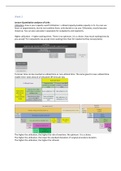
Utilization: how is your capacity used? Utilization = utilized capacity/usable capacity in %. You can use
hours or appointments, but do not combine them, only decide to use one. Otherwise, results become
mixed up. You can also calculate it separately for outpatients and inpatients.
Higher utilization -> higher waiting times. There is no optimum, it is a choice. How much waiting time do
you accept? For outpatients we accept more waiting time than for inpatients (they occupy beds).
Turnover time can be counted as utilized time or non-utilized time. The same goes for over-utilized time.
Usable time: total amount of allocated OR time per day
The higher the utilization, the higher the risk of overtime. No optimum. It is a choice.
The higher the utilization, the lower the standard deviation of surgical procedure duration.
The higher the utilization, the higher the refusals.
, Balancing capacity & demand
Lecture utilization level – research insights
The safety tipping point hypothesis (Kuntz, Mennicken, Scholtes 2015):
• If occupancy/utilization increases to moderately high levels, quality of care can largely be
maintained
• If occupancy/utilization increases further, buffers are depleted and the system can no longer
cope leading to errors/cutting corners and detrimental effects for quality of care.
Berry Jaeker & Tucker 2017
• Focus on the effect of occupancy near the day of expected discharge on patient length of stay in
the hospital
o Hypothesis 1: as occupancy near the time of expecte discharge increases, LOS increases.
Congestion effect.
o Hypothesis 2: there will be a tipping point at moderately high occupancy levels where
the length of stay of patients on the day of expected discharge becomes shorter as
occupancy increases. First tipping point, speed up.
o Hypothesis 3: there will be a second tipping point at very high occupancy levels where
the length of stay of patients approaching the day of expected discharge becomes
longer as occupancy increases. Second tipping point, saturation.
Lecture Quantitative analyses of Units
Utilization: how is your capacity used? Utilization = utilized capacity/usable capacity in %. You can use
hours or appointments, but do not combine them, only decide to use one. Otherwise, results become
mixed up. You can also calculate it separately for outpatients and inpatients.
Higher utilization -> higher waiting times. There is no optimum, it is a choice. How much waiting time do
you accept? For outpatients we accept more waiting time than for inpatients (they occupy beds).
Turnover time can be counted as utilized time or non-utilized time. The same goes for over-utilized time.
Usable time: total amount of allocated OR time per day
The higher the utilization, the higher the risk of overtime. No optimum. It is a choice.
The higher the utilization, the lower the standard deviation of surgical procedure duration.
The higher the utilization, the higher the refusals.
, Balancing capacity & demand
Lecture utilization level – research insights
The safety tipping point hypothesis (Kuntz, Mennicken, Scholtes 2015):
• If occupancy/utilization increases to moderately high levels, quality of care can largely be
maintained
• If occupancy/utilization increases further, buffers are depleted and the system can no longer
cope leading to errors/cutting corners and detrimental effects for quality of care.
Berry Jaeker & Tucker 2017
• Focus on the effect of occupancy near the day of expected discharge on patient length of stay in
the hospital
o Hypothesis 1: as occupancy near the time of expecte discharge increases, LOS increases.
Congestion effect.
o Hypothesis 2: there will be a tipping point at moderately high occupancy levels where
the length of stay of patients on the day of expected discharge becomes shorter as
occupancy increases. First tipping point, speed up.
o Hypothesis 3: there will be a second tipping point at very high occupancy levels where
the length of stay of patients approaching the day of expected discharge becomes
longer as occupancy increases. Second tipping point, saturation.