Lecture 1 (13th of September)
Summary Literature Functional Analysis
(Page & Stritzke) Chapter 5: Linking Assessment to Treatment: Case
Formulation
Case formulation: hypothesis about the causes, precipitants and maintaining influences of a
person’s psychological, interpersonal and behavioral problems.
● Organization of information about a person's (in)contradictions in
behaviour/emotion/thought content.
● Blueprint guiding treatment → captures strengths and weaknesses of the patient
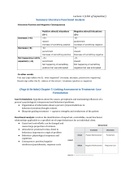
Functional analysis: involves the identification of important, controllable, causal functional
relationships applicable to a specified set of target behaviours for an individual client.
● Causal and controllable: can be changed and
causes large proportion of variance
● Antecedents: proximal in time, distal to
behaviour, important to origin of problem
● Behaviour: physiological responses and
cognitions
● Consequences: positive/negative
reinforcers/punishments, response costs
,The function of the behaviour can be identified with 3 methods:
1. Indirect assessments → questioning observer about (non-)occurrence of behaviour
2. Analogue assessments → artificial conditions constructed to test hypotheses
3. Naturalistic assessments → behaviour is observed in natural setting
Cognitive behavioural case formulation: extension on the FA by Persons and Tomkins, which
includes assessment of cognitive beliefs and attitudes. The extension has some limitations:
● Problem list: behavioural case formulation starts with obtaining a problem list
● Assign DSM diagnosis: diagnosis provides a link to literature on evidence-based
theories/treatments, but it is still a description of a cluster and lacks theory to explain
co-occurrence.
● Select nomothetic formulation of anchoring diagnosis: nomothetic formulation provides
a template for the development of an idiographic/individualized formulation.
● Individualize the template: by individualizing the nomothetic template a
comprehensive/more complete explanation is possible.
● Propose hypotheses about origins of mechanisms
● Fails to describe how the hypotheses are linked to treatments and there is no
encouragement to identify potential obstacles.
The preference of Page & Stritzke on organising case formulation:
● Presenting problems: build a picture of client’s presenting problems → get information,
but also try to understand.
● Predisposing factors: factors that started the complaints.
● Precipitating variables: specific events that caused the client to feel a certain way.
● Perpetuating cognitions and consequences: feelings/thoughts the client experiences
around this event.
● Provisional conceptualization: a provisional (voorlopige) conceptualization made by the
therapist on the links between the complaints and the factors that
developed/maintained them. Include a cognitive model of the disorder.
● Prescribed interventions: evidence-based interventions for the disorder from the
previous step.
● Potential problems and client strengths: identity of potential problems to the treatment
and also potential good factors that may help (motivation to get better?).
, (Page & Stritzke) Chapter 10: Case Management (Confidentiality)
Next to record keeping, protecting the privacy of the patient is very important. This requires
attention throughout all phases of treatment and after the patient’s file has been closed.
● Purpose: create safe therapeutic environment
Sometimes it is needed to discuss certain topics in a multidisciplinary team to achieve the best
health outcome for the patient. Then maintaining confidentiality involves maintaining a balance
between the need to respect the patient's privacy and the need to consult. Sometimes it needs
negotiation.
Summary Literature Functional Analysis
(Page & Stritzke) Chapter 5: Linking Assessment to Treatment: Case
Formulation
Case formulation: hypothesis about the causes, precipitants and maintaining influences of a
person’s psychological, interpersonal and behavioral problems.
● Organization of information about a person's (in)contradictions in
behaviour/emotion/thought content.
● Blueprint guiding treatment → captures strengths and weaknesses of the patient
Functional analysis: involves the identification of important, controllable, causal functional
relationships applicable to a specified set of target behaviours for an individual client.
● Causal and controllable: can be changed and
causes large proportion of variance
● Antecedents: proximal in time, distal to
behaviour, important to origin of problem
● Behaviour: physiological responses and
cognitions
● Consequences: positive/negative
reinforcers/punishments, response costs
,The function of the behaviour can be identified with 3 methods:
1. Indirect assessments → questioning observer about (non-)occurrence of behaviour
2. Analogue assessments → artificial conditions constructed to test hypotheses
3. Naturalistic assessments → behaviour is observed in natural setting
Cognitive behavioural case formulation: extension on the FA by Persons and Tomkins, which
includes assessment of cognitive beliefs and attitudes. The extension has some limitations:
● Problem list: behavioural case formulation starts with obtaining a problem list
● Assign DSM diagnosis: diagnosis provides a link to literature on evidence-based
theories/treatments, but it is still a description of a cluster and lacks theory to explain
co-occurrence.
● Select nomothetic formulation of anchoring diagnosis: nomothetic formulation provides
a template for the development of an idiographic/individualized formulation.
● Individualize the template: by individualizing the nomothetic template a
comprehensive/more complete explanation is possible.
● Propose hypotheses about origins of mechanisms
● Fails to describe how the hypotheses are linked to treatments and there is no
encouragement to identify potential obstacles.
The preference of Page & Stritzke on organising case formulation:
● Presenting problems: build a picture of client’s presenting problems → get information,
but also try to understand.
● Predisposing factors: factors that started the complaints.
● Precipitating variables: specific events that caused the client to feel a certain way.
● Perpetuating cognitions and consequences: feelings/thoughts the client experiences
around this event.
● Provisional conceptualization: a provisional (voorlopige) conceptualization made by the
therapist on the links between the complaints and the factors that
developed/maintained them. Include a cognitive model of the disorder.
● Prescribed interventions: evidence-based interventions for the disorder from the
previous step.
● Potential problems and client strengths: identity of potential problems to the treatment
and also potential good factors that may help (motivation to get better?).
, (Page & Stritzke) Chapter 10: Case Management (Confidentiality)
Next to record keeping, protecting the privacy of the patient is very important. This requires
attention throughout all phases of treatment and after the patient’s file has been closed.
● Purpose: create safe therapeutic environment
Sometimes it is needed to discuss certain topics in a multidisciplinary team to achieve the best
health outcome for the patient. Then maintaining confidentiality involves maintaining a balance
between the need to respect the patient's privacy and the need to consult. Sometimes it needs
negotiation.