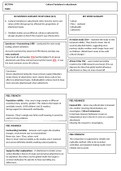
SECTION: Bowlby’s Monotropic Theory
TOPIC: Attachment
SIX SENTENCE SUMMARY OF KEY IDEAS (K/U) KEY WORD GLOSSARY
1. Bowlby explained attachment was an innate system Monotropic
(evolutionary theory) for a survival advantage, like imprinting. Critical Period
He believed the child attachment to a primary caregiver was Sensitive Period
much more important than any other – the more continuous Internal working model
and predictable care given the stronger the attachment. Social Releasers
Primary Attachment
2. The baby has ‘innate’ social releasers which are signals given Secondary Attachment
to attract person attention/interaction. The inter-play Innate
gradually builds a bond. Evolutionary
3. He proposed there is a critical period for infant between 6 SO – social releasers
months and 2 years – but it is more of a sensitive period
M – monotropy
because if an attachment isn’t formed its much more difficult
to form one later on. A – adaptative advantage
4. From this primary caregiver relationship, the child builds an G – good quality care
internal working model of relationships as it is the first loving I – internal working model
bond they experience. If they experience neglect, poor
attachment they are more likely to struggle to form C – critical period
relationships as they have a poor example.
PEEL STRENGTH PEEL STRENGTH
There is clear evidence for social releasers – in the still Studies of generational mothers show how the internal
face experiment, when the adults ignored the babies working model has affected passed on attachment
signals after interacting the babies showed distress, this qualities, those mothers who had a poorly attached
shows the role of social releasers and how they help relationship would be more likely to be poorly attached
emotional development. to their babies. Supporting Bowlby’s theory.
PEEL WEAKNESS PEEL WEAKNESS
The monotropic theory lack validity Schaffer and Emerson With his research there are concerns on parent
1964 found the baby form multiple attachments later on, pressures. It suggests the primary caregiver is most
the primary attachment may be stronger but not more significant (usually the mother) it may set up mothers to
significant than others – different family may give take the blame if their child develops slower in the future
different skills/qualities. – restricting the mothers.
Although Bowlby never directly suggested this.
TOPIC: Attachment
SIX SENTENCE SUMMARY OF KEY IDEAS (K/U) KEY WORD GLOSSARY
1. Bowlby explained attachment was an innate system Monotropic
(evolutionary theory) for a survival advantage, like imprinting. Critical Period
He believed the child attachment to a primary caregiver was Sensitive Period
much more important than any other – the more continuous Internal working model
and predictable care given the stronger the attachment. Social Releasers
Primary Attachment
2. The baby has ‘innate’ social releasers which are signals given Secondary Attachment
to attract person attention/interaction. The inter-play Innate
gradually builds a bond. Evolutionary
3. He proposed there is a critical period for infant between 6 SO – social releasers
months and 2 years – but it is more of a sensitive period
M – monotropy
because if an attachment isn’t formed its much more difficult
to form one later on. A – adaptative advantage
4. From this primary caregiver relationship, the child builds an G – good quality care
internal working model of relationships as it is the first loving I – internal working model
bond they experience. If they experience neglect, poor
attachment they are more likely to struggle to form C – critical period
relationships as they have a poor example.
PEEL STRENGTH PEEL STRENGTH
There is clear evidence for social releasers – in the still Studies of generational mothers show how the internal
face experiment, when the adults ignored the babies working model has affected passed on attachment
signals after interacting the babies showed distress, this qualities, those mothers who had a poorly attached
shows the role of social releasers and how they help relationship would be more likely to be poorly attached
emotional development. to their babies. Supporting Bowlby’s theory.
PEEL WEAKNESS PEEL WEAKNESS
The monotropic theory lack validity Schaffer and Emerson With his research there are concerns on parent
1964 found the baby form multiple attachments later on, pressures. It suggests the primary caregiver is most
the primary attachment may be stronger but not more significant (usually the mother) it may set up mothers to
significant than others – different family may give take the blame if their child develops slower in the future
different skills/qualities. – restricting the mothers.
Although Bowlby never directly suggested this.