PAPER: SECTION: Classical Conditioning
TOPIC: The Approaches
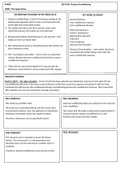
SIX SENTENCE SUMMARY OF KEY IDEAS (K/U) KEY WORD GLOSSARY
1. Classical conditioning is a form of learning according to the Neutral Stimulus
behaviourist approach which is only concerned about the (Un) conditioned response
observable and measurable studies. (Un) conditioned stimulus
2. The studies are kept in the lab to ensure control and
objectivity because the studies are only observed. Observed behaviour
Pavlov’s Experiment
3. Behaviourists believe that behaviour is only learned – that Behaviourist approach
babies are born an ‘blank slate’ Extinction
Time Continuity
4. Also, behaviourist study on animals because they believe we Stimulus discrimination
learn similarly to them Stimulus Generalisation – when other stimuli are
associated with similar things and create the
5. CC = Learning by association – occurs when an unlearned same conditioned response
neutral stimulus becomes conditioned (learned) to cause a
conditioned response.
6. When the two are paired together for long enough the
behaviour is learned but it can be unlearned if this changes.
RELEVENT EVIDENCE
Pavlov (1927) – The dogs salvation – Pavlov found that dogs salivated (unconditioned response) to the sight of food
(unconditioned stimulus) so he used a neutral stimulus (a bell that caused no response) and paired it with the food.
Eventually the bell became the conditioned stimulus and salivating became the conditioned response. This proved that
after repletion we can learn behaviours through association.
PEEL STRENGTH PEEL WEAKNESS
This study has scientific value. Classical conditioning study uses animals for the research.
(over simplified)
The study was a controlled setting, and the results were
from physical evidence. Also, the approach is reductionist This means that the study is being used to generalised for
meaning it was broken down into smaller sections. humans however animals are different to us and
therefore this study has lower validity.
Therefore, behaviours can be specifically tested.
PEEL STRENGTH PEEL WEAKNESS
The research can be repeated to prove the theory
further. This is because it is a lab experiment and
therefore there are few extraneous variables and it is
simplistic.
Therefore classical conditioning can be proven further.
TOPIC: The Approaches
SIX SENTENCE SUMMARY OF KEY IDEAS (K/U) KEY WORD GLOSSARY
1. Classical conditioning is a form of learning according to the Neutral Stimulus
behaviourist approach which is only concerned about the (Un) conditioned response
observable and measurable studies. (Un) conditioned stimulus
2. The studies are kept in the lab to ensure control and
objectivity because the studies are only observed. Observed behaviour
Pavlov’s Experiment
3. Behaviourists believe that behaviour is only learned – that Behaviourist approach
babies are born an ‘blank slate’ Extinction
Time Continuity
4. Also, behaviourist study on animals because they believe we Stimulus discrimination
learn similarly to them Stimulus Generalisation – when other stimuli are
associated with similar things and create the
5. CC = Learning by association – occurs when an unlearned same conditioned response
neutral stimulus becomes conditioned (learned) to cause a
conditioned response.
6. When the two are paired together for long enough the
behaviour is learned but it can be unlearned if this changes.
RELEVENT EVIDENCE
Pavlov (1927) – The dogs salvation – Pavlov found that dogs salivated (unconditioned response) to the sight of food
(unconditioned stimulus) so he used a neutral stimulus (a bell that caused no response) and paired it with the food.
Eventually the bell became the conditioned stimulus and salivating became the conditioned response. This proved that
after repletion we can learn behaviours through association.
PEEL STRENGTH PEEL WEAKNESS
This study has scientific value. Classical conditioning study uses animals for the research.
(over simplified)
The study was a controlled setting, and the results were
from physical evidence. Also, the approach is reductionist This means that the study is being used to generalised for
meaning it was broken down into smaller sections. humans however animals are different to us and
therefore this study has lower validity.
Therefore, behaviours can be specifically tested.
PEEL STRENGTH PEEL WEAKNESS
The research can be repeated to prove the theory
further. This is because it is a lab experiment and
therefore there are few extraneous variables and it is
simplistic.
Therefore classical conditioning can be proven further.