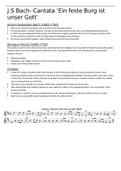
J.S Bach- Cantata ‘Ein feste Burg ist
unser Gott’
Johann Sebastian Bach (1685-1750)
Bach was a German composer and musician of the Baroque period
He was primarily a choral composer, but also wrote instrumental works such as his Brandenburg Concertos
In 1923, he was employed at the Cantor at St Thomas in Leipzig- during his time at St. Thomas, he wrote music
for the Lutheran churches of the city (that had just undergone reformation)
He wrote around 300 cantatas, 100 of which have been lost since his death
Baroque Period (1600-1750)
The political control of the church loosened, meaning that non-religious music was able to flourish during this period.
Baroque music was encouraged by the Catholic church, who decided that the arts should aim to communicate
religious themes.
Diatonic tonality
Polyphony was hugely common in both instrumental choral works
Heavy use of string instruments
Context
In the 16th century, Martin Luther (the founder of the Protestant/Lutheran church) aimed to involve more
ordinary people in church ceremonies- this led to more congregational singing in German rather than Latin, often
in the form of a Chorale. These chorales were then incorporated into more complex cantatas, written for soloist
and accompanied by an orchestra
This piece is an example of a cantata, which were required for Sunday church services
This chorale that this Cantata is based on was written by Luther, then adapted by Bach. It is one of Bach’ most
famous Cantatas
A cantata is a work for voices and instruments, with several movements, and were either sacred or secular
Bach wrote around 300 church Cantatas, of which only 200 survived
unser Gott’
Johann Sebastian Bach (1685-1750)
Bach was a German composer and musician of the Baroque period
He was primarily a choral composer, but also wrote instrumental works such as his Brandenburg Concertos
In 1923, he was employed at the Cantor at St Thomas in Leipzig- during his time at St. Thomas, he wrote music
for the Lutheran churches of the city (that had just undergone reformation)
He wrote around 300 cantatas, 100 of which have been lost since his death
Baroque Period (1600-1750)
The political control of the church loosened, meaning that non-religious music was able to flourish during this period.
Baroque music was encouraged by the Catholic church, who decided that the arts should aim to communicate
religious themes.
Diatonic tonality
Polyphony was hugely common in both instrumental choral works
Heavy use of string instruments
Context
In the 16th century, Martin Luther (the founder of the Protestant/Lutheran church) aimed to involve more
ordinary people in church ceremonies- this led to more congregational singing in German rather than Latin, often
in the form of a Chorale. These chorales were then incorporated into more complex cantatas, written for soloist
and accompanied by an orchestra
This piece is an example of a cantata, which were required for Sunday church services
This chorale that this Cantata is based on was written by Luther, then adapted by Bach. It is one of Bach’ most
famous Cantatas
A cantata is a work for voices and instruments, with several movements, and were either sacred or secular
Bach wrote around 300 church Cantatas, of which only 200 survived