Principles of Economics
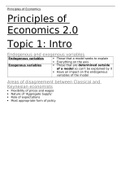
Principles of
Economics 2.0
Topic 1: Intro
Endogenous and exogenous variables
Endogenous variables Those that a model seeks to explain
Everything on the axis
Exogenous variables Those that are determined outside
of a model so can’t be explained by it
Have an impact on the endogenous
variables of the model
Areas of disagreement between Classical and
Keynesian economists
Flexibility of prices and wages
Nature of ‘Aggregate Supply’
Role of expectations
Most appropriate form of policy
,Principles of Economics
Topic 2: Classical
Theory (I)
Models
Closed economy One that does not have any flows to and from
abroad
No imports or exports
GDP = Y = C + I + G
Market-Clearing Assumptions
All economic agents are rational and aim to
maximise their benefit
All markets are perfectly competitive and all
agents have complete information
according to the classical model: all markets
clear
Flexible prices: prices adjust quickly to bring S & D into equilibrium –
classical school of thought assumes flexible prices
Sticky prices: D doesn’t always equal S and variables are sometimes
slow to adjust
GDP
Consumpti Consumption = spending by households on final goods
on and services
Depends on disposable income, Y – T
o Y = income and T = net taxes (taxes minus
transfer payments)
MPC
Consumption and disposable income share a positive
relationship
o E.g. C = 500 + 0.75(Y-T)
o The constant term represents ‘autonomous
consumption’ = consumption independent from
income
o The parameter before parentheses = MPC which
varies with income, takes a value between 0 and 1
o MPC = proportion of disposable income devoted
to consumption
, Principles of Economics
Investmen Investment = spending on things that are not
t immediately consumed but are used in production or
stored for later
3 categories
1. Business fixed investment: spending on plants +
equipment (firms)
2. Inventory investment: accumulation of goods
inventories (firms)
3. Residential fixed investment: spending on housing
units (households)
Interest Rate
Level of investment depends on IR, r
I and r have an inverse relationship:
o Investment funded by loans which are more
expensive when IRs are higher
o Even if investment isn’t funded by loans: funds
could be deposited in the bank, bigger
opportunity cost of investing
Govt Govt spending = spending on final goods and services
spending by govt, not including transfer payments (not
exchanged for goods and services)
G is assumed as an exogenous policy variable =
doesn’t depend on anything
AD
Principles of
Economics 2.0
Topic 1: Intro
Endogenous and exogenous variables
Endogenous variables Those that a model seeks to explain
Everything on the axis
Exogenous variables Those that are determined outside
of a model so can’t be explained by it
Have an impact on the endogenous
variables of the model
Areas of disagreement between Classical and
Keynesian economists
Flexibility of prices and wages
Nature of ‘Aggregate Supply’
Role of expectations
Most appropriate form of policy
,Principles of Economics
Topic 2: Classical
Theory (I)
Models
Closed economy One that does not have any flows to and from
abroad
No imports or exports
GDP = Y = C + I + G
Market-Clearing Assumptions
All economic agents are rational and aim to
maximise their benefit
All markets are perfectly competitive and all
agents have complete information
according to the classical model: all markets
clear
Flexible prices: prices adjust quickly to bring S & D into equilibrium –
classical school of thought assumes flexible prices
Sticky prices: D doesn’t always equal S and variables are sometimes
slow to adjust
GDP
Consumpti Consumption = spending by households on final goods
on and services
Depends on disposable income, Y – T
o Y = income and T = net taxes (taxes minus
transfer payments)
MPC
Consumption and disposable income share a positive
relationship
o E.g. C = 500 + 0.75(Y-T)
o The constant term represents ‘autonomous
consumption’ = consumption independent from
income
o The parameter before parentheses = MPC which
varies with income, takes a value between 0 and 1
o MPC = proportion of disposable income devoted
to consumption
, Principles of Economics
Investmen Investment = spending on things that are not
t immediately consumed but are used in production or
stored for later
3 categories
1. Business fixed investment: spending on plants +
equipment (firms)
2. Inventory investment: accumulation of goods
inventories (firms)
3. Residential fixed investment: spending on housing
units (households)
Interest Rate
Level of investment depends on IR, r
I and r have an inverse relationship:
o Investment funded by loans which are more
expensive when IRs are higher
o Even if investment isn’t funded by loans: funds
could be deposited in the bank, bigger
opportunity cost of investing
Govt Govt spending = spending on final goods and services
spending by govt, not including transfer payments (not
exchanged for goods and services)
G is assumed as an exogenous policy variable =
doesn’t depend on anything
AD