

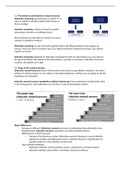
1.1 The inductive and deductive research process
Deductive reasoning: general theory is tested to
solve or explain a specific problem (also known as
theory testing)
Inductive reasoning: a theory is based on specific
observations (known as a building theory).
Both methods are used often in research, but most
common is deductive research.
Deductive reasoning: So you start with a general theory (all Tilburg students must register on
Canvas). Than you test it in practice (You are a Tilburg University student) Conclusion: you need to
register on Canvas.
Inductive reasoning: (Opposite of deductive reasoning) You first do observations (e.g. you observe
the age of students) Then based on the observations, you draw a conclusion. (inductive conclusion
could be: all students are X age).
1.2 Steps of the research process
Deductive research process (theoryobservations) also know as quantitative method or top-down
method. It is theory based, so use a theory to develop hypotheses, and then you are going to test the
hypotheses by using data.
Inductive research process (qualitative method, bottom-up): More exploratory (verkennend). Data
is the starting point, seek explanation for the data. It ends by developing a theory.
Major differences:
- Outcome is different: Deductive research outcome is confirmation/disconfirmation of an
existing theory. Inductive research: outcome is an newly developed theory.
- Differences in research process:
o Purpose of the literature review: Deductive research: literature is used to identify
important variables and defining key terms. Inductive research: using literature to
provide evidence for the relevance of the study.
- Data collection methods:
o Deductive methods: closed questions surveys, experiments, archival research.
o Inductive methods: observations, interviews, document analyses.
, - Analysing the data: Deductive process: mostly done with statistical analyses. Inductive
research: coding process to find common themes in large amount of available data.
1.3 Examples of inductive and deductive research:
Inductive research example: Post-disaster business recovery. (they did interviews (12) to collect the
data). Then they coded the data into important topics (draw theory).
Deductive research: investigate how consumers response to mistakes in price: first a literature
review to determine the hypotheses. Then collecting data by use of a online survey.
Deductive research is most common used in marketing.
1.4 defining a business problem (first step of the research problem)
When does a business problem occurs?
When there is a gap between the desired state of a
company and the actual state of a company
Two types of business problems:
1. Actual situation is seriously wrong Needs to be solved asap
2. Actual situation is not seriously wrong Can be improved
What makes a good business problem:
- Feasibility: is it doable? Can’t be impossible
- Relevance: it should matter: is it worthwhile?
1. Feasibility checklist
a. Is the problem demarcated (afgebakend)?: is it not too big?
b. Can the problem be expressed in variables? If you don’t, you can’t research your
business problem.
c. Be able to require the data
i. Existing data: data that the company owns e.g.
ii. New data: experiments, surveys e.g.
It is correct to collect only existing data or new data (both is also fine).
Examples of wrong business problems:
ABN Amro would like to know how it can increase its profitability.
Not correct: the problem is way too big, zillions of ways to improve profits and can’t be expressed in
variables. There are hundreds of variables which can increase profit. And if the list of variables is
endless, you are also unlikely to gather all the needed data.
Pfizer would like to know whether soft-selling new drugs to doctors works better than hard-selling
It is demarcated enough, but you can’t expressed it okay in variables: better? So what is better.
Philips would like to know whether running price promotions (vs. no price promotions) on its
products can reduce the profitability of its competitors’ new products.
It is well demarcated and can be expressed in variables, but you are not able to require the needed
data of competitors. So this business problem is not feasible.
Example of right business problems:
Pfizer would like to know whether soft-selling new drugs to doctors leads to more prescriptions than
hard-selling.
Deductive reasoning: general theory is tested to
solve or explain a specific problem (also known as
theory testing)
Inductive reasoning: a theory is based on specific
observations (known as a building theory).
Both methods are used often in research, but most
common is deductive research.
Deductive reasoning: So you start with a general theory (all Tilburg students must register on
Canvas). Than you test it in practice (You are a Tilburg University student) Conclusion: you need to
register on Canvas.
Inductive reasoning: (Opposite of deductive reasoning) You first do observations (e.g. you observe
the age of students) Then based on the observations, you draw a conclusion. (inductive conclusion
could be: all students are X age).
1.2 Steps of the research process
Deductive research process (theoryobservations) also know as quantitative method or top-down
method. It is theory based, so use a theory to develop hypotheses, and then you are going to test the
hypotheses by using data.
Inductive research process (qualitative method, bottom-up): More exploratory (verkennend). Data
is the starting point, seek explanation for the data. It ends by developing a theory.
Major differences:
- Outcome is different: Deductive research outcome is confirmation/disconfirmation of an
existing theory. Inductive research: outcome is an newly developed theory.
- Differences in research process:
o Purpose of the literature review: Deductive research: literature is used to identify
important variables and defining key terms. Inductive research: using literature to
provide evidence for the relevance of the study.
- Data collection methods:
o Deductive methods: closed questions surveys, experiments, archival research.
o Inductive methods: observations, interviews, document analyses.
, - Analysing the data: Deductive process: mostly done with statistical analyses. Inductive
research: coding process to find common themes in large amount of available data.
1.3 Examples of inductive and deductive research:
Inductive research example: Post-disaster business recovery. (they did interviews (12) to collect the
data). Then they coded the data into important topics (draw theory).
Deductive research: investigate how consumers response to mistakes in price: first a literature
review to determine the hypotheses. Then collecting data by use of a online survey.
Deductive research is most common used in marketing.
1.4 defining a business problem (first step of the research problem)
When does a business problem occurs?
When there is a gap between the desired state of a
company and the actual state of a company
Two types of business problems:
1. Actual situation is seriously wrong Needs to be solved asap
2. Actual situation is not seriously wrong Can be improved
What makes a good business problem:
- Feasibility: is it doable? Can’t be impossible
- Relevance: it should matter: is it worthwhile?
1. Feasibility checklist
a. Is the problem demarcated (afgebakend)?: is it not too big?
b. Can the problem be expressed in variables? If you don’t, you can’t research your
business problem.
c. Be able to require the data
i. Existing data: data that the company owns e.g.
ii. New data: experiments, surveys e.g.
It is correct to collect only existing data or new data (both is also fine).
Examples of wrong business problems:
ABN Amro would like to know how it can increase its profitability.
Not correct: the problem is way too big, zillions of ways to improve profits and can’t be expressed in
variables. There are hundreds of variables which can increase profit. And if the list of variables is
endless, you are also unlikely to gather all the needed data.
Pfizer would like to know whether soft-selling new drugs to doctors works better than hard-selling
It is demarcated enough, but you can’t expressed it okay in variables: better? So what is better.
Philips would like to know whether running price promotions (vs. no price promotions) on its
products can reduce the profitability of its competitors’ new products.
It is well demarcated and can be expressed in variables, but you are not able to require the needed
data of competitors. So this business problem is not feasible.
Example of right business problems:
Pfizer would like to know whether soft-selling new drugs to doctors leads to more prescriptions than
hard-selling.



