Internal Communication
Chapter 7: Communication
Organizational communication is essential in e.g. selection, training, performance reviews,
problem-solving, determining strategy.
—> It is not neutral, but it is an attempt from management to gauge or change attitudes and
behavior.
—> There are many ways to communicate with employees, but what is the most effective depends
on the communication goal.
—> The bigger the change, the more involvement from employees is required.
Interpersonal communication: the transfer / exchange of information and meaning between at
least two people; it often corresponds to social imperatives (e.g. value of silences in conversations).
—> Why is communication so hard: it is also about transferring meaning via a channel in a certain
context.
—> Moreover, everyone has their own perceptual filters (e.g. whether you’re paying attention, or
whether you have the same frame of reference as the receiver) which can change the meaning.
—> Perceptual filters: individual characteristics, predispositions and preoccupations that interfere
with the effective transmission and receipt of messages.
—> For effective communication, the signal should be stronger than the noise.
—> Noise: factors outside the communication process which interfere with or distract attention
from the transmission and reception of the intended meaning.
1
,—> Feedback: processes through which the transmitter of a message detects whether and how that
message has been received and decoded.
—> Moreover, power differences, gender differences, physical surroundings, language, and cultural
differences can disrupt effective communication.
Media richness theory:
—> Characteristics of the information/communication task: complexity and ambiguity.
—> Characteristics of the medium: it depends on multiple cues, the speed of feedback, personal
focus, and natural language.
Verbal communication: the written or spoken conveying of message.
—> Questioning techniques: how do you achieve what you want?
—> Conversation controls: which signals do you convey?
2
, Non-verbal communication: the process of coding meaning through behaviors such as facial
expressions, hand gestures, and body postures, clothing, etc.
—> Power tells: non-verbal signals that indicate to others how important / dominant someone
(wants us to) think he/she) is.
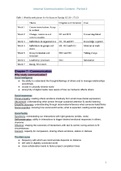
—> Modes of non-verbal behavior:
Category Mode of communication Examples
Kinesics Body movements Facial expressions, gestures, posture,
synchronizing movements with those of
others
Appearance The way you look Dress, accessories, makeup, height,
weight, attractiveness
Oculesics With your eyes Eye contact, direction of gaze, blinking,
pupil dilation, eye movements
Haptics Through touch Types of touch, touch avoidance
Paralanguage Voice qualities (aka vocalics) Pitch, volume, laughter, pauses, silence
Olfactics Smell Body odour, perfume, after shave
Proxemics Physical space Personal space, territory
Chronemics Through the use of time Talk time, speech rate
Environment and Through objects Build environment, design, landscape,
artefacts objects that say something about you
Communication climate: the prevailing atmosphere in an organization - open or closed - in which
ideas and information are exchanged.
3
Chapter 7: Communication
Organizational communication is essential in e.g. selection, training, performance reviews,
problem-solving, determining strategy.
—> It is not neutral, but it is an attempt from management to gauge or change attitudes and
behavior.
—> There are many ways to communicate with employees, but what is the most effective depends
on the communication goal.
—> The bigger the change, the more involvement from employees is required.
Interpersonal communication: the transfer / exchange of information and meaning between at
least two people; it often corresponds to social imperatives (e.g. value of silences in conversations).
—> Why is communication so hard: it is also about transferring meaning via a channel in a certain
context.
—> Moreover, everyone has their own perceptual filters (e.g. whether you’re paying attention, or
whether you have the same frame of reference as the receiver) which can change the meaning.
—> Perceptual filters: individual characteristics, predispositions and preoccupations that interfere
with the effective transmission and receipt of messages.
—> For effective communication, the signal should be stronger than the noise.
—> Noise: factors outside the communication process which interfere with or distract attention
from the transmission and reception of the intended meaning.
1
,—> Feedback: processes through which the transmitter of a message detects whether and how that
message has been received and decoded.
—> Moreover, power differences, gender differences, physical surroundings, language, and cultural
differences can disrupt effective communication.
Media richness theory:
—> Characteristics of the information/communication task: complexity and ambiguity.
—> Characteristics of the medium: it depends on multiple cues, the speed of feedback, personal
focus, and natural language.
Verbal communication: the written or spoken conveying of message.
—> Questioning techniques: how do you achieve what you want?
—> Conversation controls: which signals do you convey?
2
, Non-verbal communication: the process of coding meaning through behaviors such as facial
expressions, hand gestures, and body postures, clothing, etc.
—> Power tells: non-verbal signals that indicate to others how important / dominant someone
(wants us to) think he/she) is.
—> Modes of non-verbal behavior:
Category Mode of communication Examples
Kinesics Body movements Facial expressions, gestures, posture,
synchronizing movements with those of
others
Appearance The way you look Dress, accessories, makeup, height,
weight, attractiveness
Oculesics With your eyes Eye contact, direction of gaze, blinking,
pupil dilation, eye movements
Haptics Through touch Types of touch, touch avoidance
Paralanguage Voice qualities (aka vocalics) Pitch, volume, laughter, pauses, silence
Olfactics Smell Body odour, perfume, after shave
Proxemics Physical space Personal space, territory
Chronemics Through the use of time Talk time, speech rate
Environment and Through objects Build environment, design, landscape,
artefacts objects that say something about you
Communication climate: the prevailing atmosphere in an organization - open or closed - in which
ideas and information are exchanged.
3