

Exam (elaborations) GIZMO Torque and Moment of Inertia
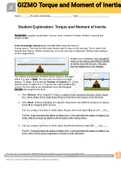
Exam (elaborations) GIZMO Torque and Moment of Inertia Vocabulary: angular acceleration, fulcrum, lever, moment of inertia, Newton’s second law, torque, weight Prior Knowledge Question (Do this BEFORE using the Gizmo.) During recess, Tom and his little sister Marcie want to play on the see-saw. Tom is quite a bit heavier than Marcie. Where should they sit so the see-saw is balanced? Sketch their positions on the image below. Explain your reasoning: Tom should sit closer to the fulcrum and Marcie should sit farther from the fulcrum. This way they are balanced on the seesaw. Gizmo Warm-up The Torque and Moment of Inertia Gizmo shows a see-saw, which is a type of lever. The see-saw can hold up to eight objects. To begin, check that the Number of objects is 2. Check that the mass of object A is 1.0 kg and the mass of object B is 2.0 kg. The two objects are equidistant from the triangular fulcrum that supports the lever. 1. Click Release. What happens? There is rotation in the clockwise direction where object B is. Since object B has more mass there is more force and torque in this direction. 2. Click Reset. Without changing the masses, experiment with different positions of objects A and B by dragging them around. Can you create a scenario in which object A goes down and object B goes up? __Yes__ Explain: If you increase the radius of object A to -2.0m and keep the radius of object 2 at 0.5m, then the torque on object A will be larger and it will go down. 3. Can you create a scenario in which object A perfectly balances object B? ___Yes____ Explain: If you increase the radius of object A to -1.0m and keep the radius of object 2 at 0.5m, there will be equal magnitude of torque in both directions. This study source was downloaded by from CourseH on :15:12 GMT -05:00 This study resource was shared via CourseH GIZMO Torque and Moment of Inertia 2019 Activity A: Principle of the lever Get the Gizmo ready: Click Reset. Turn on Show ruler. Check that object A is 1.0 kg and B is 2.0 kg. Question: How can you use a light object to balance a heavy object? 1. Explore: Experiment with the Gizmo to see how you can balance a heavy object with a light object. What do you notice about the distances of each object from the fulcrum? The distance of object B increases as the mass of object A increases. 2. Gather data: For each mass and location of object A, find a location for object B so it perfectly balances object A. You can change the mass of object A by typing the mass into the text box and hitting “Enter” on your keyboard. Leave the mass of object B the same (1 kg) in each experiment. Include all units in the table. Object A mass Object A location Object B mass Object B location Object A m × d Object B m × d 1.0 kg -0.4 m 1.0 kg 0.4m 0.4 kg*m 0.4 kg*m 2.0 kg -0.4 m 1.0 kg 0.8m 0.8kg*m 0.8kg*m 3.0 kg -0.4 m 1.0 kg 1.2m 1.2kg*m 1.2kg*m 4.0 kg -0.4 m 1.0 kg 1.6m 1.6kg*m 1.6kg*m 3. Analyze: What patterns do you notice in your data? The location of object B increases by 0.4m as the mass of object A increases in order to balance them. 4. Calculate: Fill in the last two columns by multiplying each object’s mass by its distance from the fulcrum. The units are kg·m. (Note: The distance d is always a positive number.) What do you notice? The mass times distance for object A and B are the same. 5. Generalize: In general, how can you calculate the distance of object B from the fulcrum so that it balances object A? You can multiply the mass and location of object A and then divide the result by mass of object B. 6. Apply: Suppose you wanted to lift a heavy rock with a lever. Would you place the fulcrum near the rock or near the part of the lever where you are pushing? Explain. Near the part of lever where I am pushing because with a greater distance the torque increases, so it would be easy to lift the rock. This study source was downloaded by from CourseH on :15:12 GMT -05:00 This study resource was shared via CourseH 2019 Activity B: Torque Get the Gizmo ready: Click Reset. Turn on Show initial torque. Set the Number of objects to 1. Set Mass A to 2.0 kg. Question: What is the rotational force that an object exerts on a lever? 1. Calculate: When object A is positioned on the see-saw, it is pulled down by the force of gravity. The gravitational force on an object, or its weight (w), is equal to its mass multiplied by gravitational acceleration (g). Gravitational acceleration is 9.81 m/s2 on Earth’s surface. What is the weight of object A? _19.6N_____ [Note: The unit for weight is the newton (N).] 2. Predict: The twisting force an object exerts on a see-saw is called torque (τ). How do you think the torque depends on the distance of object A from the fulcrum? The greater the distance from the fulcrum, the larger the torque. 3. Gather data: Place object A at several locations on the see-saw, on both sides of the fulcrum. Use a different mass in each experiment. In each trial, click Release and record the initial torque. Record object A’s mass, weight, location, and torque in the table below. Object A mass (kg) Object A weight (N) Object A location (m) Object A torque (N·m) 1.0kg 9.81N -1.0m 9.81N*m 2.0kg 19.6N -1.0m 19.6N*m 3.0kg 29.4N -1.0m 29.4N*m 4.0kg 39.24N -1.0m 39.24N*m 5.0kg 49.1N -1.0m 49.1N*m 4. Analyze: Based on your data, write an equation for torque. Use the symbol r to represent distance. For now, ignore the sign of the torque. Test your equation with the Gizmo. τ = r*m*g = Fr 5. Make a rule: Now focus on the sign of each torque value in your table. How does the sign relate to the direction of rotation? (Fill in each blank with “clockwise” or “counterclockwise.”) If torque is positive, the resulting motion is _____counterclockwise_______________. If torque is negative, the resulting motion is ____clockwise_____________________. (Activity B continued on next page) This study source was downloaded by from CourseH on :15:12 GMT -05:00 This study resource was shared via CourseH 2019 Activity B (continued from previous page) 6. Apply: What is the torque exerted by a 4.2-kg mass that is located 1.8 m to the right of the fulcrum? _74N*m_____ Check your answer with the Gizmo. 7. Explore: Set the Number of objects to 2. Set the Mass of object A to 5 kg and its Location to 1.2 m. Set the Mass of object B to 3.0 kg and is Location to 0.5 m. A. What torque does object A exert on the see-saw? _____-59N*m________________ B. What torque does object B exert on the see-saw? ______-14.7N*m_____________ C. What do you think is the total torque on the see-saw? ____-73.7N*m_____________ D. Check that Show initial torque is on and click Release. What is the total torque? __-73.7N*m______________________ 8. Practice: A lever supports four objects: Object A is 3.0 kg and located 2.0 m left of the fulcrum. Object B is 7.0 kg and located 0.5 m left of the fulcrum. Object C is 8.0 kg and located 0.1 m right of the fulcrum. Object D is 4.5 kg and located 1.6 m right of the fulcrum. A. What is the total torque on the lever? ___-16.2N*m_____________________ (Hint: Recall that objects to the right of the fulcrum will have a negative torque.) Show your work: TA = (9.8m/s^2)(3.0kg)(2.0m) = 58.8 N*m TB = (9.8m/s^2)(7.0kg)(0.5m) = 34.3 N*m TC = (9.8m/s^2)(8.0kg)(-0.1m) = -7.84 N*m TD = (9.8m/s^2)(4.5.0kg)(-1.6m) = -70.56 N*m Ttotal = -16.2N*m B. When released, will the left rotate clockwise or counterclockwise? counterclockwise C. Check your answers on the Gizmo. Were you correct? _______N/A___________ 9. Explain: If two kids are playing on the see-saw, why should the larger kid sit closer to the fulcrum than the smaller kid? Use the term “torque” in your explanation. If the larger kid sits closer to the fulcrum the radius will be smaller. The smaller kid will have a larger radius but since his mass is smaller the torque on either side will almost be the same. This study source was downloaded by from CourseH on :15:12 GMT -05:00 This stud
Document information
- Uploaded on
- January 4, 2022
- Number of pages
- 6
- Written in
- 2021/2022
- Type
- Exam (elaborations)
- Contains
- Questions & answers


