Reforming Rational Bureaucracies:
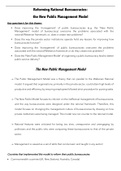
the New Public Management Model
Key question/s for this theme:
§ Does improving the ‘management’ of public bureaucracies (e.g. the ‘New Public
Management’ model of bureaucracy) overcome the problems associated with the
rational/Weberian framework; or, does it create new problems?
§ Does the way the private sector institutions operate hold any lessons for improving how
bureaucracies function?
§ Does improving the ‘management’ of public bureaucracies overcome the problems
associated with the rational/Weberian framework or do they create new problems?
§ Does the ‘New Public Management Model’ of organising a public bureaucracy lead to better
public service delivery?
The New Public Management Model
® The Public Management Model was a theory that ran parallel to the Weberian Rational
model. It argued that organisations, primarily in the private sector, could attain high levels of
productive and efficiency by ensuring employees followed strict procedure for pursing tasks.
® The New Public Model focuses its criticism on the ineffectual management of bureaucracies;
and the way bureaucracies were designed under the rational framework. Therefore, this
model focuses on changing the management culture of bureaucracies by drawing on how
private institutions were being managed. This model now ran counter to the rational model.
® Rational features were criticised for being too slow, unresponsive and unengaging by
politicians and the public who were comparing these bureaucracies to that of the private
sector.
® Management is viewed as a set of skills that can be learn and taught in any sector!
Countries that implemented this model to reform their public bureaucracies:
• Commonwealth countries (UK, New Zealand, Australia, Canada)
the New Public Management Model
Key question/s for this theme:
§ Does improving the ‘management’ of public bureaucracies (e.g. the ‘New Public
Management’ model of bureaucracy) overcome the problems associated with the
rational/Weberian framework; or, does it create new problems?
§ Does the way the private sector institutions operate hold any lessons for improving how
bureaucracies function?
§ Does improving the ‘management’ of public bureaucracies overcome the problems
associated with the rational/Weberian framework or do they create new problems?
§ Does the ‘New Public Management Model’ of organising a public bureaucracy lead to better
public service delivery?
The New Public Management Model
® The Public Management Model was a theory that ran parallel to the Weberian Rational
model. It argued that organisations, primarily in the private sector, could attain high levels of
productive and efficiency by ensuring employees followed strict procedure for pursing tasks.
® The New Public Model focuses its criticism on the ineffectual management of bureaucracies;
and the way bureaucracies were designed under the rational framework. Therefore, this
model focuses on changing the management culture of bureaucracies by drawing on how
private institutions were being managed. This model now ran counter to the rational model.
® Rational features were criticised for being too slow, unresponsive and unengaging by
politicians and the public who were comparing these bureaucracies to that of the private
sector.
® Management is viewed as a set of skills that can be learn and taught in any sector!
Countries that implemented this model to reform their public bureaucracies:
• Commonwealth countries (UK, New Zealand, Australia, Canada)