

Exam (elaborations) Collision Theory Gizmo DONE
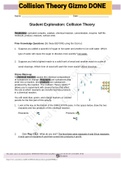
Exam (elaborations) Collision Theory Gizmo DONE Vocabulary: activated complex, catalyst, chemical reaction, concentration, enzyme, half-life, molecule, product, reactant, surface area Prior Knowledge Questions (Do these BEFORE using the Gizmo.) 1. Suppose you added a spoonful of sugar to hot water and another to ice-cold water. Which type of water will cause the sugar to dissolve more quickly? Hot water. 2. Suppose you held a lighted match to a solid hunk of wood and another match to a pile of wood shavings. Which form of wood will catch fire more easily? Wood shavings. Gizmo Warm-up A chemical reaction causes the chemical compositions of substances to change. Reactants are substances that enter into a reaction, and products are substances produced by the reaction. The Collision Theory Gizmo™ allows you to experiment with several factors that affect the rate at which reactants are transformed into products in a chemical reaction. You will need blue, green, and orange markers or colored pencils for the first part of this activity. 1. Look at the key at the bottom of the SIMULATION pane. In the space below, draw the two reactants and two products of this chemical reaction. Reactants: A Products: A B B 2. Click Play ( ). What do you see? The first three were reactants A and B but reactants A took part of reactants B and then turned into products A and B. This study source was downloaded by from CourseH on :23:16 GMT -05:00 This study resource was shared via CourseH Collision Theory Gizmo DONE Activity A: Temperature Get the Gizmo ready: Click Reset ( ). Check that the Reactant concentration is set to 1.0 mol/L, the Catalyst concentration is set to 0.00 mol/L, and the Surface area is Minimum. Question: How does temperature affect the rate of a chemical reaction? 1. Observe: Select the ANIMATION tab. View the animation with No catalyst selected. What do you see? the higher the temperature, the faster the chemical reaction. When two reactant molecules meet, they form a temporary structure called an activated complex. The activated complex breaks up into the product molecules. 2. Observe: Return to the CONTROLS pane. Set the Temperature to 0 °C and the Simulation speed to its maximum setting. Click Play. A. Describe the motions of the molecules. They slow down. B. Now set the Temperature to 200 °C. How does increasing the temperature affect the motions of the molecules? They speed up. C. What do you notice about the chemical reaction at the higher temperature? The chemical reactions become faster. 3. Interpret: Select the GRAPH tab. Click the zoom out button ( ) until you can see the whole graph. What does this graph show? The reactants go down and the products go up. 4. Predict: How do you think temperature will affect the rate of a chemical reaction? The reaction will happen in a shorter amount of time if the temperature is up. (Activity A continued on next page) This study source was downloaded by from CourseH on :23:16 GMT -05:00 This study resource was shared via CourseH Activity A (continued from previous page) 5. Gather data: Click Reset. A useful way to compare reaction rates is to record the time required for half of the reactants to react, called the half-life of the reaction. With the Temperature set to 200 °C, click Play. Click Pause ( ) when the number of reactant molecules is 10. Record the half-life time in the first space of the table below. Trial 200 °C 150 °C 100 °C 50 °C 1 5:42 7:04 12:02 45:02 2 4:42 7:02 20:42 48:02 Mean half-life 5:32 7:03 16:22 46:52 Repeat the experiment at different temperatures to complete the table. (Note: To get exact times, you can refer to the TABLE tab.) 6. Calculate: Calculate the mean half-life for each temperature. Fill in these values above. (Hint: To get an exact mean, first convert each time to seconds by multiplying the minutes value by 60 and adding this to the seconds. To find the mean in seconds, add up the two times and divide by two. Convert the answer back to minutes and seconds.) 7. Analyze: What do your results indicate? As the temperature goes down, the time goes up. 8. Draw conclusions: For two molecules to react, they must collide at just the right angle and with enough energy to break the original bonds and form new ones. Based on these facts, why does the reaction tend to go more quickly at higher temperatures? At a higher temperature, the molecules move faster so they can more of a chance of hitting each other at just the right angle. 9. Apply: Paper must be heated to 234 °C to begin reacting with oxygen. This can be done by putting the paper over a flame. Why do you think the paper must be heated to start burning? Even though the paper is put over a flame, it still needs time to react or for the molecules to hit each other just right. This study source was downloaded by from CourseH on :23:16 GMT -05:00 This study resource was shared via CourseH Activity B: Surface area and concentration Get the Gizmo ready: Click Reset. Check that the Catalyst concentration is set to 0.00 mol/L and the Surface area is Minimum. Set the Temperature to 200 °C. Introduction: Reaction rates are also influenced by surface area and concentration. The surface area of a solid is a measure of how much of the solid is exposed to other substances. The concentration of a substance is a measure of how many molecules of that substance are present in a given volume. Question: How do surface area and concentration affect reaction rates? 1. Observe: Change the Surface area from Minimum to Maximum. How does this change the amount of Reactant B molecules that are exposed to Reactant A? They are moving around and not staying on one side. 2. Predict: How do you think increasing the surface area will affect the rate of the reaction? It will make the reaction go faster. 3. Gather data: Set the Reactant concentration to 2.0 mol/L. Use the Gizmo to measure the half-life of the reaction for each surface area setting. (There will now be 20 reactant molecules left at the half-life.) Then, calculate the mean half-life for each setting. Trial Minimum surface area Maximum surface area 1 3:32 1:22 2 4:22 0:22 Mean half-life 4:17 1:12 4. Analyze: What do your results indicate? Most surface area speeds up the process of the chemical reaction. 5. Explain: Why does the reaction proceed more quickly when the surface area is increased? The reactants B are spread out so they don’t have to wait for a reactant A to come get them and they are moving. (Activity B continued on next page) This study source was downloaded by from CourseH on :23:16 GMT -05:00 This study resource was shared via CourseH Activity B (continued from previous page) 6. Observe: Click Reset. Move the Reactant concentration slider back and forth. What do you notice? With more reactant, it’s easier for them to find each other. 7. Predict: How will increasing the reactant concentration affect the rate of the reaction? Why? A higher concentration will make the reaction longer because there is more to react. 8. Gather data: Make sure the Temperature is 200 °C and the Surface area is Maximum. Use the Gizmo to measure the half-life for each given reactant concentration. (Note that the number of reactant molecules changes with each concentration.) Calculate the means. Trial 0.4 mol/L 0.8 mol/L 1.2 mol/L 1.6 mol/L 2.0 mol/L 1 10:00 2:54 1:58 1:08 1:10 2 8:24 2:04 2:26 1:18 0:46 Mean half-life 9:12 2:58 2:12 1:32 0:58 9. Compare: If possible, find the mean times for each concentration for your entire class. What is the mean class time for a concentration of 0.4 mol/L? How about for 2.0 mol/L? Mean for 0.4 mol/L: ? Mean for 2.0 mol/L: ? 10. Analyze: What do these results indicate? More concentration will equal a faster result. 11. Apply: Hydrochloric acid reacts with the mineral calcite to produce carbon dioxide gas, water, and calcium chloride. Based on what you have learned in activity A and activity B, what are three things you could do to make the reaction occur more quickly? Increases the temperature, surface area, and the reactant concentration. This study source was downloaded by from CourseH on :23:16 GMT -05:00 This study resource was shared via CourseH
Document information
- Uploaded on
- December 29, 2021
- Number of pages
- 7
- Written in
- 2021/2022
- Type
- Exam (elaborations)
- Contains
- Questions & answers


