

Block 1: Nutrition Lecture 1: Growth
^A: selection for growth rate
B: digestibility, feed quality
C: changing maintenance: temperature,
, Lecture 2: Energy metabolism
Growth or maintenance requires: structural components (AAs,
fat, nucleotides, minerals etc) and ATP (substrates and oxygen)
Fecal losses (FE) dependent on feed intake, digestibility (diet composition, fish species,
environmental conditions) → variable between 5-25% of GE
Branchial and Urine losses (BUE) dependent on feed intake, diet quality (protein to
energy ration, protein quality) → variable <7.5% of DE
How to measure heat production:
Direct calorimetry: temperature increase
Indirect: oxygen consumption, CO2, NH4+, urea production
Comparative carcass analysis: initial and final body composition,
growth and feed intake, digestibility, calculation on N
and energy balances
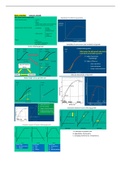
Metabolic weight in fish: BW(kg)0.80 for energy
Effect of body size: Max feed intake increases with size (line continuous longer)
Maintenance increases with size (line starts lower)
Slope (kg), energy utilization efficiency for growth is equal
Effect of temperature: Max feed intake increases with temperature
Maintenance increases with temperature
Slope is equal (because amount of ATP needed to bind AAs stays the same (only the rate of binding speeds up)
^A: selection for growth rate
B: digestibility, feed quality
C: changing maintenance: temperature,
, Lecture 2: Energy metabolism
Growth or maintenance requires: structural components (AAs,
fat, nucleotides, minerals etc) and ATP (substrates and oxygen)
Fecal losses (FE) dependent on feed intake, digestibility (diet composition, fish species,
environmental conditions) → variable between 5-25% of GE
Branchial and Urine losses (BUE) dependent on feed intake, diet quality (protein to
energy ration, protein quality) → variable <7.5% of DE
How to measure heat production:
Direct calorimetry: temperature increase
Indirect: oxygen consumption, CO2, NH4+, urea production
Comparative carcass analysis: initial and final body composition,
growth and feed intake, digestibility, calculation on N
and energy balances
Metabolic weight in fish: BW(kg)0.80 for energy
Effect of body size: Max feed intake increases with size (line continuous longer)
Maintenance increases with size (line starts lower)
Slope (kg), energy utilization efficiency for growth is equal
Effect of temperature: Max feed intake increases with temperature
Maintenance increases with temperature
Slope is equal (because amount of ATP needed to bind AAs stays the same (only the rate of binding speeds up)


