

Energetics
Enthalpy change
Enthalpy: the heat energy stored in a chemical system
Enthalpy change (∆H): the heat energy change measured under conditions of constant
pressure, the unit is kJ mol-1
Enthalpy changes usually determined under standard conditions: 100kPa (pressure), 298K
(temperature), solutions at 1mol dm-3 (concentration), all substances in their standard states
under standard conditions
Standard Enthalpy of Combustion and Formation
Standard enthalpy of combustion: Exam tip: The
The enthalpy change when 1 mol of a substance enthalpy of formation
Is burned completely in oxygen under standard conditions is 0 of elements – by
With all reactants and products in their standard states definition.
Standard enthalpy of formation:
The enthalpy change when 1 mol of a substance
Is formed from its elements under standard conditions
With all products and reactants in their standard states
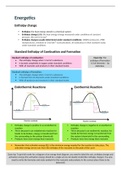
Endothermic Reactions Exothermic Reaction
Enthalpy change is positive in an endothermic Enthalpy change is negative in an exothermic
reaction reaction
This is because in an endothermic reaction for This is because in an exothermic reaction, for
bonds to be broken, energy is transferred from bonds be formed, energy is transferred from
the surrounding to the system (chemicals) the system (chemicals) to the surrounding
Products have more energy than reactants Products have less energy than reactants
Remember that activation energy (Ea) is the minimum energy needed for the reaction to take place. The
activation energy arrow runs from the enthalpy of the reactants to the peak of the curve
Exam tip: To get full marks for a diagram of an energy level diagram, you need to label the axis, enthalpy change and
activation energy (the activation energy should be a single arrow not double ended like enthalpy change). You also
need to write the formulas and state symbols for the reactants and products in the correct place (have to be
balanced).
Enthalpy change
Enthalpy: the heat energy stored in a chemical system
Enthalpy change (∆H): the heat energy change measured under conditions of constant
pressure, the unit is kJ mol-1
Enthalpy changes usually determined under standard conditions: 100kPa (pressure), 298K
(temperature), solutions at 1mol dm-3 (concentration), all substances in their standard states
under standard conditions
Standard Enthalpy of Combustion and Formation
Standard enthalpy of combustion: Exam tip: The
The enthalpy change when 1 mol of a substance enthalpy of formation
Is burned completely in oxygen under standard conditions is 0 of elements – by
With all reactants and products in their standard states definition.
Standard enthalpy of formation:
The enthalpy change when 1 mol of a substance
Is formed from its elements under standard conditions
With all products and reactants in their standard states
Endothermic Reactions Exothermic Reaction
Enthalpy change is positive in an endothermic Enthalpy change is negative in an exothermic
reaction reaction
This is because in an endothermic reaction for This is because in an exothermic reaction, for
bonds to be broken, energy is transferred from bonds be formed, energy is transferred from
the surrounding to the system (chemicals) the system (chemicals) to the surrounding
Products have more energy than reactants Products have less energy than reactants
Remember that activation energy (Ea) is the minimum energy needed for the reaction to take place. The
activation energy arrow runs from the enthalpy of the reactants to the peak of the curve
Exam tip: To get full marks for a diagram of an energy level diagram, you need to label the axis, enthalpy change and
activation energy (the activation energy should be a single arrow not double ended like enthalpy change). You also
need to write the formulas and state symbols for the reactants and products in the correct place (have to be
balanced).


