THEME 2: ATMOSPHERIC COMPOSITION AND
STRUCTURE
2.1 ATMOSPHERIC COMPOSITION
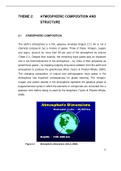
The earth’s atmosphere is a thin, gaseous envelope (Figure 2.1). Air is not a
chemical compound, but a mixture of gases. Three of these, nitrogen, oxygen
and argon, account for more than 99 per cent of the atmosphere by volume
(Table 2.1). Despite their scarcity, the remaining trace gases play an important
role in the thermodynamics of the atmosphere – by virtue of their properties as
greenhouse gases – by trapping outgoing long-wave radiation from the earth and
atmosphere to produce the greenhouse effect (Tyson & Preston-Whyte, 2000).
The changing composition of natural and anthropogenic trace gases in the
atmosphere has important consequences for global warming. The nitrogen,
oxygen and carbon dioxide in the atmosphere represent the gaseous phase of
biogeochemical cycles in which the elements or compounds are converted into a
gaseous form before being re-used by the biosphere (Tyson & Preston-Whyte,
2000).
Figure 2.1 Atmospheric dimensions (UCLA, 2005).
12
, Table 2.1 Composition of the Earth's atmosphere near the surface (Ahrens, 2003)
Permanent gases Variable gases
Gas Symbol % per Gas Symbol % per Parts per
volume volume million
dry air dry air (ppm)¤
Nitrogen N2 78.08 Water vapour H2O 0–4
Oxygen O2 20.95 Carbon dioxide CO2 0.037 374¤
Argon Ar 0.93 Methane CH4 0.00017 1.7
Neon Ne 0.0018 Nitrous oxide N2O 0.00003 0.3
Helium He 0.0005 Ozone O3 0.000004 0.04*
Hydrogen H2 0.00006 Particles 0.000001 0.01 – 0.15
(dust, soot, etc.)
Xenon Xe 0.000009 Chlorofluoro- CFCs 0.00000002 0.0002
carbons
¤ In the case of CO2, 374 ppm means that out of every million air molecules, 374 are CO2
molecules.
* Stratospheric values at altitudes between 11 km and 50 km are about 5 to 12 ppm.
For example, nitrogen is removed from the atmosphere primarily by biological
processes that involve soil bacteria. In addition, nitrogen is taken from the air by
tiny ocean-dwelling plankton that converts it into nutrients that help fortify the
ocean’s food chain. It is returned to the atmosphere mainly through the decaying
of plant and animal matter. Oxygen, on the other hand, is removed from the
atmosphere when organic matter decays and when oxygen combines with other
substances, producing oxides. It is also taken from the atmosphere during
respiration, as the lungs take in oxygen and release carbon dioxide. The addition
of oxygen to the atmosphere occurs during photosynthesis, as plants, in the
presence of sunlight, combine carbon dioxide and water to produce sugar and
oxygen (Ahrens, 2003).
The concentration of water vapour, H2O, varies greatly from place to place, and
from time to time. Close to the surface in warm, humid, tropical locations, water
vapour may account for up to 4 per cent of the atmospheric gases, whereas in
colder arctic areas its concentration may dwindle to a mere fraction of a per cent
(Ahrens, 2003). Water vapour is an extremely important gas in our atmosphere.
Not only does it form into both liquid and solid cloud particles that grow in size
and fall to earth as precipitation, but it also releases large amount of heat – called
13
STRUCTURE
2.1 ATMOSPHERIC COMPOSITION
The earth’s atmosphere is a thin, gaseous envelope (Figure 2.1). Air is not a
chemical compound, but a mixture of gases. Three of these, nitrogen, oxygen
and argon, account for more than 99 per cent of the atmosphere by volume
(Table 2.1). Despite their scarcity, the remaining trace gases play an important
role in the thermodynamics of the atmosphere – by virtue of their properties as
greenhouse gases – by trapping outgoing long-wave radiation from the earth and
atmosphere to produce the greenhouse effect (Tyson & Preston-Whyte, 2000).
The changing composition of natural and anthropogenic trace gases in the
atmosphere has important consequences for global warming. The nitrogen,
oxygen and carbon dioxide in the atmosphere represent the gaseous phase of
biogeochemical cycles in which the elements or compounds are converted into a
gaseous form before being re-used by the biosphere (Tyson & Preston-Whyte,
2000).
Figure 2.1 Atmospheric dimensions (UCLA, 2005).
12
, Table 2.1 Composition of the Earth's atmosphere near the surface (Ahrens, 2003)
Permanent gases Variable gases
Gas Symbol % per Gas Symbol % per Parts per
volume volume million
dry air dry air (ppm)¤
Nitrogen N2 78.08 Water vapour H2O 0–4
Oxygen O2 20.95 Carbon dioxide CO2 0.037 374¤
Argon Ar 0.93 Methane CH4 0.00017 1.7
Neon Ne 0.0018 Nitrous oxide N2O 0.00003 0.3
Helium He 0.0005 Ozone O3 0.000004 0.04*
Hydrogen H2 0.00006 Particles 0.000001 0.01 – 0.15
(dust, soot, etc.)
Xenon Xe 0.000009 Chlorofluoro- CFCs 0.00000002 0.0002
carbons
¤ In the case of CO2, 374 ppm means that out of every million air molecules, 374 are CO2
molecules.
* Stratospheric values at altitudes between 11 km and 50 km are about 5 to 12 ppm.
For example, nitrogen is removed from the atmosphere primarily by biological
processes that involve soil bacteria. In addition, nitrogen is taken from the air by
tiny ocean-dwelling plankton that converts it into nutrients that help fortify the
ocean’s food chain. It is returned to the atmosphere mainly through the decaying
of plant and animal matter. Oxygen, on the other hand, is removed from the
atmosphere when organic matter decays and when oxygen combines with other
substances, producing oxides. It is also taken from the atmosphere during
respiration, as the lungs take in oxygen and release carbon dioxide. The addition
of oxygen to the atmosphere occurs during photosynthesis, as plants, in the
presence of sunlight, combine carbon dioxide and water to produce sugar and
oxygen (Ahrens, 2003).
The concentration of water vapour, H2O, varies greatly from place to place, and
from time to time. Close to the surface in warm, humid, tropical locations, water
vapour may account for up to 4 per cent of the atmospheric gases, whereas in
colder arctic areas its concentration may dwindle to a mere fraction of a per cent
(Ahrens, 2003). Water vapour is an extremely important gas in our atmosphere.
Not only does it form into both liquid and solid cloud particles that grow in size
and fall to earth as precipitation, but it also releases large amount of heat – called
13